52 Ancestors #5 Mary Elizabeth Howington

52ancestors-2015

This challenge is set forth by No Story Too Small, and this week’s theme is “Plowing through.”

There are a few ways to interpret this week’s theme, Plowing Through, and the first thing that comes to mind is a farmer, but I’ve decided to take a different perspective. Here is an ancestor that was so hard to trace, I had to Plow Through for a long time to find answers.

My great grandmother, Mary Elizabeth Howington Burke.

Granny Burke was a million years old when I was a child, so I never paid her much mind. But as I grew older and began researching my ancestors, I thought back on those days and wished I would have sat down and talked to her about her family.

burke Mary Howington Burke headstoneShe came from poor roots, born in 1893 to John Thomas Howington and Florence Smith. She was followed by seven siblings, including a brother named Milton Howington whom we called “Uncle Sug”(as in sugar) while I was growing up. In 1914, she married John Patrick “Pat” Burke and had seven children, including my grandmother Ina Burke. Pat died in 1958 and Mary died in 1977. They are buried at Liberty Baptist Church Cemetery in Duffee, Mississippi. That’s all the information I had for years. She lived a quiet life in the country and did not leave a paper trail.

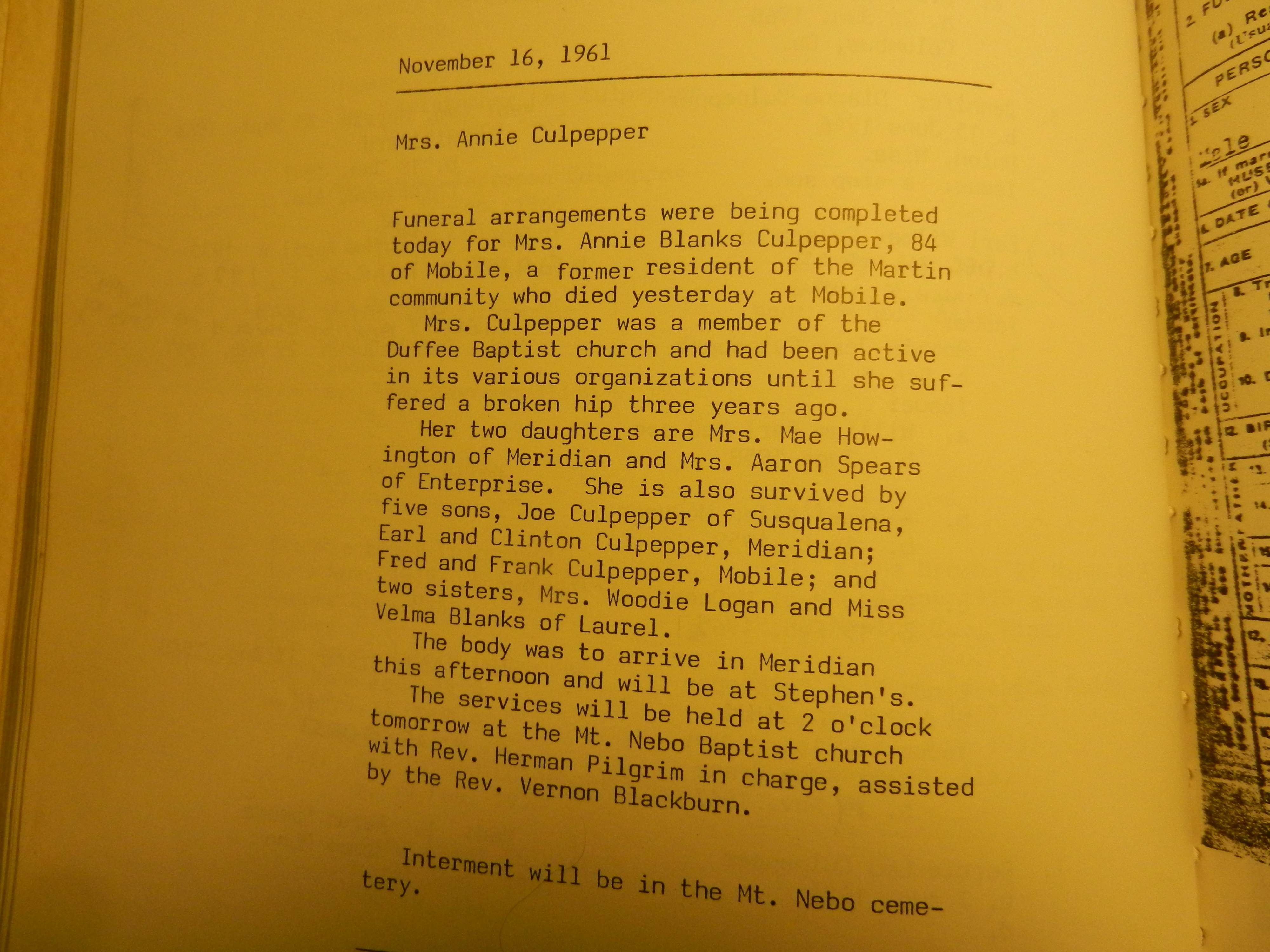
culpepper annie blanks culpepper obitOne day, I read an obituary for my other great grandmother, Annie Culpepper, one that I had read many, many times before, but something stuck out this time. It said Annie was survived by her children, including my grandfather, Earl Culpepper, and a daughter named Mae Howington. First of all, I was sure “Mae” was referring my grandfather’s little sister Zeffie Mae. Second of all, who was this Howington my great aunt Zeffie was married to? Could this Howington be related to Mary Howington? (Note: my grandfather Earl Culpepper was married to Mary Howington’s daughter, Ina Burke.)

As I plowed through documents, made phone calls to elderly family members, and lived inside the time-sucking monster we call Ancestry.com for a whole week, I found the answers about Mary Howington’s ancestry.

Zeffie Mae Culpepper Howington was married to Milton “Uncle Sug” Howington. My grandpa’s little sister was married to grandma’s uncle. By tracing Milton Howington, who left tons of records, I uncovered the whole Howington clan.

The hardest part was explaining to my aunt that her “Uncle Sug” was also her mother’s “Uncle Sug.”

Welcome to the South.

52 Ancestors #4 Bettie Brown

52ancestors-2015

This challenge is set forth by No Story Too Small, and this week’s theme is “Closest to your birthday.”

This week’s theme is a piece of cake for me – birthday cake! My birthday is November 19, 1962. The ancestor closest to my birthday is my great great grandmother who was born November 19, 1862.

Sarah Elizabeth “Bettie” Brown Keene

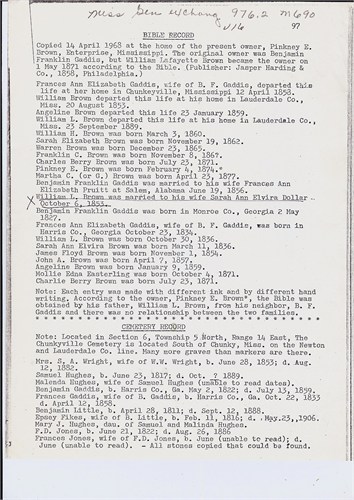
brown william lafayett bibleSarah Elizabeth “Bettie” Brown was born to William Lafayette Brown Jr and Sarah Ann Elvira Dollar Brown in Lauderdale County, Mississippi. (photo: transcribed family Bible) There were ten children in her family, seven boys and three girls, one of whom died at birth. Five of the children were born just before the Civil War began, and her father was a sharp shooter guarding the railroad bridges at Chunky, Mississippi, so her mother was home with a handful of children under the age of eight at the start of the war. When her father returned from the war, the next child was born in 1865. They wasted no time!

At the age of 18, Bettie married John Thompson 16 Nov 1881 and had one daughter, Fleta. I don’t know what happened to Mr. Thompson, but in 1890 Bettie married Thomas Gilbert Lafayette Keene who served as Lauderdale County’s treasure 1904-1907. They had seven children: Eunice Tabitha, Isaac, Essie Mae, Ernest Grady, Benjamin Blaine, Eula Ouida (my great grandmother), and Earl Vandorn. Bettie outlived her husband by five years and died on 18 Jul 1926 at the age of 63.

Brown Sarah Elizabeth Bettie Brown Keene

52 Ancestors #3 Mary Ann Rodgers

52ancestors-2015

This challenge is set forth by No Story Too Small, and this week’s theme is “Tough Woman.”

This week’s theme was an easy one for me. I’ve written about her before, as a matter of fact, I’ve written a whole book about her, but the theme dictates that I must do so again.

My #3 ancestor is my third great grandmother, Mary Ann Rodgers.

Rodgers, Mary Ann Rodgers Carpenter JollyShe was just a name in my family tree. Mary Ann Rodgers Carpenter Jolly. My third great grandmother. 1828-1898. I visited her grave at Bethel Cemetery in Mississippi in 2012, and my husband asked, “Now, who is this again?” I sat with him at the foot of her grave and told him her story.

I first discovered she lost her husband, Rice Carpenter, in the Civil War in 1862. How sad to lose the one you love, but hey, it’s war, people die. After he died, she remarried in 1864.

I looked at the 1870 census and found she married William Jolly and was living with his children, her children, and three children they had together. It was a house-full! But at least their three children were proof they must have liked each other, right? That’s good. I was interested in where William came from, so I traced him back and looked at his 1860 census. In 1860, he was living with his wife Harriet, their four children, and a woman named Nancy Carpenter who was 69 years of age.

Nancy Carpenter? The only Nancy Carpenter I know is Rice’s mother. Why was Mary Ann’s mother-in-law living with her future husband in 1860?? Were they neighbors? Was Nancy the cleaning lady? I clicked on Nancy Carpenter and saw her relationship to the “head of house” was listed as “mother-in-law.” She was William’s mother-in-law? What?? She was Harriet’s mother?

So, I went back and looked at Rice’s family, and sure enough, his sister Harriet was married to William. Rice died 31 Dec 1862 and Harriet died a month later of typhoid on 30 Jan 1863. Their spouses, Mary Ann and William, brother-in-law/sister-in-law, married in 1864. Well of course they did. They had known each other for many years, hadn’t they?

The more I looked at the Rodgers and Carpenter families, the more I was amazed by the sheer number of family members they lost to war and typhoid. At the time of my research, I remember counting SEVENTEEN, but I’m sure there were many more I missed. I couldn’t wrap my head around that kind of heartache and quickly became impressed with Mary Ann’s strength. How would you react if you lost two or three family members this year? You would probably need Prozac. How would you respond if you lost a dozen? I wouldn’t even be able to get out of bed. Seventeen in one year? I can’t even fathom that.

okatibbee creek cover front JPEGWe all come from these strong women. We are the living proof of their strength. If the boat sank, the story would be over. But it didn’t, and we know that because we are here. We are the survivors. I dug deep down in my heart and soul and decided to tell her story, a story she would be proud of. I wanted her to know that she didn’t endure all of that heartache in vain. I am here. I am her legacy. Her story has been told to make us see the strength in our own hearts. We are the products of strength, fortitude, and integrity, as well as tears, heartache, and pain. We are the children our grandmothers fought so hard for, and I want Mary Ann to be as proud of me as I am of her.

Lori Crane Books at Amazon You may also want to pick up a box of Kleenex.


52 Ancestors #2 Lord John Culpepper 1st Baron of Thoresway

52ancestors-2015

This challenge is set forth by No Story Too Small, and this week’s theme is “King.”

Women of my Culpepper line are traced back to King Charlemagne, so I could have taken the easy way and simply wrote about him, but let’s take a road less traveled, shall we?

My 12th great grandfather was John Culpepper of Wigsell. He had four sons: Thomas, William, John (my 11th great), and Alexander. The eldest son, Thomas, had a couple sons, but none with greater ties to THREE Kings than:

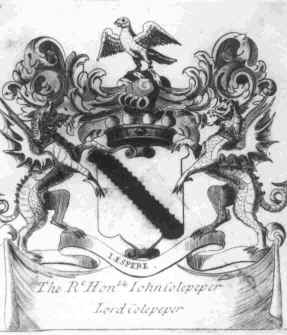
Lord John Culpepper, First Baron of Thoresway

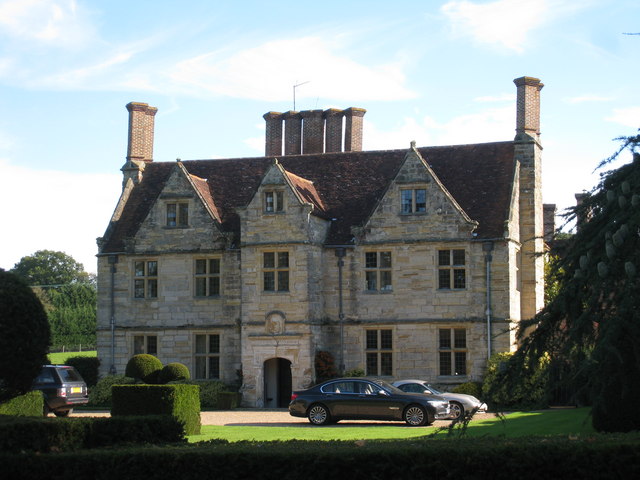
book 1 different angleLord Culpepper was born in 7 Aug 1599 in Wigsell Manor (photo), Sussex, England. His mother died in February of the following year and his father died in 1613 when he was a young lad of 14. He attended Oxford University and graduated in 1616, and then attended Middle Temple law school. In 1621, he was knighted by King James. He sold his inherited Wigsell Manor to an uncle to finance his jaunts around the country. After King James died in 1625 and King Charles I took over, Lord Culpepper finally settled down a bit and married Philipa Snelling in 1628, but the young lady died two years later. He remarried in 1631. This young lady was his distant cousin Judith Culpepper (granddaughter of the uncle who bought Wigsell). They had nine children, many of whom died in infancy.

On January 2, 1642, he was sworn in by the Privy Council and appointed Chancellor of the Exchequer. The following year, he became Master of the Rolls. In 1644, at the onset of the English civil war, King Charles made him a baron.

When the war began, Lord Culpepper was the one who protected the king’s heir (Prince Charles) and took him from England for his own safekeeping. The war ended badly for the monarchy as King Charles was charged with treason and beheaded in 1649. Parliament, under the leadership of Oliver Cromwell, governed the country as the “English Commonwealth” for the next decade.

When Cromwell died, Parliament signed a proclamation that Prince Charles was the rightful king and had been so since his father’s death. They postdated all documents and acted as if the last ten years had never happened. Lord Culpepper had been guarding the prince in France and Denmark all this time and escorted him into London in May of 1660 as King Charles II. For his service, Lord Culpepper received all the prestige and glory he was due, including getting all the Culpepper property back that Parliament had seized at the end of the war and being given a large portion of Virginia in the new world.

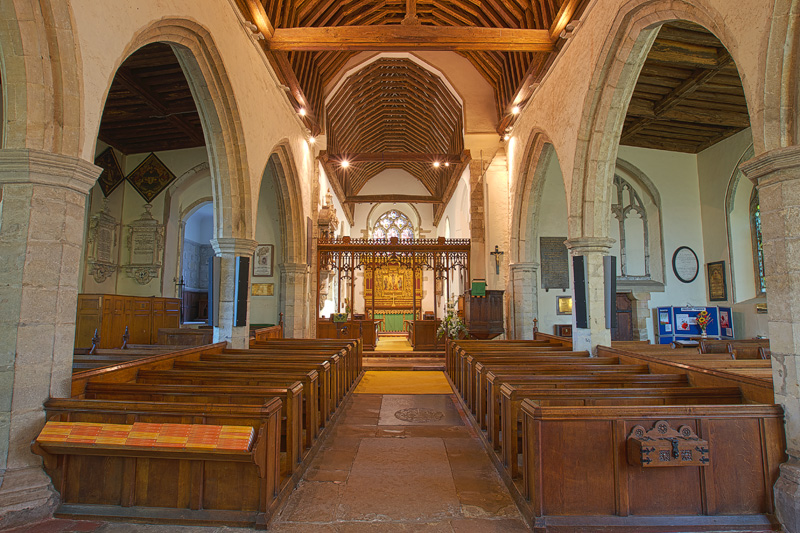
all saints church hollingbourne kent insideShortly after putting the king on his rightful throne, Lord John Culpepper died on 11 July 1660. The inscription placed by his children on his tomb in All Saints Church in Hollingbourne reads:

“To the lasting memory of John, Lord Culpeper, Baron of Thoresway, Master of the Rolles and Privy Counsellor to two Kings, Charles the First and Charles the Second. For equal fidelity to the King and Kingdome he was most exemplary. And in an exile of above ten years was a constant attendant and upright Minister to the Prince last mentioned. With him he returned tryumphant into England on the 29th of May 1660; but died the 11th of July next following in the 61st year of his age to the irreparable loss of his family. He commended his soul to God his faithful Creator, and ordered his body here to expect a blessed Resurrection. His Patent of Honour from King Charles the First dated the 21st of October 1644 may serve for his immortal Epitaph.”

John_Lord_Colepeper_Arms

October Ancestry Challenge – Linda Faye Culpepper

oct ancestry challenge-001 October Ancestry Challenge 2013

23 days – 23 posts – 23 ancestors. I’d like to thank the folks who participated in the challenge. It has been a pleasure getting to know your ancestors. This will be the last installment in the challenge on my page, and thank goodness, it’s been…well…a challenge to come up with 23 ancestors. I’m posting a little early as I’m participating in a Halloween Blog Hop tomorrow. Stop by tomorrow for a creepy story and a chance to win a free Kindle of “The Legend of Stuckey’s Bridge.” Now, without further ado…

Ancestor #23 – Linda Faye Culpepper

I saved the best for last. ♥

MommaThis beautiful woman was my mother. She was born in 1944 in Meridian, Mississippi to Earl Culpepper and Ina Inez Burke (Ancestor #7). She had only one sister and no brothers.

She married my daddy (Ancestor #22) on August 15, 1960 when she was only 15 years old (the same age she was in this photograph). She said her father tried to discourage her from marrying at such a young age, but the woman I knew was always rebellious. When I was a baby, we moved to Tennessee for a while, but by 1966, the marriage was over, and we moved back to Mississippi and lived with her parents.

While she was a young working mother, she had a woman babysit me and eventually met his son. They married and we moved to Michigan. She went to school to become a nurse and worked for thirteen years in the cardiac unit of the local hospital.

The morning of November 17, 2000, she fell from the second floor balcony of her home when the railing broke. She suffered greatly from seven broken ribs, three broken vertebrae, a ruptured spleen, and a broken arm. After months of fighting, her body gave up and she died July 11, 2001.

She is buried at Resurrection Cemetery in Clinton Township, MI in the Angel Mausoleum.

Rest in peace, momma. I miss you every day.

October Ancestry Challenge – Andrew Frank Crane

oct ancestry challenge-001 October Ancestry Challenge 2013

23 days – 23 posts – 23 ancestors

 Ancestor #22 – Andrew Frank Crane

I’ve saved the best two ancestors for last.

His friends called him Andy. I called him daddy.


Daddy

Andrew Frank “Andy” Crane was born in 1940 in Mississippi to Andrew Frank Sr and Azalea Pickett Crane. He was the only son of the union and had one sister. He married Linda Faye Culpepper on August 15, 1960 at the age of 20, she was 15. He worked as a carpenter at L.B. Prister and Co.

Two years later, they had “me,” and I am the only child of the union.

crane, andy and linda 1960

The marriage didn’t last long, and by 1966 he was living in Tennessee and married for the second time. In that marriage, he had two sons. He was an avid duck hunter and loved to operate his ham radio. He also played guitar. His guitar now belongs to my brother and has been passed on to my niece who seems to have the same music bug I have.

Daddy headstone He died on October 31, 1994 of complications following a removal of a pituitary tumor. He is missed by his children and by his seven grandchildren whom he never had the pleasure of meeting. crane andy headstone with lori

October Ancestry Challenge – Rice Benjamin Carpenter

oct ancestry challenge-001 October Ancestry Challenge 2013

23 days – 23 posts – 23 ancestors

Ancestor #21 – Rice Benjamin Carpenter

Rice was my 3rd great grandfather. He was born to Benjamin Carpenter and Nancy Rice in 1828 in Tennessee. Before 1834, his family moved to Lauderdale County, Mississippi. This was just following the signing of the Treaty of Dancing Rabbit Creek in 1830, and the government had moved the Choctaw Indians off the land and were selling it for cheap to get it settled by Americans.

Rice married Mary Ann Rodgers (Ancestor #17) in 1846 and had five children before he went off to fight in the Civil War. On December 31, 1862, he fought in the Battle of Stones River in Murfreesboro, Tennessee. The following is a chapter from my book “Okatibbee Creek.”

****************************************************************

okatibbee creek cover front JPEGThe ground is hard. The air is chilly. Every night, it’s pitch-black out here. I haven’t been able to sleep a wink. I can hear some low, quiet talking outside, an ole hoot owl in the woods far away, a couple of bull-frogs croaking in the grass, and even someone snoring next to me. I wish I could sleep.

I remember the day we arrived. The land here was quite beautiful then. There were thick woods of cedar trees lining a beautiful river.

That was a month ago. Over the last three weeks, most of the trees have been used for firewood, to build makeshift cabins, and turned into poles to hold up tents. It’s been raining a lot, mixed with a little snow and freezing rain. When the sun comes out in the morning, everything melts. Now this once beautiful land looks like one big, muddy pigsty. The mud is awful and the smell is even worse. God, the smell.

We were told that we would be awakened well before dawn for a mission. It must be almost that time. I’m tired. I’m anxious. I’m hungry. If we have a mission this early, there won’t be time for any breakfast. Maybe some hardtack and warm canteen water and that’s it.

I don’t know what I’d do right now for a good, strong cup of hot coffee. We haven’t had any coffee for weeks. We’ve been boiling chicory and peanuts instead. I would like some real coffee.

I would also like some clean clothes and some new shoes as well. I wonder if Mr. Calhoun has new shoes selling in the store. I would like some of his well-made shoes without mud on them, and with soles that aren’t worn through. I would like some clothes that aren’t caked in mud and sweat. I would like a chicken dinner. I would like to see my wife and my children. I would like to get away from these drunken, loud men. I would like to get away from the coughing and the diseases that are spreading through our camp like wild-fire. I would like to get back to my civilized store and my comfortable life, away from this godforsaken war that has gone on far too long for my taste. I should have been home months ago.

I hear them outside moving around now. I hear them all waking up and starting to stir. Someone sticks his head in my tent and says, “Rice, come on, we’re meeting at the captain’s tent in ten minutes.”

Yeah, there is something big going on, all right. One could almost cut the tension in the air with a knife. In ten minutes, we will find out exactly what it is. I put on my coat and hat and what remains of my worn shoes, and head through the mud to the captain’s tent.

“Men, you all know we have Yankees just over the river. We’ve heard that they plan to engage us after breakfast, but we’re not going to wait for them to come across. We’re going to give them a nice little surprise wake-up right now.” He points to a map on the table and continues. “The Kentucky boys are going to go around this way, and the Tennessee boys are going to take them on from that direction. We will move through this way. Since it is so early, we should be able to catch most of them still asleep in their tents.”

He waves his stick around the map so quickly, it is almost hard to figure out exactly where we are supposed to go.

“Any questions?” he asks.

All the men shake their heads.

“Good, let’s go kick some Yankee butt. When we are finished, we will confiscate their coffee, and I’ll join you in a cup,” he says.

“Now you’re speaking my language, Captain,” I joke.

He smiles and pats me on the shoulder as I leave the tent.

We grab our muskets and revolvers and move through what remains of the dense cedar glades, up the river-bank, as quiet as deer at dusk. It is still dark. I guess it must be about four or four thirty in the morning. We usually move to the sound of drum and bugle, but not on this day. Today, we are gravely quiet. As we plant ourselves behind some low limestone rocks about seven hundred yards away from the enemy, I can see about thirty campfires and a few men wandering around, but the camp is mostly quiet. It might be my imagination, but I think I smell coffee. Oh, what I wouldn’t give for a cup of that. It dawns on me that there are a lot more campfires than men, so they must want us to think that their army is a lot bigger than it actually is. Why else have so many campfires?

I am uncomfortable lying on my belly so low on the ground behind eight-inch-tall limestone rocks, and I wonder why we haven’t built some fortifications over the last month. Not that there are any trees left to build them with, but I wonder nonetheless. I assume we weren’t planning on this attack, but since the opportunity has presented itself, we are going to take advantage of it, with or without fortifications.

When everyone gets into position, we start aiming for the men who are walking around, though when they hear the first gun-shot, they crouch down, running and scurrying for their guns. I see quite a few of them fall before I ever hear one of their guns shooting back at us. For a moment, I think this is going to be an easy victory. We’ll send those Yankees back home with their tails between their legs before dawn. Then we’ll drink their coffee.

A few days ago, about twenty-five hundred of our Calvary boys rode all the way around the Union camp, confiscated four wagon trains, and took about a thousand Union prisoners, but we didn’t get any coffee. Maybe these Yankees don’t have much coffee, either.

“Well, they’re not getting any today,” I mumble to myself as I raise my musket and fire.

As the Yankees start to run away, someone behind us gives the rebel yell and we all follow suit. It is a mix of an Indian war cry and a gypsy scream. The Yankees probably think Indians are attacking them. We all rise from our positions and start running after them.

After we cross the freezing cold river, we pick up speed and are almost right on top of them. We are moving in and fast. Roughly ten thousand Confederate troops are raining down on their heads before breakfast. Most of those Yankee boys are running away like scared little rabbits.

“Run, rabbit, run!” I yell.

Our band starts playing “Dixie” and we hum along as we aim, fire, and reload. Occasionally, cannon fire shakes the ground, fills the air with smoke, and drowns out the band. One cannon fires so close behind me, I think my hearing will be gone for good. I am aiming at a Yankee when a cannon fires. I blink my eyes and the Yankee is gone.

One of the boys loading the cannon yells to me, “I got him for you, Rice. You go on home now.”

He roars with laughter as I roll my eyes at him and wiggle my finger in my ear, gesturing that I can’t hear him. He laughs louder.

Our band is now playing “My Bonnie Blue Flag” as we start moving in closer. We walk so far and so long, it seems the Yankees have all but run all the way back home. We move for a solid two miles before we catch up with them again. By the time we engage them again, it is light outside.

Our band always plays marches like “Marching Through Georgia” or “I’m a Good Ole Rebel.” The Yankee bands always play songs like “Battle Hymn of the Republic.” A popular song on both sides is “Home Sweet Home,” but our band is not allowed to play that. The captain says the melancholy tune makes everyone homesick, and he is afraid some of the men will desert and go home. But for some reason on this cold Tennessee morning, our band starts playing that song.

Our boys always sing along, but today, the strangest thing happens. The Union boys start singing along. I can hear them singing over the gunfire. I can’t believe I can hear Yankees singing, partly because they are that close, but mostly because we are in the heat of battle. Singing together seems more than bizarre to me. Then the Union band picks up on the tune and they start to play along also. Everyone is singing and for a split second, the shooting stops. For a brief moment, the cannon fire stops.

I think, how can everyone sing together and then resume shooting one another? How can everyone share this melancholy moment and take up arms again? Men on both sides are singing together like I’ve never heard anyone sing before. In another time, another place, we would be friends.

I stop firing and listen to everyone singing, thinking this is the most surreal moment I can remember in my life. I am lying flat on my stomach, and I lift my head to look around at the men. As I rise further and turn to look at the ones behind me, I feel a searing pain rip through my chest. I reach up to my chest and feel warm blood oozing out of a bullet wound. Damn. I optimistically think it is probably only a surface wound, and I will be all right if I can make it all the way back to camp. I can write to Mary and tell her I’m all right. I don’t want her and the children to worry about me.

As I try to get to my feet and turn toward the direction of camp, I feel another hot pain go through my left temple.

I hear someone yell, “Rice, get down!”

I fall to my knees, thinking this can’t possibly be the end. No, it can’t be. I have a beautiful wife and wonderful children to get home to. I try to get up again, but stumble forward and fall facedown onto the ground.

“Rice!” I hear someone yell again.

I stare at the pebbles and the pine needles on the ground. Blood starts to pool under my face, turning the dirt and pebbles and pine needles a flood of bright red.

I listen as the cannons roar and the rifles fire and the band plays “Home Sweet Home,” and I think of my beautiful Mary and my wonderful children—Mattie, Benjamin, Charlie, and Monroe. How lucky I am to have them.

Then slowly, everything fades from red to black.

****************************************************************
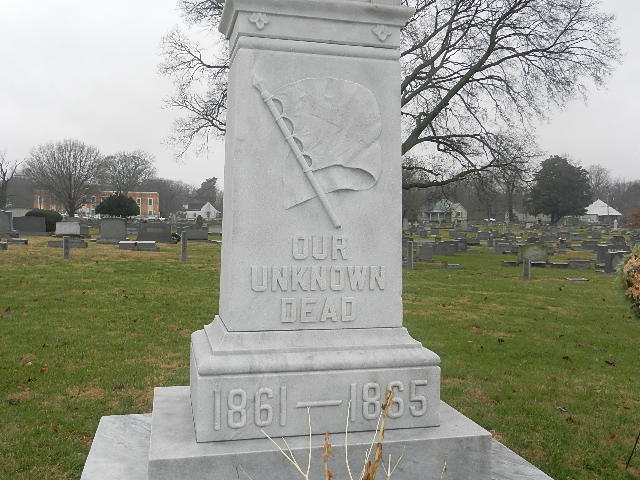
dec 2012 407Private Rice Benjamin Carpenter

Killed in battle December 31, 1862

Murfreesboro, Tennessee

Remains and memorial at Evergreen Cemetery in the Confederate Circle

October Ancestry Challenge – Elizabeth “Elly” Hays

oct ancestry challenge-001 October Ancestry Challenge 2013

23 days – 23 posts – 23 ancestors

Ancestor #20 – Elizabeth “Elly” Hays

My fifth great grandma was Elizabeth “Elly” Hays. She was born just before the start of the Revolutionary War on the Tennessee-North Carolina border to Samuel Hays and Elizabeth Pricilla Brawford.


Marriage document James Rodgers and Elizabeth Hays GreeneCoTN1790Elly was sixteen when she married James Rodgers in Tennessee on 20 Dec 1790. The document to the left is their marriage license. She birthed twelve children.

In 1811, the family packed up and moved to the eastern Mississippi Territory – a place called Alabama, which wouldn’t become a state until 1819. You know how difficult it is going on a road trip with little kids in the car? Imagine being on a wagon for two months with a dozen of the little rug rats and not a McDonalds in sight.

This was a time in history when the U. S. was flexing its political muscle and tensions were escalating, leading up to the War of 1812. And little did the Rodgers family know, they were moving into Creek territory. Not only were the Creek Indians fighting the U.S. Government, they had also broken into two factions and were fighting among themselves in a civil war called the Red Stick War. The Rodgers family moved into the middle of a hornet’s nest. They were harassed for years by the marauding Indians, who taunted them and stole their livestock, and the final straw, burnt down their home.

In 1815, her two eldest sons, Hays (Ancestor #18) and Absolom, joined the Mississippi Militia to help fight off the hostile Creek Indians, and following the boy’s discharges in 1818, the family moved west to Lauderdale County, Mississippi.

James died in Mississippi eight years later, and Elly moved back to Clarke County, Alabama and probably lived with her daughter Elizabeth. She died in the 1830s in her 60s in Grove Hill, Alabama. The exact date of her death is unknown. Her burial place is unknown.

elly cover_webElizabeth Hays Rodgers is the heroine of my book “Elly Hays” which is the third book in the Okatibbee Creek series.

October Ancestry Challenge – Martha Ellen Rodgers

oct ancestry challenge-001 October Ancestry Challenge 2013

23 posts – 23 days – 23 ancestors

Ancestor #19 – Martha Ellen Rodgers 

Martha Ellen Rodgers is my cousin. Her father and my 3rd great grandmother were siblings.


James daughter Martha Ellen Rodgers MeekShe was born in 1853 in Lauderdale County, Mississippi to James Rodgers and Martha Sanderford Rodgers. She had a five-year-old brother and a two-year-old sister, and two more children would follow. She grew up in a farming community, surrounded by loving grandparents and more than a dozen aunts and uncles, along with their respective spouses and children. Her father and a slave named Bill built the log home she grew up in. Her childhood was ideal.

In 1861, Mississippi seceded from the Union and Civil War broke out. Though she had many uncles go off to fight in the war, her brothers were too young and her father was too old, so they remained safely at home with her.

But all would not remain ideal, as during the fall of 1862, a typhoid epidemic invaded her community, killing her grandparents, many aunts, uncles, and cousins, and both of her parents. Her father died October 12, 1862. Her mother died a few short weeks later.

She was nine.

Her given name was Martha Ellen Rodgers, but she was simply known as Ellen.

Hays Rodgers Jr and wife Lucinda GrahamShe and her siblings were placed in the custody of the eldest male in the family, their uncle Hays Rodgers Jr. (photo with wife Lucinda), but he was off fighting in the war, so she was raise for a time by her aunt Mary Ann Rodgers Carpenter (Ancestor #17). When Hays Jr. returned home from the war, he sold his farm and moved to Alabama. Ellen went with him. Her other aunt, Aunt Elizabeth Rodgers (photo with husband George), was also there, and when Aunt Elizabeth died in 1875, Ellen returned to Mississippi. rodgers elizabeth and husb george malon graham, daug of hays g

She stayed in Mississippi for a while with her two sisters, but eventually went to Texas. Her two brothers had moved there years earlier, and I imagine she only went out for visit, though the thought of a young woman traveling alone in the 1800s seems dangerous to me. When she got there, everything changed for her.

When she arrived, she met her brother’s wife’s brother, Sam Houston Meek. She and Sam married in 1885. They had twin sons in 1886 who both died. Then they had a daughter Olive Lee in 1888. When Olive Lee was two, Ellen had another girl in 1890, but the baby girl died, and sadly, Ellen died of complications within the week. She was 37.

rodgers martha ellen rodgers meek, dau of james rodgersShe is buried in Nolanville, Bell County, Texas at Pleasant Hill Cemetery.

My book, AN ORPHAN’S HEART, is her story.

October Ancestry Challenge – Hays Rodgers

oct ancestry challenge-001


 The October Ancestry Challenge 2013

23 posts – 23 days – 23 ancestors.

 Ancestor #18 – Hays Rodgers


Rodgers Hays SrHays Rodgers was my 4th great grandfather. He was married to Marey Ann Scott and had 14 children: Lewis, James, Allen, Jackson, Susannah, Stephen, William, Mary Ann (heroine of my book Okatibbee Creek and my 3rd great grandmother, ancestor #17), Timothy, Hays Jr, Wilson, John W, Elizabeth and Martha Jane. Geez, how can you even remember all those names. I call my two dogs by each other’s names.

His sons, Stephen and William, died in 1834 at the ages of 8 and 10. His son, James, died of typhoid in Nov of 1862. Between 1863 and 1864, his sons, Timothy, Wilson and John W,  all  died during the Civil War. Timothy and Wilson died of illness. John died of a gunshot wound to the stomach in Jonesboro, GA. Fortunately, Hays was not alive to witness the soldier’s deaths as he died of typhoid in Dec of 1862, a couple weeks after his son James.

He was born 1 Feb 1783 in Greene County, TN to James Rodgers and Elizabeth “Elly” Hays (heroine of my new book Elly Hays). He was the eldest son of 12 children. At the age of 18, he moved with his parents to Clarke Co, AL which was part of the Mississippi Territory at that time. Alabama didn’t become a state until 1819. He and his brother, Absolom, signed up for the Mississippi Militia in 1814, and were assigned to Capt Evan Austill’s company of volunteers in Maj Sam Dale’s Battalion to fight against the hostile Creek Indians. Hays remained in the Militia until Oct 1818, but was only called out once for a two-month tour.

MS Cemetery 076On 11 Dec 1816, he married Marey Ann Scott, who was from Georgia. In 1818, following the end of his military service, he, Marey, and 1st born Lewis, moved to Copiah Co, MS (what later became Simpson, MS). He started buying land and farming. He built the “Ole Stennis House” in 1857 at the age of 61 (with the help of 13 slaves). In 1860, the U.S. Census states Hays owned 13 slaves, a 640 acre (square mile) plantation, 2 horses, 3 mules, 10 cows, 4 oxen, 16 sheep, 60 swine, and $600 in farming instruments, for a total worth of $8400. However, most of his wealth was tied up in slaves, as they were worth about $1000 each – that’s probably a million bucks in today’s money.

Upon his death in Dec 1862 in Lauderdale Co, MS, he owned 690 acres of land and stock in the Mobile and Ohio Railroad, which was sold and divided between his heirs. His wife died three months after him in March of 1863, also of typhoid.

His property was sold in 1869 at public auction on the steps of the Meridian Courthouse to Major Adam T Stennis, hence the name “Ole Stennis House.” It remained in the Stennis family for 100 years until 1970, then sat abandoned for two decades. It is now owned by the Hover family who have restored it as you can see by the photo above. Right before the property was auctioned in 1869, Hays Jr, who was the only son to return home from the war, albeit with a useless arm and a wilted spirit, sold his farm and moved to Alabama to be near his wife’s family. He sold his farm to a black man named Tom Stennis. Tom Stennis was a former slave to Major Adam T Stennis.

elly cover_web