Saturday Snippet – John Culpepper the Merchant

culpepper book 2 cover ideaThe second book in The Culpepper Saga takes place in the mid-1600s. John Culpepper finally got himself the boat he wished for throughout the first book (“I, John Culpepper”) and has fulfilled his dream of sailing to the new colony of Virginia. However, while he was away, civil war broke out at home in England, and John is in an understandable hurry to get back to his wife and family.

Here’s a scene from “John Culpepper the Merchant.”

***************************************************

November 1642, The Doldrums


The Thomas and John sat idle, unmoving in the dim morning light. Her sails hung limp, as they had for the last two days. John ran his hands through his hair and impatiently tapped his foot as he stared across her bow at the unending sea of glass before him. The water blended with the sky, creating a mist as far as the eye could see. There was no horizon, just an endless mirror of foggy steel blue.

He never thought this place existed and had never experienced it on any of his prior journeys, but now, when he most needed to make haste, he found his ship stuck in the middle of it. They called it the doldrums—the place in the ocean where no wind billowed sails, no waves lapped against hulls, and no mighty vessels leapt across the breakers. John had heard tales of ships being stuck in the doldrums for weeks at a time. He prayed this wouldn’t be the case, but on this third morning, he was beginning to wonder if they’d ever break free of it. He’d heard ancient legends of ships carrying horses beneath their decks, and when they found themselves stuck in the doldrums, the crew would build cranes, lower the horses into the water, and allow them to pull the ship. He didn’t know if those stories were true, for he had never witnessed a horse swimming, but in any case, he wasn’t carrying any horses. He was, however, carrying two small rowboats.

“Drop the boats!” he yelled to Benjamin. “We’ll row.”

“Sir?” Benjamin approached. “You want the crew to row us out of the doldrums?”

“Yes, Benjamin. Put them to oar. See to it at once.”

“Yes, sir.”

* * *

The men dropped the small boats into the water, tied them to the ship, and began to row. They struggled against the weight of their load, but ever so slowly, the majestic ship began to creep forward.

“How long do you think we’ll have to row?” one of the sailors asked another next to him.

“Until the cap’n gets her back to wind…or until we’re all dead. Whichever comes first.”

“Stop talking and keep rowing!” Benjamin bellowed from the bow.

For the next thirty hours, the sailors took turns rowing. The only movement in the water surrounding them came from the small ripples caused by their oars. After more than a day, the limp sails picked up a small draft and began swaying in the midafternoon sun.

“Sir!” yelled a sailor from one of the boats.

Benjamin turned and saw the sailor pointing up toward the sails. He looked up and saw the sails flutter in the breeze, and an uncommon grin spread across his unshaven face. He jogged to the back of the ship and descended the creaking, wooden steps to the lower deck. He dropped his head below the opening and blinked to adjust to the dim light. “Cap’n, she’s back to wind!”

“Finally!” John jumped from behind his scarred, wooden desk and followed Benjamin up the steps. On deck, he raised his hand to block the sun’s rays as he looked up at the fluttering sails. A cold, Atlantic breeze blew across John’s face, the first he had felt in four days, and he laughed out loud. “Ha! We’ve cleared the doldrums! Benjamin, hoist the sails and get us underway.”

“Aye, sir. Hoist the sails!”

Almost instantly, there was a flurry of activity on the upper deck as weathered sailors began pulling up the small boats, climbing the masts, raising the sails, and shouting commands.

“We have a lot of time to make up,” John said. “I want to be in London within the week.”

“Aye, sir!”

***********************************

John Culpepper the Merchant is now available at Amazon!

For pictures, paintings, and documents of the people and places in the Culpepper Saga, please visit the Culpepper Saga Facebook page.

52 Ancestors #4 Bettie Brown

52ancestors-2015

This challenge is set forth by No Story Too Small, and this week’s theme is “Closest to your birthday.”

This week’s theme is a piece of cake for me – birthday cake! My birthday is November 19, 1962. The ancestor closest to my birthday is my great great grandmother who was born November 19, 1862.

Sarah Elizabeth “Bettie” Brown Keene

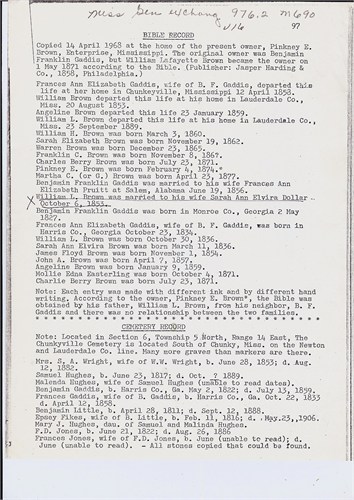
brown william lafayett bibleSarah Elizabeth “Bettie” Brown was born to William Lafayette Brown Jr and Sarah Ann Elvira Dollar Brown in Lauderdale County, Mississippi. (photo: transcribed family Bible) There were ten children in her family, seven boys and three girls, one of whom died at birth. Five of the children were born just before the Civil War began, and her father was a sharp shooter guarding the railroad bridges at Chunky, Mississippi, so her mother was home with a handful of children under the age of eight at the start of the war. When her father returned from the war, the next child was born in 1865. They wasted no time!

At the age of 18, Bettie married John Thompson 16 Nov 1881 and had one daughter, Fleta. I don’t know what happened to Mr. Thompson, but in 1890 Bettie married Thomas Gilbert Lafayette Keene who served as Lauderdale County’s treasure 1904-1907. They had seven children: Eunice Tabitha, Isaac, Essie Mae, Ernest Grady, Benjamin Blaine, Eula Ouida (my great grandmother), and Earl Vandorn. Bettie outlived her husband by five years and died on 18 Jul 1926 at the age of 63.

Brown Sarah Elizabeth Bettie Brown Keene

52 Ancestors #2 Lord John Culpepper 1st Baron of Thoresway

52ancestors-2015

This challenge is set forth by No Story Too Small, and this week’s theme is “King.”

Women of my Culpepper line are traced back to King Charlemagne, so I could have taken the easy way and simply wrote about him, but let’s take a road less traveled, shall we?

My 12th great grandfather was John Culpepper of Wigsell. He had four sons: Thomas, William, John (my 11th great), and Alexander. The eldest son, Thomas, had a couple sons, but none with greater ties to THREE Kings than:

Lord John Culpepper, First Baron of Thoresway

book 1 different angleLord Culpepper was born in 7 Aug 1599 in Wigsell Manor (photo), Sussex, England. His mother died in February of the following year and his father died in 1613 when he was a young lad of 14. He attended Oxford University and graduated in 1616, and then attended Middle Temple law school. In 1621, he was knighted by King James. He sold his inherited Wigsell Manor to an uncle to finance his jaunts around the country. After King James died in 1625 and King Charles I took over, Lord Culpepper finally settled down a bit and married Philipa Snelling in 1628, but the young lady died two years later. He remarried in 1631. This young lady was his distant cousin Judith Culpepper (granddaughter of the uncle who bought Wigsell). They had nine children, many of whom died in infancy.

On January 2, 1642, he was sworn in by the Privy Council and appointed Chancellor of the Exchequer. The following year, he became Master of the Rolls. In 1644, at the onset of the English civil war, King Charles made him a baron.

When the war began, Lord Culpepper was the one who protected the king’s heir (Prince Charles) and took him from England for his own safekeeping. The war ended badly for the monarchy as King Charles was charged with treason and beheaded in 1649. Parliament, under the leadership of Oliver Cromwell, governed the country as the “English Commonwealth” for the next decade.

When Cromwell died, Parliament signed a proclamation that Prince Charles was the rightful king and had been so since his father’s death. They postdated all documents and acted as if the last ten years had never happened. Lord Culpepper had been guarding the prince in France and Denmark all this time and escorted him into London in May of 1660 as King Charles II. For his service, Lord Culpepper received all the prestige and glory he was due, including getting all the Culpepper property back that Parliament had seized at the end of the war and being given a large portion of Virginia in the new world.

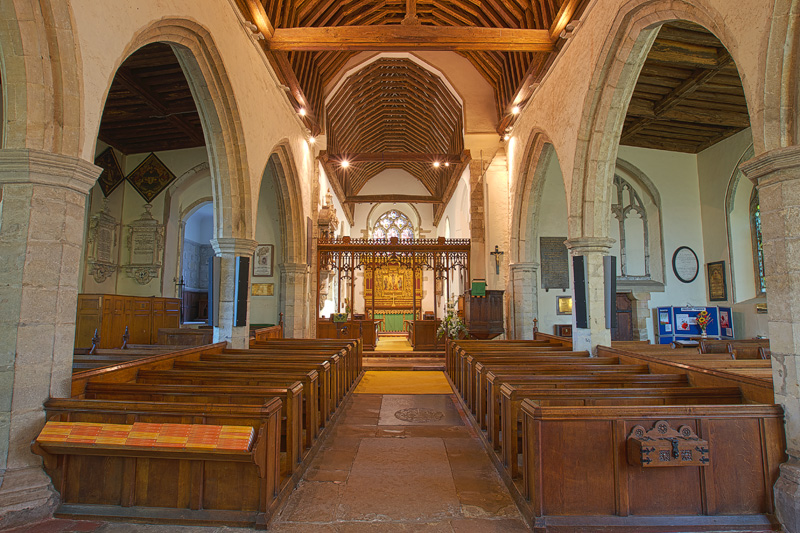
all saints church hollingbourne kent insideShortly after putting the king on his rightful throne, Lord John Culpepper died on 11 July 1660. The inscription placed by his children on his tomb in All Saints Church in Hollingbourne reads:

“To the lasting memory of John, Lord Culpeper, Baron of Thoresway, Master of the Rolles and Privy Counsellor to two Kings, Charles the First and Charles the Second. For equal fidelity to the King and Kingdome he was most exemplary. And in an exile of above ten years was a constant attendant and upright Minister to the Prince last mentioned. With him he returned tryumphant into England on the 29th of May 1660; but died the 11th of July next following in the 61st year of his age to the irreparable loss of his family. He commended his soul to God his faithful Creator, and ordered his body here to expect a blessed Resurrection. His Patent of Honour from King Charles the First dated the 21st of October 1644 may serve for his immortal Epitaph.”

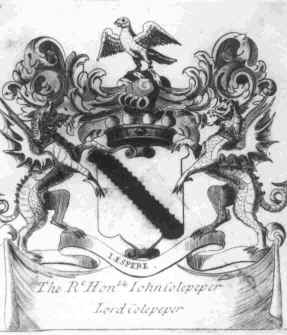
John_Lord_Colepeper_Arms

52 Ancestors #1 John Francis Burke

52ancestors-2015

This challenge is set forth by No Story Too Small. I’m late in joining, but will catch up this week. The challenge for week one is “A Fresh Start.” That being said…

May I present my great great grandfather, John Francis Burke

There is no ancestor in my tree who made such a dramatic effort at a fresh start as John Francis Burke.

He was born in Dublin on February 27, 1847 in the middle of the potato blight in Ireland. One million people died of starvation and another million left the country. One can imagine how the family struggled. Not much is known about his parents or his childhood, but a family member told me his sibling had the same names as his children, so I expect there was a Patrick, Robert, Emmett, Nina, Virginia, Kathleen, David, and/or an Edmond somewhere in the bunch, and if I ever venture to Dublin, I should be able to find family records.

culpepper book 2 cover ideaWhen John was a young lad of 15, he snuck down to the shipyard and stowed away on an American-bound ship. After they set sail, the captain found him en route and told him the ship couldn’t take him back home. He replied to the captain, “If I wanted to go home, I wouldn’t have stowed away.” We don’t know the relationship or lack of one he had with his parents, but we can imagine a mother searching for her fifteen-year-old son and being heartbroken. I don’t know if he ever contacted his family after leaving Dublin.

The ship dropped him off in Miami, Florida in 1862. Yes, 1862, during the middle of the Civil War. Confederate War Records show a couple men with similar names that could be him serving in Florida, Alabama, and Mississippi. The 1870 census shows a couple names that could be him: one in Florida and one in Alabama. He finally shows up in the 1880 census as being a “ditcher” and living with his new in-laws, the Spencer family.

On December 10, 1879, at the age of 32, he married Nancy Didama Spencer in Lauderdale County, Mississippi. Over the next fourteen years, they had six children: John Patrick, Robert Emmett, George Washington, Nina Virginia, Kathlene L, and David Edmond.

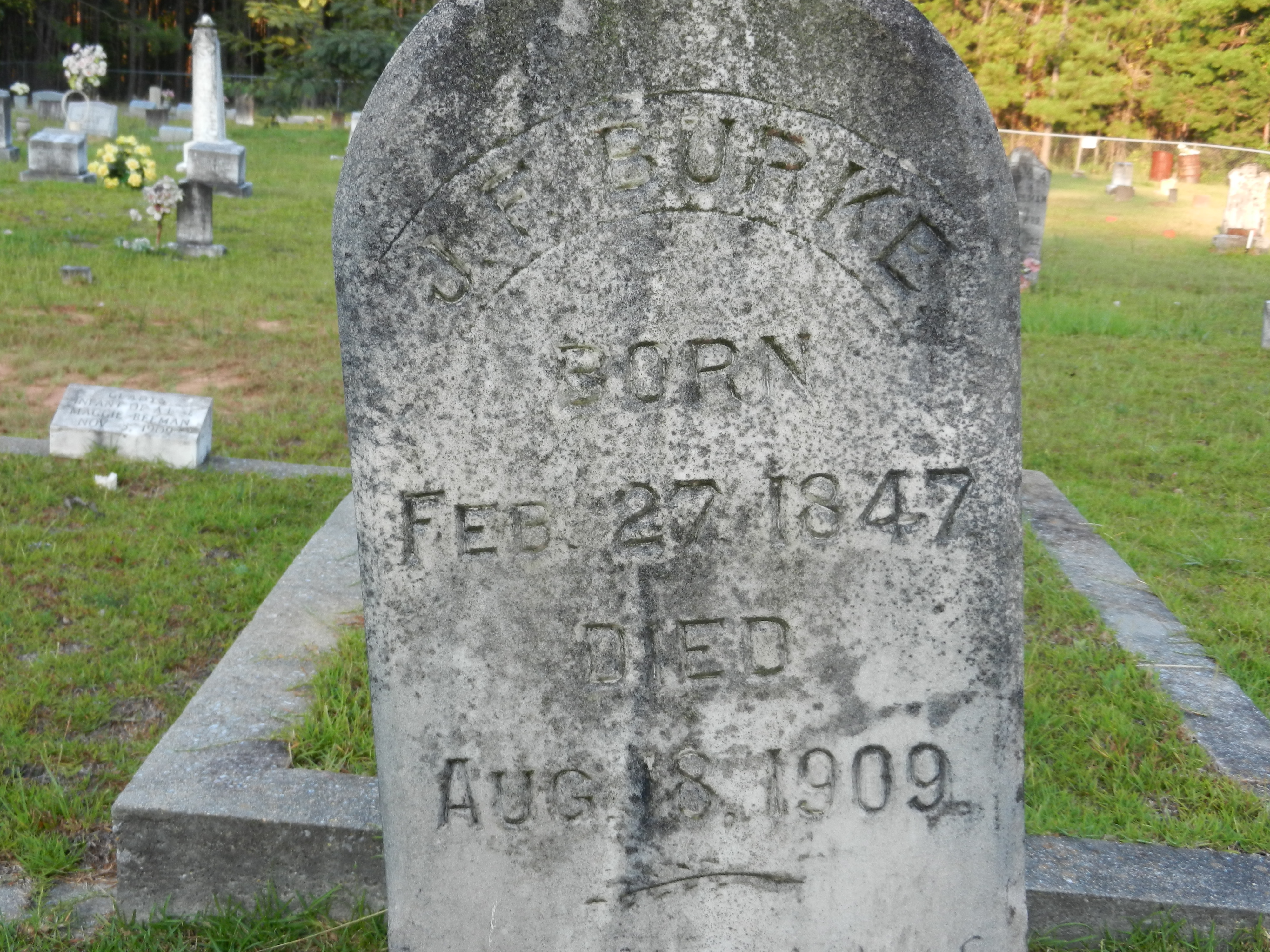
burke JP Burke Sr headstoneAfter John’s death August 18, 1909, the 1910 census shows Nancy as a widow with five children still at home.

John is laid to rest at Liberty Baptist Church Cemetery in Duffee, Mississippi, among children and grandchildren.

His son John Patrick “Pat” (my great grandfather) was a fiddle player on the weekends at barn dances. I wonder if Pat learned to play from his father. Playing the fiddle is such an Irish thing to do, don’t you think?

Genealogy 101

613treeI blog a lot about my ancestors, as I have over 9000 people in my family tree. I am not a professional genealogist, but I have researched my family since I was in my teens. I’m 50mumble now. Not only was I researching my family before Ancestry.com was born, I was researching them before COMPUTERS were born. Take that!

Some visitors to my blog have asked me where to begin in their own search. Below are some basic tips. These tips are for people who have access to their families. If you were orphaned or adopted, you may need the help of a professional to assist you in your search. In some cases, that professional would be a genealogist, in others cases, it would be a private investigator, in others, a lawyer to help you gain access to court documents.


  • The first place to start is with your living relatives. (Take a tape recorder and/or a pad of paper with you!) Ask them what they know about the family. You’ll often find elderly family members will not only be a wealth of information, they will be happy to stroll down memory lane and fill you will stories of the past. Stories of their parents and grandparents, and stories of their great grandparents that they heard when they were small. Write these stories down. They don’t exist anywhere else and can shed light on records you will find. An elderly man in my family said his sibling had pink eye when they were about to immigrate to America, so they were not allowed to board the ship from Italy. When we found the immigration records at Ellis Island, there were two dates of immigration for the family – three months apart. We would have wondered what happened at immigration had we not been told the pink-eye story.
  • The next thing to do is dig through attics and basements. Look through photo albums, newspaper clippings, programs and announcements. I’ve seen old wedding invitations at my aunt’s house and had no idea who the couple was, but once she explained to me the connection to the family, I began extending my tree.
  • Now that you have a handful of names, dates, and places, Google them. You may be pleasantly surprised to find records online or find someone else has already been researching your family. If you find some of your ancestors have already been researched on Ancestry, you may decide to join. There are also other sites to store your findings – My Heritage, Family Search, Genealogy.com – or you can purchase software like Family Tree Maker, or you can use a notebook. Whatever works for you.
  • Check U.S. Census records. They are all online and you can find them at sites like Ancestry and Find My Past. There are also directions on those site on how to search records. Be warned that the 1890 census was mostly destroyed in a fire, so you’ll have to connect your own lines between 1880 and 1900.
  • If you are near the city your ancestors lived, drive to the history/archives office. Also check old newspapers which are usually kept at the library, court records, church records, and cemetery records. Visiting cemeteries where your ancestors were buried can also shed light on the family. Infant mortality used to be a lot higher than it is now. If you are not near your ancestor’s city, visit Find A Grave.com. where volunteers catalog grave sites. You can ‘virtually’ visit cemeteries all over the country.
  • Don’t be discouraged if you run into a dead end. Attempt to go around your ancestor. I got stuck on my great grandmother because she lived a quiet life in the country and didn’t leave any records, but when I looked up her brother, the whole family came to life. If your ancestor didn’t leave records, he/she may have siblings or children who did. Keep searching.
  • Keep meticulous notes. When you find something, write yourself a detailed note of where and what the document was. Many times I’m asked how I know something, and it’s always good to verify the information came from a Bible Record or a Last Will. Beware of anyone else’s information. Sometimes people fill in the gaps in their research with guesses. Once others start to latch onto those guesses, everyone begins to take the information as fact. Keep notes. Research things for yourself.

Not only will you learn about your family and your heritage, you will also learn an amazing amount of history. When you take your ancestors birth and death dates and add the history of the town and the political and religious climate of the world into the mix, you begin to understand who you are and where you came from. Researching genealogy is a time-consuming hobby, but it’s an exciting journey!


Saturday Snippet – ELLY HAYS

elly cover_webElly Hays is the real-life story of a woman struggling to keep her family safe from the Creek Indians during the War of 1812. From the first few chapters, you know there is no way this story is going to end without a terrifying confrontation.

*********************************

She angrily plopped down on a rock and yanked dirty stockings from the basket. She dunked them in the water and began scrubbing them hard enough to put holes in them. She could feel her ears buzzing and her shortness of breath and realized she needed to calm down. She stopped scrubbing, closed her eyes, and took a deep breath through her nose, trying to slow her heart. She concentrated on releasing the tension in her shoulders and the knot in her stomach. She felt guilty for losing her temper with her husband, but frustration was taking over her life. Every day brought new problems—life-and-death problems. Her mounting anger was overriding her fear of the Indians and her love for her husband.

She opened her eyes when she heard him clear his throat behind her, and she turned to apologize for her harsh tone of voice. But when she saw the black eyes looking back at her that did not belong to James, she stopped and gasped. They belonged to an Indian, sitting tall on a brown and white painted horse. She hadn’t heard him approach. She jumped to her feet, wondering where she could run.

The Indian was bare-chested, wearing only tan animal hide pants and moccasins. His hair was short, shaved on the sides and sticking up higher on top. Most of the Indians she had seen had this same haircut. His face was covered with lines of red and black paint, and he wore a headband tied around his head with strips of animal fur hanging on either side of his face. His headband was not adorned with any feathers. This was not the same Indian she had seen before.

He stared at her for a long time and did not move. She glanced across the swift creek to the left and right, but there was nowhere to run. She would never be able to outrun a horse. Her heart beat wildly as beads of sweat broke out on her brow. She remained frozen.

“I came to warn you,” the Indian said in a monotone.

Elly was surprised by his English.

He sat motionless, waiting for her response.

She finally blurted out, “Warn me about what? That you want us to leave? We already got that warning.” She could feel her temper escalating again. All of the tension she had felt the last few months, all of the worry for her children, all of the stress of building a new life, was about to explode in this Indian’s face.

“Yes, I’m here to warn you that you need to leave, but not for the reason you are thinking.” He looked down at the reins in his hands, as if trying to gather his thoughts and find the correct words. “My brother and I were the ones who killed your animals.”

Elly threw a wet stocking on the ground. She hadn’t realized she was still holding it, and it had dripped down her blue linen skirt, causing the front of her dress to become dark in color. “You? You did that? How am I supposed to feed my children?” she raised her voice, her temper becoming stronger than her fear.

“This is the least of your worries. When your husband chased us away, my brother’s boy fell from his horse and snapped his neck.” His eyes carried a tint of sadness. “The boy is dead.”

Elly felt her heart soften for a young boy she didn’t even know. Her anger began to subside, as if it were being washed away by the babbling creek beside her. “I’m…I’m very sorry to hear that,” she stammered, wringing her wet hands together.

“You must understand, my brother is the great warrior of our village. He has vowed revenge on your husband and your family for the death of his son.”

Elly’s eyes widened as the Indian continued.

“He told our Great Chief your husband killed his son, and the Great Chief has given him permission to slaughter your family.”

Elly was shocked by the revelation and quickly shook her head. “No. My…my husband would never kill a boy. He’s never killed anyone, for any reason.”

“Our great warrior does not know this.”

“Please tell him. Tell him my husband didn’t kill his son.” She took a step forward as she begged.

The Indian shook his head and looked at her with compassion. “I cannot tell him anything. I can only warn you. You must leave now…before it’s too late.”

*********************************

Lori Crane Books at Amazon

On This Day in 1862

My 3rd great grandfather, Rice Benjamin Carpenter, was born August 15, 1828 in Greene County, Alabama to Benjamin Carpenter and Nancy Rice Carpenter. He was the eighth of ten children.

In 1834, following the signing of the Treaty of Dancing Rabbit Creek, his family moved to Pine Springs, Lauderdale County, Mississippi for the low-cost land and fertile soil. Rice was six years old.

He married Mary Ann Rodgers in 1846. They were both seventeen.

They had five children – Martha Lettie, Benjamin Hays, William Travis, Charles Clinton, and MF – one girl and four boys.

frs4544After living with some friends in Pine Springs for a few years, in 1853 they bought 80 acres of land from Mary Ann’s father and began farming, but within a few short years, Rice realized he was a better merchant than a farmer, and by 1860 they had opened a general store in Marion Station, Mississippi.


dec 2012 388When the Civil War began, Rice signed up for the 41st Mississippi Infantry, Company C on February 8, 1862. This must have been a frightening time for the family, as Mary Ann was eight months pregnant with their last child who was born March 12th, 1862.


dec 2012 394On This Day at dawn on December 31, 1862, amid limestone boulders and cedar forest, his infantry attacked the Union soldiers at the Battle of Stones River in Murfreesboro, Tennessee. (only 20 miles from my house)


Page 6Private Rice Benjamin Carpenter died on that day on the battlefield at the age of 34, leaving behind his wife and children.


dec 2012 407He is laid to rest at Confederate Circle, Evergreen Cemetery, Murfreesboro, Tennessee.

RIP 3rd great grandpa. Rest well soldier, your job is done.

A portion of his story is told in my book, “Okatibbee Creek.” Available at Amazon.

This post brought to you by On This Day. 

On This Day in 1848, 1859, 1879, 1917, 1939, 2010

There are some days in my family tree that have far too many events attached to them. There won’t be a death or birth or marriage for the weeks prior and following, but on one day, they all stack up. Very strange. December 10th is one of those days.

On Thisblanks martha lettie carpenter Day in 1848, my 2nd great grandmother was born. She was Martha Lettie “Mattie” Carpenter. She was born to Mary Ann Rodgers and Rice Benjamin Carpenter. Her father died during the Civil War when she was only fourteen. The story is written in Okatibbee Creek. Mattie married William Henry Blanks III, and they had seven children, six being girls. (photo Mattie Carpenter Blanks)

On This Day in 1859, my other 2nd great grandmother was born. She was Nancy Didama Spencer, and she was born to George Washington Spencer and Nancy Virginia Holdcroft.

On This Day in 1879, my 2nd great grandparents wed. The above Nancy Spencer married an Irish immigrant named John Francis Burke. They had six children and twenty-seven grandchildren.

On This Day in 1917, my great aunt Minnie Ellen Crane was born, baby sister of my grandfather.

culpepper Sam and Annie CulpepperOn This Day in 1939, my great grandfather William Samuel Culpepper died. He was 66 and suffered from hypertension. He married Annie Josephine Blanks, daughter of the above Mattie and William Henry Blanks. So Annie’s husband died on her mother’s birthday. (photo of Sam and Annie)

On This Day in 2010, my great aunt Myrnis Burke died at the age of 76. She was my grandmother’s little sister. She was a granddaughter of the above Nancy Spencer and John Francis Burke. She died on their wedding anniversary.

This post brought to you by On This Day.

On This Day in 1893

On This Day in 1893, Mary Elizabeth Howington was born to John Thomas Howington and Florence J Smith in Mississippi. She was the first born to the union, followed by three sisters and four brothers.

burke JP and Mary howingtonShe and her younger sister Julia married Burke brothers, both in November 1912. Mary Elizabeth was 18 and married John Patrick “Pat” Burke and had seven children. Julia was 16 and married David Edmund Burke and had eight children. (photo is Pat and Mary)

john thomas howington florence j smith marriage recordThere have been family stories of one of my grandmothers being a full-blooded Choctaw Indian. In all of my research, I could never find any records for Mary Elizabeth’s mother, Florence, other than her marriage record which states she was 16 years of age. I believe Florence Smith is the Choctaw Indian my family speaks of.

burke Mary Howington Burke headstoneMary Elizabeth remained in the small community of Newton County, Mississippi her entire life and died at the age of 83 on 7 July 1977. Her husband died in 1958. She never remarried. She is laid to rest at Liberty Baptist Church with her husband and children.

This post brought to you by On This Day.

On This Day in 1911

On This Day in 1911, Amos Bolivar Crane Jr. was born to Amos Sr. and Minnie White Crane in Mississippi. He had three older siblings: Frank 8 (my grandfather), Horace 6, and Evelyn 1. There would be two more children to follow: Tommy and Minnie Ellen.

seated from left Tommy, Amos Sr, Minnie, Amos Jr, Minnie Ellen. Standing Toots Peterson, Evelyn, Horace, Horace wife, Frank, WillieAmos is seated to the right of his mother in the front row. The names left to right front row: Tommy, Amos Sr. Minnie, grandchild in lap, Amos Jr, Minnie Ellen. Left to right back row: Friend of Evelyn’s, Evelyn, Horace, Horace’s wife, Frank (my grandfather), Frank’s 1st wife Willie.

baaef72c-9c81-4cc3-9ee6-213bca036f0fcrane, amos bolivar jrAmos was in the United States Navy. This photo was taken in the 1930s at the San Diego Naval Training Center. He died at the young age of 29 on 22 Nov 1941 and is buried at Pleasant Hill Cemetery, Zero, Lauderdale County, MS with his siblings. His parents are buried at McGowan Chapel Cemetery in Harmony, MS. He married Ardessa Pierce in 1939. They were only married two years before he was killed in a car accident. They had no children.

This post brought to you by On This Day.