Reviewers Who “Got” It

imagesIf you’re a writer, you’ve had to endure reviews. Sometimes you’re pleasantly surprised by a five-star only to be confused by a comment like “It’s okay if you don’t have anything else to read.” Sometimes you’re saddened by a one-star that strangely says something like “It’s okay if you don’t have anything else to read.” Huh? Usually reviews are flat comments like “I liked it,” or “I didn’t like it,” and nothing more. But, there are the occasional reviews that show the reader understood what the writer was trying to say. No matter the rating; the reviewer “got” it!

I wrote a story based in Mississippi during the Civil War called Okatibbee Creek. It was about Mary Ann (my third great grandmother) and how she grew up with fourteen siblings. Most of those siblings had eight/ten/twelve children of their own, so it was a HUGE family. By the middle of the book, the Civil War and typhoid fever decimated them, killing a majority of her family members in just one year. The family went from nearly 100 members to a scant handful. Mary Ann ended up without her parents or husband, taking in her orphaned nieces and nephews with no means of supporting them, trying to survive alone during the hell of war. She had never been alone before, seriously ALONE.  I wanted the reader to have a sense of where she came from and what the war and disease had done to her, so they could feel her isolation, her panic, her sadness. Most of the poor reviews complain that there are too many family members, too many names. They don’t get it.

Here’s a review from someone who “got” it…

Loldog-funny-pictures-you-got-it-babe“This book is fascinating. For those of you that haven’t, it’s a glimpse into the mystery and fascination of finding your roots and imagining the life of your ancestors. I couldn’t help but wonder how a long dead relative felt when 3 of her 7 children died on the trail west. Or the first grandchild perishing as a baby along the Columbia River in Oregon. What kept these pioneers feeling that the trek was worth the pain? Yes, there are a lot of names. Start a family tree and enjoy the story. It’s just what I would have wanted to write about my family.”

October Ancestry Challenge – Rice Benjamin Carpenter

oct ancestry challenge-001 October Ancestry Challenge 2013

23 days – 23 posts – 23 ancestors

Ancestor #21 – Rice Benjamin Carpenter

Rice was my 3rd great grandfather. He was born to Benjamin Carpenter and Nancy Rice in 1828 in Tennessee. Before 1834, his family moved to Lauderdale County, Mississippi. This was just following the signing of the Treaty of Dancing Rabbit Creek in 1830, and the government had moved the Choctaw Indians off the land and were selling it for cheap to get it settled by Americans.

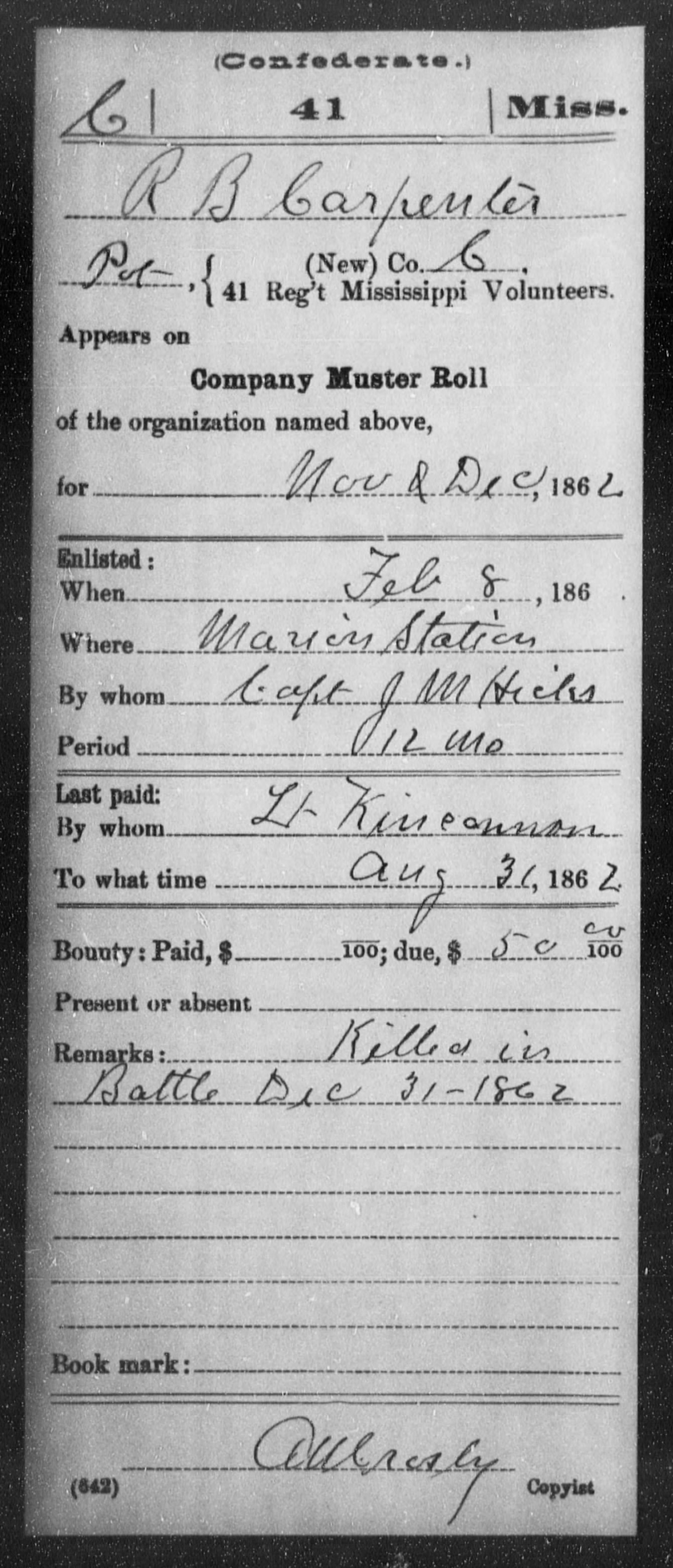
Rice married Mary Ann Rodgers (Ancestor #17) in 1846 and had five children before he went off to fight in the Civil War. On December 31, 1862, he fought in the Battle of Stones River in Murfreesboro, Tennessee. The following is a chapter from my book “Okatibbee Creek.”

****************************************************************

okatibbee creek cover front JPEGThe ground is hard. The air is chilly. Every night, it’s pitch-black out here. I haven’t been able to sleep a wink. I can hear some low, quiet talking outside, an ole hoot owl in the woods far away, a couple of bull-frogs croaking in the grass, and even someone snoring next to me. I wish I could sleep.

I remember the day we arrived. The land here was quite beautiful then. There were thick woods of cedar trees lining a beautiful river.

That was a month ago. Over the last three weeks, most of the trees have been used for firewood, to build makeshift cabins, and turned into poles to hold up tents. It’s been raining a lot, mixed with a little snow and freezing rain. When the sun comes out in the morning, everything melts. Now this once beautiful land looks like one big, muddy pigsty. The mud is awful and the smell is even worse. God, the smell.

We were told that we would be awakened well before dawn for a mission. It must be almost that time. I’m tired. I’m anxious. I’m hungry. If we have a mission this early, there won’t be time for any breakfast. Maybe some hardtack and warm canteen water and that’s it.

I don’t know what I’d do right now for a good, strong cup of hot coffee. We haven’t had any coffee for weeks. We’ve been boiling chicory and peanuts instead. I would like some real coffee.

I would also like some clean clothes and some new shoes as well. I wonder if Mr. Calhoun has new shoes selling in the store. I would like some of his well-made shoes without mud on them, and with soles that aren’t worn through. I would like some clothes that aren’t caked in mud and sweat. I would like a chicken dinner. I would like to see my wife and my children. I would like to get away from these drunken, loud men. I would like to get away from the coughing and the diseases that are spreading through our camp like wild-fire. I would like to get back to my civilized store and my comfortable life, away from this godforsaken war that has gone on far too long for my taste. I should have been home months ago.

I hear them outside moving around now. I hear them all waking up and starting to stir. Someone sticks his head in my tent and says, “Rice, come on, we’re meeting at the captain’s tent in ten minutes.”

Yeah, there is something big going on, all right. One could almost cut the tension in the air with a knife. In ten minutes, we will find out exactly what it is. I put on my coat and hat and what remains of my worn shoes, and head through the mud to the captain’s tent.

“Men, you all know we have Yankees just over the river. We’ve heard that they plan to engage us after breakfast, but we’re not going to wait for them to come across. We’re going to give them a nice little surprise wake-up right now.” He points to a map on the table and continues. “The Kentucky boys are going to go around this way, and the Tennessee boys are going to take them on from that direction. We will move through this way. Since it is so early, we should be able to catch most of them still asleep in their tents.”

He waves his stick around the map so quickly, it is almost hard to figure out exactly where we are supposed to go.

“Any questions?” he asks.

All the men shake their heads.

“Good, let’s go kick some Yankee butt. When we are finished, we will confiscate their coffee, and I’ll join you in a cup,” he says.

“Now you’re speaking my language, Captain,” I joke.

He smiles and pats me on the shoulder as I leave the tent.

We grab our muskets and revolvers and move through what remains of the dense cedar glades, up the river-bank, as quiet as deer at dusk. It is still dark. I guess it must be about four or four thirty in the morning. We usually move to the sound of drum and bugle, but not on this day. Today, we are gravely quiet. As we plant ourselves behind some low limestone rocks about seven hundred yards away from the enemy, I can see about thirty campfires and a few men wandering around, but the camp is mostly quiet. It might be my imagination, but I think I smell coffee. Oh, what I wouldn’t give for a cup of that. It dawns on me that there are a lot more campfires than men, so they must want us to think that their army is a lot bigger than it actually is. Why else have so many campfires?

I am uncomfortable lying on my belly so low on the ground behind eight-inch-tall limestone rocks, and I wonder why we haven’t built some fortifications over the last month. Not that there are any trees left to build them with, but I wonder nonetheless. I assume we weren’t planning on this attack, but since the opportunity has presented itself, we are going to take advantage of it, with or without fortifications.

When everyone gets into position, we start aiming for the men who are walking around, though when they hear the first gun-shot, they crouch down, running and scurrying for their guns. I see quite a few of them fall before I ever hear one of their guns shooting back at us. For a moment, I think this is going to be an easy victory. We’ll send those Yankees back home with their tails between their legs before dawn. Then we’ll drink their coffee.

A few days ago, about twenty-five hundred of our Calvary boys rode all the way around the Union camp, confiscated four wagon trains, and took about a thousand Union prisoners, but we didn’t get any coffee. Maybe these Yankees don’t have much coffee, either.

“Well, they’re not getting any today,” I mumble to myself as I raise my musket and fire.

As the Yankees start to run away, someone behind us gives the rebel yell and we all follow suit. It is a mix of an Indian war cry and a gypsy scream. The Yankees probably think Indians are attacking them. We all rise from our positions and start running after them.

After we cross the freezing cold river, we pick up speed and are almost right on top of them. We are moving in and fast. Roughly ten thousand Confederate troops are raining down on their heads before breakfast. Most of those Yankee boys are running away like scared little rabbits.

“Run, rabbit, run!” I yell.

Our band starts playing “Dixie” and we hum along as we aim, fire, and reload. Occasionally, cannon fire shakes the ground, fills the air with smoke, and drowns out the band. One cannon fires so close behind me, I think my hearing will be gone for good. I am aiming at a Yankee when a cannon fires. I blink my eyes and the Yankee is gone.

One of the boys loading the cannon yells to me, “I got him for you, Rice. You go on home now.”

He roars with laughter as I roll my eyes at him and wiggle my finger in my ear, gesturing that I can’t hear him. He laughs louder.

Our band is now playing “My Bonnie Blue Flag” as we start moving in closer. We walk so far and so long, it seems the Yankees have all but run all the way back home. We move for a solid two miles before we catch up with them again. By the time we engage them again, it is light outside.

Our band always plays marches like “Marching Through Georgia” or “I’m a Good Ole Rebel.” The Yankee bands always play songs like “Battle Hymn of the Republic.” A popular song on both sides is “Home Sweet Home,” but our band is not allowed to play that. The captain says the melancholy tune makes everyone homesick, and he is afraid some of the men will desert and go home. But for some reason on this cold Tennessee morning, our band starts playing that song.

Our boys always sing along, but today, the strangest thing happens. The Union boys start singing along. I can hear them singing over the gunfire. I can’t believe I can hear Yankees singing, partly because they are that close, but mostly because we are in the heat of battle. Singing together seems more than bizarre to me. Then the Union band picks up on the tune and they start to play along also. Everyone is singing and for a split second, the shooting stops. For a brief moment, the cannon fire stops.

I think, how can everyone sing together and then resume shooting one another? How can everyone share this melancholy moment and take up arms again? Men on both sides are singing together like I’ve never heard anyone sing before. In another time, another place, we would be friends.

I stop firing and listen to everyone singing, thinking this is the most surreal moment I can remember in my life. I am lying flat on my stomach, and I lift my head to look around at the men. As I rise further and turn to look at the ones behind me, I feel a searing pain rip through my chest. I reach up to my chest and feel warm blood oozing out of a bullet wound. Damn. I optimistically think it is probably only a surface wound, and I will be all right if I can make it all the way back to camp. I can write to Mary and tell her I’m all right. I don’t want her and the children to worry about me.

As I try to get to my feet and turn toward the direction of camp, I feel another hot pain go through my left temple.

I hear someone yell, “Rice, get down!”

I fall to my knees, thinking this can’t possibly be the end. No, it can’t be. I have a beautiful wife and wonderful children to get home to. I try to get up again, but stumble forward and fall facedown onto the ground.

“Rice!” I hear someone yell again.

I stare at the pebbles and the pine needles on the ground. Blood starts to pool under my face, turning the dirt and pebbles and pine needles a flood of bright red.

I listen as the cannons roar and the rifles fire and the band plays “Home Sweet Home,” and I think of my beautiful Mary and my wonderful children—Mattie, Benjamin, Charlie, and Monroe. How lucky I am to have them.

Then slowly, everything fades from red to black.

****************************************************************
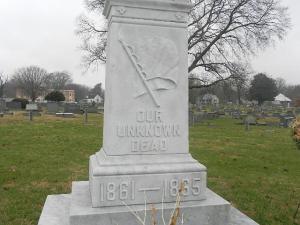
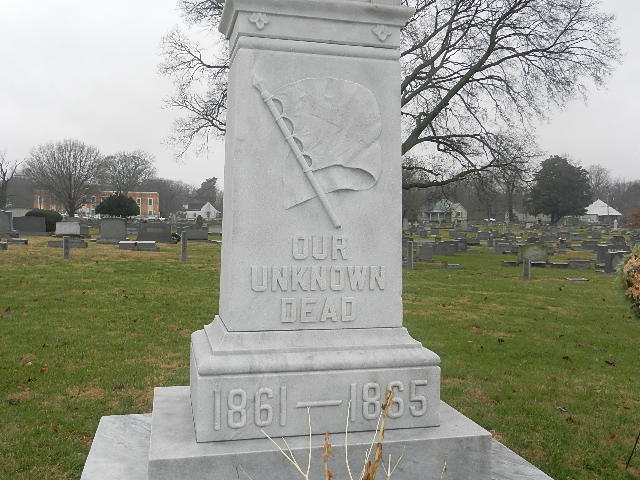
dec 2012 407Private Rice Benjamin Carpenter

Killed in battle December 31, 1862

Murfreesboro, Tennessee

Remains and memorial at Evergreen Cemetery in the Confederate Circle

October Ancestry Challenge – Hays Rodgers

oct ancestry challenge-001


 The October Ancestry Challenge 2013

23 posts – 23 days – 23 ancestors.

 Ancestor #18 – Hays Rodgers


Rodgers Hays SrHays Rodgers was my 4th great grandfather. He was married to Marey Ann Scott and had 14 children: Lewis, James, Allen, Jackson, Susannah, Stephen, William, Mary Ann (heroine of my book Okatibbee Creek and my 3rd great grandmother, ancestor #17), Timothy, Hays Jr, Wilson, John W, Elizabeth and Martha Jane. Geez, how can you even remember all those names. I call my two dogs by each other’s names.

His sons, Stephen and William, died in 1834 at the ages of 8 and 10. His son, James, died of typhoid in Nov of 1862. Between 1863 and 1864, his sons, Timothy, Wilson and John W,  all  died during the Civil War. Timothy and Wilson died of illness. John died of a gunshot wound to the stomach in Jonesboro, GA. Fortunately, Hays was not alive to witness the soldier’s deaths as he died of typhoid in Dec of 1862, a couple weeks after his son James.

He was born 1 Feb 1783 in Greene County, TN to James Rodgers and Elizabeth “Elly” Hays (heroine of my new book Elly Hays). He was the eldest son of 12 children. At the age of 18, he moved with his parents to Clarke Co, AL which was part of the Mississippi Territory at that time. Alabama didn’t become a state until 1819. He and his brother, Absolom, signed up for the Mississippi Militia in 1814, and were assigned to Capt Evan Austill’s company of volunteers in Maj Sam Dale’s Battalion to fight against the hostile Creek Indians. Hays remained in the Militia until Oct 1818, but was only called out once for a two-month tour.

MS Cemetery 076On 11 Dec 1816, he married Marey Ann Scott, who was from Georgia. In 1818, following the end of his military service, he, Marey, and 1st born Lewis, moved to Copiah Co, MS (what later became Simpson, MS). He started buying land and farming. He built the “Ole Stennis House” in 1857 at the age of 61 (with the help of 13 slaves). In 1860, the U.S. Census states Hays owned 13 slaves, a 640 acre (square mile) plantation, 2 horses, 3 mules, 10 cows, 4 oxen, 16 sheep, 60 swine, and $600 in farming instruments, for a total worth of $8400. However, most of his wealth was tied up in slaves, as they were worth about $1000 each – that’s probably a million bucks in today’s money.

Upon his death in Dec 1862 in Lauderdale Co, MS, he owned 690 acres of land and stock in the Mobile and Ohio Railroad, which was sold and divided between his heirs. His wife died three months after him in March of 1863, also of typhoid.

His property was sold in 1869 at public auction on the steps of the Meridian Courthouse to Major Adam T Stennis, hence the name “Ole Stennis House.” It remained in the Stennis family for 100 years until 1970, then sat abandoned for two decades. It is now owned by the Hover family who have restored it as you can see by the photo above. Right before the property was auctioned in 1869, Hays Jr, who was the only son to return home from the war, albeit with a useless arm and a wilted spirit, sold his farm and moved to Alabama to be near his wife’s family. He sold his farm to a black man named Tom Stennis. Tom Stennis was a former slave to Major Adam T Stennis.

elly cover_web

October Ancestry Challenge – Mary Ann Rodgers

oct ancestry challenge-001The October Ancestry Challenge 2013 23 posts – 23 days – 23 ancestors.

Ancestor #17 – Mary Ann Rodgers


Rodgers, Mary Ann Rodgers Carpenter JollyShe was just a name in my family tree. Mary Ann Rodgers Carpenter Jolly. My third great grandmother. 1828-1898.

I discovered that she lost her first husband, Rice Carpenter, in the Civil War in 1862. How sad to lose the one you love, but hey, it’s war, people die. After he died, she remarried in 1864.

I looked at the 1870 census and found she was married to William Jolly and was living with his children, her children, and three children they had together. It was a house-full! But at least their three children (Ancestor #15) were proof they must have liked each other, right? That’s good. I was interested where William came from, so I traced him back and looked at his 1860 census. In 1860, he was living with his wife Harriet, their four children, and a woman named Nancy Carpenter who was 69 years of age.

Nancy Carpenter? The only Nancy Carpenter I know is Rice’s mother, whose maiden name was Nancy Rice. Why was Mary Ann’s mother-in-law living with her future husband?? Were they neighbors? Was she their cleaning lady? I clicked on Nancy Carpenter and saw her relationship to the “head of house” was listed as “mother-in-law.” She was William’s mother-in-law? What?? She was Harriet’s mother?

So, I went back and looked at Rice’s family, and sure enough, his sister Harriet was married to William. Rice died 31 Dec 1862 and Harriet died a month later on 30 Jan 1863. Their spouses, Mary Ann and William, brother-in-law/sister-in-law, married in 1864. Well of course they did. They had known each other for many years, hadn’t they?

The more I looked at the Rodgers and Carpenter families, the more I was amazed by the sheer number of family members they lost to war and typhoid. At the time of my research, I remember counting SEVENTEEN, but I’m sure there were many more I missed. I couldn’t wrap my head around that kind of heartache and quickly became impressed with Mary Ann’s strength. How would you react if you lost two or three family members this year? You would probably need Prozac. How would you respond if you lost a dozen? I wouldn’t even be able to get out of bed. Seventeen in one year? I can’t even fathom that.

okatibbee_cover frontYears, numbers, and names from census records are just that – years, numbers, and names – unless you put yourself in their shoes. Then they become tears, children, and heartaches. We all come from those strong women. We are the living proof of their strength. If the boat sank, the story would be over. But it didn’t, and we know that because we are here. We are the survivors. I dug deep down in my heart and soul and decided to tell her story, a story she would be proud of. I wanted her to know that she didn’t go through all of that in vain. I am here. I am her legacy. Her story has been told to make us all stronger. We are the products of strength, fortitude, and integrity, as well as tears, heartache, and pain. We are the children our grandmothers fought so hard for, and I want Mary Ann to be as proud of me as I am of her.


October Ancestry Challenge – Ludie, Alice, and John

oct ancestry challenge-001The October Ancestry Challenge 2013 

23 posts/23 days/23 ancestors.

Ancestor #15 – Ludie, Alice, and John


Ludie, Alice, and John were children of my 3rd great grandmother, Mary Ann Rodgers Carpenter, and her second husband, William Jolly.

Mary Ann had married Rice Carpenter and had a handful of children before he was killed in the Civil War on Dec 31, 1862.

William Jolly had married Rice’s sister, Harriet Carpenter, and also had a handful of children before she died of typhoid in Jan 1863 – only a month after Rice died.

I imagine Mary Ann and William (brother-in-law/sister-in-law) were a good support system for each other at the time. So much so, that in 1864, they married. Their children, who were once cousins, became 1/2 siblings. And to make the family even more complicated, in 1866, 1867, and 1869, they had three of their own children: Sarah Louella “Ludie” Jolly, Alice Jolly, and John Jolly. I feel as though I am closely related to the Jollys, but since I am a descendant of Mary Ann and Rice, it feels as though I’m not really related to them at all. It’s like they’re a different family. Ludie, Alice, and John would be my 1/2 aunts and 1/2 uncle. I’ve never even heard of such a thing.

Sarah Louella Jolly family 1900, hub Frank, kids Oscar, Cora, Alma, Grover, Elma, Queenie, Fred, Austin, BarneyAnyway, to make a confusing family EVEN MORE confusing, Ludie married Frank Williamson…


Alice Jolly family 1896, with hub Henry, Carl and Edith, girl standing is not hers - Copy …and Alice married Jeff Williamson.


I know what you’re thinking, and no, they weren’t brothers. I breathed a sigh of relief, too. Ludie moved to Louisiana and had, ready?, FIFTEEN kids! Alice remained in Mississippi and had four kids.


Their little brother John first married Missouri Johnson. On Dec 7, 1891, she gave birth to their first child, a son, and on Dec 14, she died of complications.


John Eades Jolly and wife SarahIn 1894, John found love again and remarried. Guess what her name was? Yep, Johnson…Bettie Johnson. I’m not going to tell you the women weren’t related because I don’t know for sure. I can’t find much info on Missouri.


I will tell you one thing for sure, even though I don’t have a photo of my 3rd great grandmother, Mary Ann, I can tell by her children that she was a beautiful woman!


P.S. If this family menagerie has peaked your interest, Mary Ann’s whole story is told in my book Okatibbee Creek.” I’ve been thinking about her and the family recently because we are finishing up the audio book for release in November, and listening to the narrator speak in my grandmother’s voice has really been haunting me. I think I’ll do an ancestry post about her in the next couple days. 🙂

October Ancestry Challenge – William Lafayette Brown Jr

oct ancestry challenge-001The October Ancestry Challenge 2013 

23 posts/23 days/23 ancestors.

Ancestor #13 – William Lafayette Brown Jr


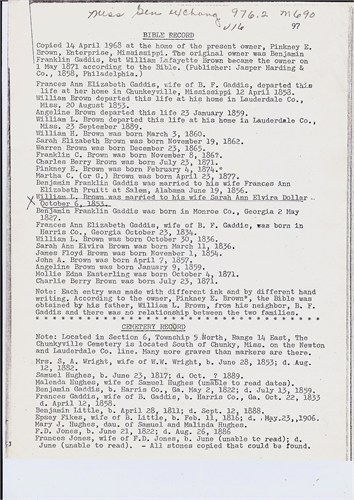
brown william lafayett bibleMy 3rd great grandfather was William Lafayette Brown Jr. He was born in 1836 in Lauderdale County, Mississippi to William Sr and Martha Hamrick Brown. He only had one brother, John Henry, and six sisters. Poor boy.  The document to the left is the transcribed family bible.

William Jr (24) and John Henry (29) both signed up for the 37th Mississippi Infantry during the Civil War in May 1862. They were in Company D under Lt H. G. Hamrick. As close as everyone was in Lauderdale County at the time, I’m sure Lt Hamrick was a relative. In November of 1862, William Jr was promoted to Corporal. In November of 1863, he was sent to work with the Calvary, and in February of 1864, he was promoted to 3rd Sargent.

7872_561759593863541_1656188250_nFor you Civil War buffs, here are the details of his company

Officers of Company D (Enterprise Tigers)
Whitman C. Turner, Capt., r. January 3, 1863
F. S. Pickle], Capt., r. August 29, 1864
Allen C. Carter, 2nd Lt., died August 23, 1862
H. G. Hamrick, 2nd Lt., r. July 27, 1862
Ira J. Williams, 1st Lt., died April 9, 1862
J. L. Peters, 1st Lt.
D. Lindsey, 2nd Lt.
N. R. Sumrall, 2nd Lt.
 

Stationed at Enterprise, Mississippi, March 7, 1862.
March 7. Muster-in roll of Captain Whitman C. Turner’s Company, the Enterprise Tigers, of Mississippi Volunteers . . .
called into the service of the Confederate States of America by virtue of a proclamation of the Governor of the state of Mississippi January 1862 from March 7, 1862 for the term of three years or for the war, unless sooner discharged. . . .
ROBERT McLAIN, Mustering Officer.

Stationed at Columbus, Mississippi, March 7-June 30, 1862.
Stationed at Saltillo, Mississippi, July-August 1862.
Stationed near Lumpkin’s Mill, September-October 1862.
September 10. Left for Iuka from Baldwyn.
September 14. Took possession of Iuka.
September 19-20. Had battle on the evening of September 19 and evacuated the place on the morning of September 20 and retreated back to Baldwyn, traveling about 100 miles.
September 25. Left Baldwyn for Corinth via Ripley.
October 3-4. Gave the enemy battle at Corinth and began our retreat from Corinth on the evening of October 4 and came back to Ripley and thence to this place, traveling about 140 miles on that march.
Stationed in barracks, Yazoo County, Mississippi, November-December 1862.
Stationed at Snyder’s Mill, Mississippi, January-February 1863.
Stationed at Enterprise, Mississippi, April 30-October 31, 1863.
Stationed near Enterprise, Mississippi, November-December1863.
Stationed near Pollard, Alabama, January-February 1864.
Stationed at Atlanta, Georgia, February 29-August 31, 1864.


Okay, let’s back up just a moment, and then we’ll fast forward to the good part.


william lafayette brown and sarah dollar marriage licenseBefore joining the Infantry, William Jr married Sarah Ann Dollar on October 6, 1854. The document to the left is their marriage license. They had three boys and a girl. While he was running around fighting, his wife gave birth to my 2nd great grandmother Sarah Elizabeth “Bettie” Brown on November 19, 1862 (100 years to the day before I was born). Once he returned from the war, they had five more children: four more boys and another girl.

He was obviously a viral young man, and while he was away from home from 62 to 65, he needed to find a way to burn off all that testosterone. The story is: he was a sniper and guarded the railroad bridges at the Chunky River in Mississippi, and was captured by Federal forces. He dug a hole out of the stockade and escaped. Later, he allowed himself to be captured a second time to help others escape. He/they did. He had a bounty on his head by the Union for the remainder of the war.


brown william L and Sarah A at goodwater cemeteryWilliam Lafayette Brown Jr, the father, the Rebel, and the war hero, died at the age of 52 on September 23, 1889 and is buried at Goodwater Cemetery in Enterprise, Mississippi.


October Ancestry Challenge – William Henry Blanks II

oct ancestry challenge-001The October Ancestry Challenge 2013 – 23 posts/23 days/23 ancestors.

We’re in week three!

Ancestor #10 – William Henry Blanks II and kids

William Henry Blanks II was my 3rd great grandfather. He was born in 1800 in Greene County, Georgia. His father, grandfather, great grandfather, 2nd great, and 3rd great were all born in Virginia, dating back to 1660.

His grandfather was Henry Blanks. The following is Henry’s will.

***********************************************

HENRY BLANKS 1794 will

Will of HENRY BLANKS-Pittsylvania County, Va., dated September 15, 1794-, recorded October 20, 1794.

“IN THE NAME OF GOD AMEN I HENRY BLANKS of the County of Pittsylvania being sick and weak of body but of sound sense and memory and considering the certainty of death and the uncertainty of the time thereof have thought fit to make this my last Will and Testament in the manner followeth.

ImprImis I recommend my soul to God who gave it me and my body to the earth to be interred at the discretion of Executors hereafter named,

Item I lend to my beloved wife during her widowhood my house hold and kitchen furniture, all my stock of horses, cattle and hogs, the tools and plantation utensils belong to the plantation whereon I live together wilth use of the same during her widowhood after my just debts are pay’d

Item I give to my Sons JOHN and JOSEPH two hundred and ten acres of Land that I now Live on joining Bannister river to be equally divided between them. Also it is my will and desire that the above mentioned household and Kitchen furniture and all my stock of horses, cattle and hogs, the tools and plantation utensils belong to the Plantation should be equally divided between my Sons JOHN and JOSEPH and my Son in law WILLIAM PARSONS and POLLY his wife , WILLIAM FARTHING and TABITHA his wife .

Item I gave to my Son JAMES of Georgia a horse now in his possession to him I give the same to his heirs forever

Item I give to my Son WILLIAM of Georgia a mare cow & calf and a sow now in his possession to him I give the same to his heirs forever

Item I give to my Son in Law BENJAMIN WATKINS and his wife SARAH five Shillings and of my movable Property after my wife’s widowhood

Item I give to my Son in Law DANIEL BAYTS and his Wife ELIZABETH a cow and calf now in their possession to him I give the same to his heirs forever

And lastly this is my last Will and Testament hereby revoking all former Wills by me made. In Witness whereof I have hereunto set my hand and Seal this fifteenth day of September one thousand seven hundred and ninety four.

Signed, Sealed and published in the

presence of us who subscribed the same

in the presence of the said Testator

Thomas Anderson, Francis Anderson

Elkanah Echols, Richard Anderson

AT A COURT held for Pittsylvania County the 20th day of October 1794– within written last Will and Testament of HENRY BLANKS deceased was exhibited into Court and proved by the Oaths of two of the witnesses hereto and Ordered to be Recorded. And on the motion of NAOMI widow and relict of the said Testator Certificate is granted her for obtaining Letters of Administration of all and singular the Goods and Chattels, rights and Credits of the said Testator with the said Will annexed she having first taken the Oath by Law prescribed and together with JOHN BLANKS, JOSEPH BLANKS and JOHN OWEN the securities entered into Bond and acknowledged. the same By the Court Teste Will Tunstall C. C. -Pittsylvania County, Va., Deed & Will Bk. 10, p. 75.

**************************************************

blanks william henry blanks I Georgia Journal 27 Jan 1824 pg 3William Henry II’s father William Henry I was born about 1760 in Virginia and was captain in the NC militia during the American Revolution. He served 1779-1780 and defended Charleston, SC under Brigadier General Caswell. In 1799, after five generations in Virginia, the family moved to Georgia, but as evidence of the above will, there was already some family there. After William Henry I died in 1823, his son sold all of his belongings. The newspaper clipping is from the Georgia Journal, 27 Jan 1824, pg 3.

William Henry II married Nancy Young in 1819 and had 8 children in Greene County, Georgia. Sometime between 1840 and 1850, he moved his family to Lauderdale County, Mississippi. I don’t know the reason, but every one of them went.

His two eldest sons James Lafayette Blanks and Thomas Young Blanks became Reverends and also served in the Confederate Army. His third son Jefferson Franklin Blanks moved to Arkansas between 1857 and 1860. Next, he had a fourth son Richard Lane Blanks and two daughters Martha Ellen and Nancy Ann. Finally, his youngest child was my 2nd great grandfather, William Henry Blanks III.

blanks william henry III and mattie carpenter blanksWilliam III married Martha Lettie “Mattie” Carpenter and remained in Lauderdale County until he retired. He spent his golden years an hour away in Laurel, Jones County, Mississippi. His death certificate states he died of senility and chronic bronchitis in 1922. His wife died eleven years later, following a stroke.

blanks family bibleI find it strange that all of the children remained in Lauderdale County except for Jefferson. I wonder what was so intriguing about Arkansas  in the late 1850s to make him leave his family. Jefferson married, had seven children, and raised them in Arkansas.

His youngest son was Jack Bruce Blanks. Jack also moved away from his family and married a girl in Louisiana and opened a general store. I don’t know which one in this photo is him, but I love this old picture. blanks jack bruce general store

According to William II’s will, his youngest children Nancy Ann and William III were his favorites. He left them his entire estate. He left $1 to each of his other children.

********************************************************

The Last Will and Testament of William H Blanks… State of Mississippi Lauderdale County August 18,1859.

Know all persons by these present that I do this day bequeath to my daughter Nancy & son William the sum total of my Estate being in consideration of my parental affection and love for them. My sons James, Thomas, Jefferson, and Richard I do give unto one dollar a piece also my daughter Martha English I give the same one dollar to be by each and all of them held in peace for life. My daughter Nancy and son William are by the Law of the Land old enough to choose their own guardians. Let them choose who they please their money is to be for their education and raising to be laid out on them at the will of their Guardian he to give Security for his management of the same, all of the above do request as the Last Will on Earth hoping the same may be satisfactory to all people on Earth in Testimony on which setting my hand and Seal Witness by undersigned. W H Blanks

W J Brown, P H Higgins

Jas F Ginnen                                                                  

P. S. It is my wish for Nancy & William to have their brother Thomas to hold their business in charge.

Will Book 1, Page 17 Lauderdale County Courthouse, Meridian, Mississippi.

October Ancestry Challenge – Joel B Culpepper

oct ancestry challenge-001The October Ancestry Challenge 2013 is 23 posts in 23 days (Monday through Friday) about 23 ancestors.

We’re in week two!

Ancestor #6 – Joel Bluett Culpepper

culpepper Joel B CulpepperMy great great grandfather Joel Bluett Culpepper was born in 1845 in Clark County, MS and died 11 Nov 1911 at Beauvoir Confederate Soldiers home in Biloxi, MS.

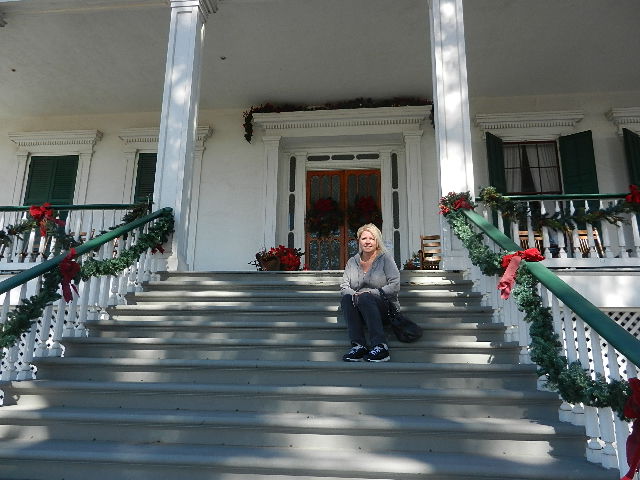
If you’re not familiar with Beauvoir, it was the home of Confederate President Jefferson Davis, and following the Civil War, it was turned into a home for Confederate veterans. It is now a historical site and I have sat on that porch many, many times. The first photo is pre-hurricane Katrina. The second is me on the rebuilt front steps in December 2012.

Beauvoirdec 2012 231

Joel was born to Rev. Joseph M Culpepper and Nancy Yarbrough along with 3 brothers and 2 sisters. His paternal grandparents were Simeon Culpepper and Elizabeth Bluett. That’s where his middle name came from. It’s an old southern tradition to give maiden names of mothers and grandmothers to son and grandsons.

Page 1 joel Joel signed up for the 63rd Alabama Infantry Co K, stating that his residence was in Choctaw Co, Alabama. His brother Benjamin signed up for the 40th Alabama Infantry Co C. I have no idea why the boys signed up in Alabama or if they were actually living there at the time. The answer may lie in their father.

Their father, the Rev Joseph M, signed up for the 37th Mississippi Infantry on April 11, 1862 and died on August 15th of the same year in a battle at Columbus, Mississippi. Joel was only 17 at the time and Benjamin was 18. They may have been sent to Alabama to live with relatives following their father’s death and signed up for the cause to honor him. The enrollment date on Benjamin’s war documents is October 1863 in Sumter County, Alabama, but the date is not visible on Joel’s document, but it was definitely before Benjamin signed up. Page 4 joseph

fort massachusetts on ship islandPrior to Benjamin signing up, on April 9, 1863, Joel was captured by Federal Forces and held prisoner at Fort Massachusetts on Ship Island until the end of the war. He was an 18-yr-old boy.

In 1870, Joel married Mary E “Mollie” McFarland and they had six children, one of them being my great grandfather William Samuel “Sam” Culpepper who married Annie Josephine Blanks. I wrote about her in my Ancestor #1 blog.

Mollie died in 1908, and Joel moved in with his daughter for a time until it was decided he would enter Beauvoir under his rights as a Confederate soldier. He lived there for 10 months preceding his death. The records on file name him as James B Culpepper. He and Mollie are laid to rest at Zion Cemetery in Kemper County, Mississippi. culpepper, mary e molly mcfarlandculpepper, joel bluitt

October Ancestry Challenge – George Washington Spencer

oct ancestry challenge-001

The October Ancestry Challenge 2013 is 23 posts in 23 days (Monday through Friday) about 23 ancestors.

We’re in week two!


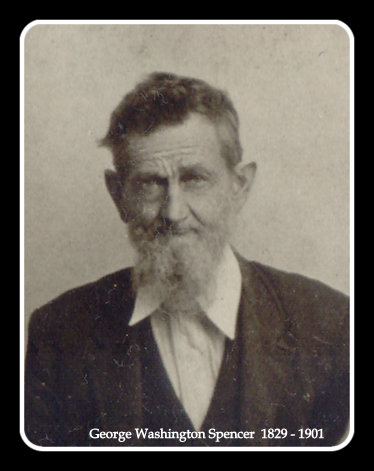
Ancestor #5 – My 3rd great grandfather George Washington Spencer


50643187_136536244812My 3rd great grandfather was George Washington Spencer. He was born June 1829 in Tuscaloosa, Alabama and died at the age of 72 in July 1901 in Newton Co, Mississippi. He was the son of Rev. William Saladin Spencer and Martha Didama Gross. He had ten siblings and was the second from youngest, so I imagine he got away with just about anything he wanted to. You can just imagine by the tenth child, you’d just throw up your hands and say, “Whatever!”


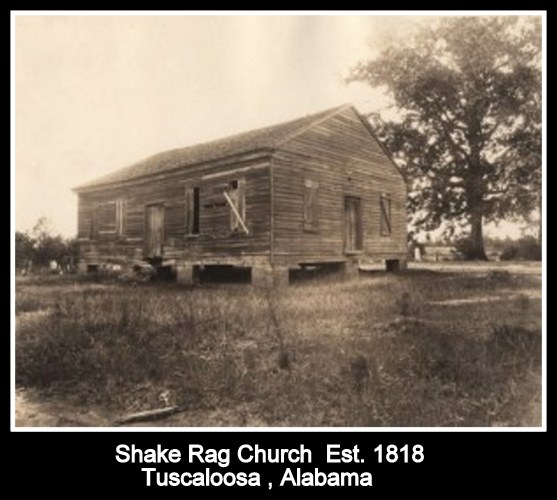
Behind this church is the cemetery where his parents are buried. It is possible George attended this church and his father may have preached there. (the photo is from my cousin mebauc)50643187_137826751612


George married Nancy Virginia “Jenny” Holdcroft in 1858 at the age of 29. She was ten years is junior. Hubba hubba. They lived in Newton County, Mississippi, and he was listed on the 1860 Federal Census as a school teacher.


Page 1When the Civil War broke out, he joined the 35th Mississippi Infantry, Company B on March 1, 1862 and some of the muster rolls show him as being hospitalized in Jackson, Marion, and Lauderdale Springs. Reports state he had an infection in his leg. In 1864, he was granted a medical discharge. My cousin told me George’s wife went by wagon to pick him up and bring him home. Though it’s nearly impossible to read, the following is his medical discharge.Page 13


The leg infection did not stop him from making whoopee, however! He had seven children between 1859 and 1878, the eldest being my 2nd great grandmother Nancy Didama “Grandma Damie” Spencer Burke.


He is laid to rest next to his wife (who died in 1928 at the age of 89) in unmarked graves at Hickory Cemetery, Newton County, Mississippi.


Born August 15, 1828

Rice Benjamin Carpenter was born August 15, 1828 in Greene County, Alabama to Benjamin Carpenter and Nancy Rice Carpenter. He was the eighth of ten children.

In 1834, his family moved to Pine Springs, Lauderdale County, Mississippi for the low-cost land and fertile soil. Rice was six years old.

He married Mary Ann Rodgers in 1846. They were both seventeen.

They had five children – Martha Lettie, Benjamin Hays, William Travis, Charles Clinton, and MF – one girl and four boys.

After living with his friends Ebenezer and Sarah Miles in Pine Springs for a few years, in 1853 they bought 80 acres of land from Mary Ann’s father and began farming, but within a few short years, Rice realized he was a better merchant than a farmer, and by 1860 they had opened a general store in Marion Station, Mississippi.

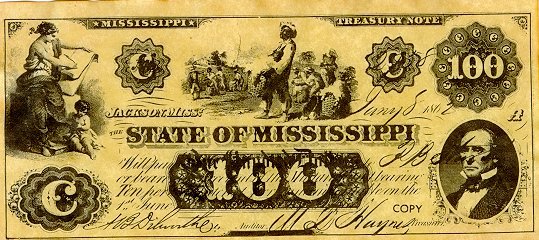
conf_money

When the Civil War began, Rice signed up for the 41st Mississippi Infantry, Company C on February 8, 1862. This must have been a frightening time for the family, as Mary Ann was eight months pregnant with their last child who was born March 12th, 1862.

dec 2012 388

At dawn on December 31, 1862, amid limestone boulders and cedar forest, his infantry attacked the Union soldiers at the Battle of Stones River in Murfreesboro, Tennessee.

port-hudson

Private Rice Benjamin Carpenter died on that day on the battlefield at the age of 34, leaving behind his wife and children.

Page 5

He is laid to rest at Confederate Circle, Evergreen Cemetery, Murfreesboro, Tennessee. RIP 3rd great grandpa. Rest well soldier, your job is done.

dec 2012 407

A portion of his story is told in my book, “Okatibbee Creek.” Available at Amazon.

okatibbee_cover front