October Ancestry Challenge – Hays Rodgers

oct ancestry challenge-001


 The October Ancestry Challenge 2013

23 posts – 23 days – 23 ancestors.

 Ancestor #18 – Hays Rodgers


Rodgers Hays SrHays Rodgers was my 4th great grandfather. He was married to Marey Ann Scott and had 14 children: Lewis, James, Allen, Jackson, Susannah, Stephen, William, Mary Ann (heroine of my book Okatibbee Creek and my 3rd great grandmother, ancestor #17), Timothy, Hays Jr, Wilson, John W, Elizabeth and Martha Jane. Geez, how can you even remember all those names. I call my two dogs by each other’s names.

His sons, Stephen and William, died in 1834 at the ages of 8 and 10. His son, James, died of typhoid in Nov of 1862. Between 1863 and 1864, his sons, Timothy, Wilson and John W,  all  died during the Civil War. Timothy and Wilson died of illness. John died of a gunshot wound to the stomach in Jonesboro, GA. Fortunately, Hays was not alive to witness the soldier’s deaths as he died of typhoid in Dec of 1862, a couple weeks after his son James.

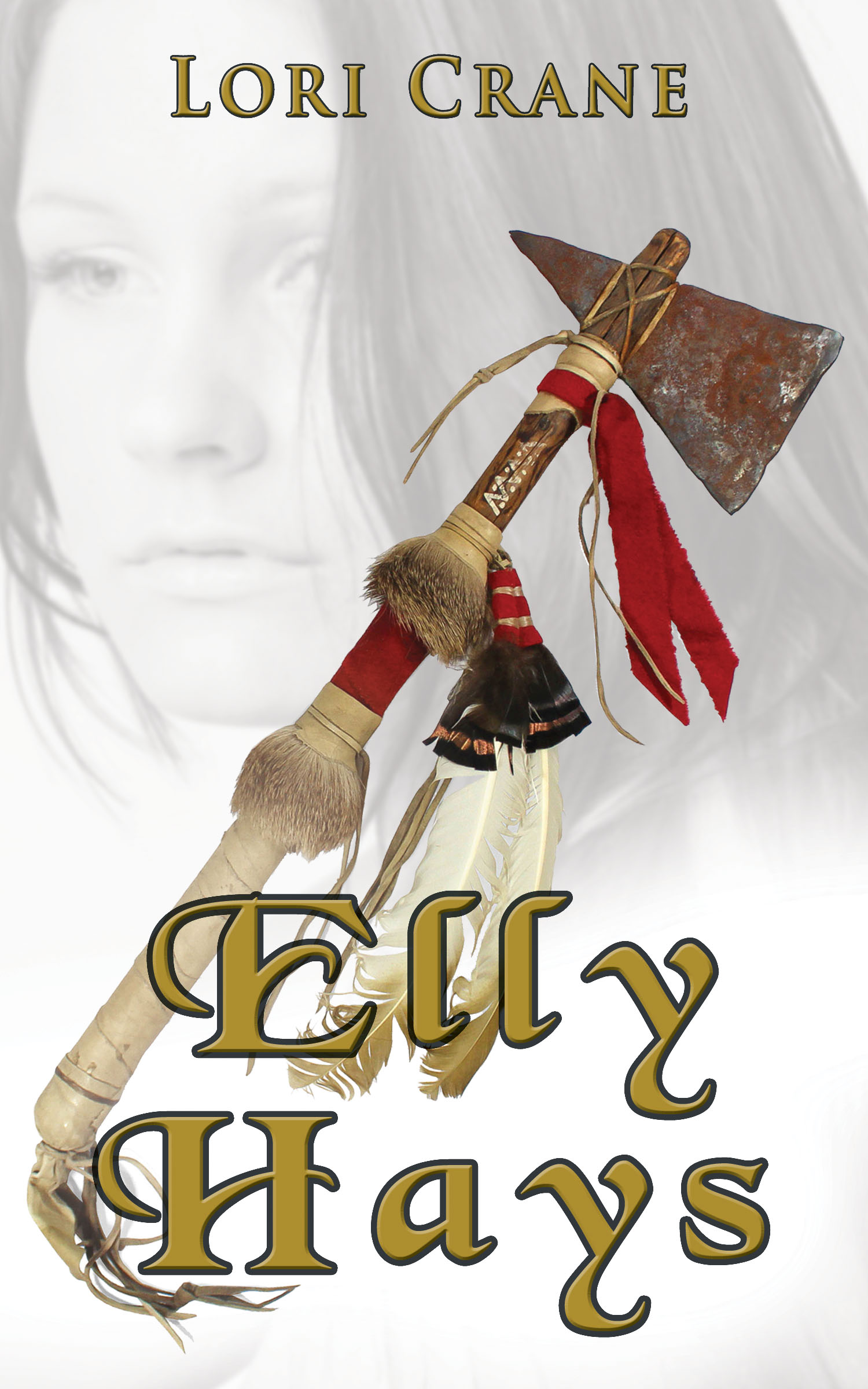
He was born 1 Feb 1783 in Greene County, TN to James Rodgers and Elizabeth “Elly” Hays (heroine of my new book Elly Hays). He was the eldest son of 12 children. At the age of 18, he moved with his parents to Clarke Co, AL which was part of the Mississippi Territory at that time. Alabama didn’t become a state until 1819. He and his brother, Absolom, signed up for the Mississippi Militia in 1814, and were assigned to Capt Evan Austill’s company of volunteers in Maj Sam Dale’s Battalion to fight against the hostile Creek Indians. Hays remained in the Militia until Oct 1818, but was only called out once for a two-month tour.

MS Cemetery 076On 11 Dec 1816, he married Marey Ann Scott, who was from Georgia. In 1818, following the end of his military service, he, Marey, and 1st born Lewis, moved to Copiah Co, MS (what later became Simpson, MS). He started buying land and farming. He built the “Ole Stennis House” in 1857 at the age of 61 (with the help of 13 slaves). In 1860, the U.S. Census states Hays owned 13 slaves, a 640 acre (square mile) plantation, 2 horses, 3 mules, 10 cows, 4 oxen, 16 sheep, 60 swine, and $600 in farming instruments, for a total worth of $8400. However, most of his wealth was tied up in slaves, as they were worth about $1000 each – that’s probably a million bucks in today’s money.

Upon his death in Dec 1862 in Lauderdale Co, MS, he owned 690 acres of land and stock in the Mobile and Ohio Railroad, which was sold and divided between his heirs. His wife died three months after him in March of 1863, also of typhoid.

His property was sold in 1869 at public auction on the steps of the Meridian Courthouse to Major Adam T Stennis, hence the name “Ole Stennis House.” It remained in the Stennis family for 100 years until 1970, then sat abandoned for two decades. It is now owned by the Hover family who have restored it as you can see by the photo above. Right before the property was auctioned in 1869, Hays Jr, who was the only son to return home from the war, albeit with a useless arm and a wilted spirit, sold his farm and moved to Alabama to be near his wife’s family. He sold his farm to a black man named Tom Stennis. Tom Stennis was a former slave to Major Adam T Stennis.
elly cover_web

October Ancestry Challenge – Mary Ann Rodgers

oct ancestry challenge-001The October Ancestry Challenge 2013 23 posts – 23 days – 23 ancestors.

Ancestor #17 – Mary Ann Rodgers


Rodgers, Mary Ann Rodgers Carpenter JollyShe was just a name in my family tree. Mary Ann Rodgers Carpenter Jolly. My third great grandmother. 1828-1898.

I discovered that she lost her first husband, Rice Carpenter, in the Civil War in 1862. How sad to lose the one you love, but hey, it’s war, people die. After he died, she remarried in 1864.

I looked at the 1870 census and found she was married to William Jolly and was living with his children, her children, and three children they had together. It was a house-full! But at least their three children (Ancestor #15) were proof they must have liked each other, right? That’s good. I was interested where William came from, so I traced him back and looked at his 1860 census. In 1860, he was living with his wife Harriet, their four children, and a woman named Nancy Carpenter who was 69 years of age.

Nancy Carpenter? The only Nancy Carpenter I know is Rice’s mother, whose maiden name was Nancy Rice. Why was Mary Ann’s mother-in-law living with her future husband?? Were they neighbors? Was she their cleaning lady? I clicked on Nancy Carpenter and saw her relationship to the “head of house” was listed as “mother-in-law.” She was William’s mother-in-law? What?? She was Harriet’s mother?

So, I went back and looked at Rice’s family, and sure enough, his sister Harriet was married to William. Rice died 31 Dec 1862 and Harriet died a month later on 30 Jan 1863. Their spouses, Mary Ann and William, brother-in-law/sister-in-law, married in 1864. Well of course they did. They had known each other for many years, hadn’t they?

The more I looked at the Rodgers and Carpenter families, the more I was amazed by the sheer number of family members they lost to war and typhoid. At the time of my research, I remember counting SEVENTEEN, but I’m sure there were many more I missed. I couldn’t wrap my head around that kind of heartache and quickly became impressed with Mary Ann’s strength. How would you react if you lost two or three family members this year? You would probably need Prozac. How would you respond if you lost a dozen? I wouldn’t even be able to get out of bed. Seventeen in one year? I can’t even fathom that.

okatibbee_cover frontYears, numbers, and names from census records are just that – years, numbers, and names – unless you put yourself in their shoes. Then they become tears, children, and heartaches. We all come from those strong women. We are the living proof of their strength. If the boat sank, the story would be over. But it didn’t, and we know that because we are here. We are the survivors. I dug deep down in my heart and soul and decided to tell her story, a story she would be proud of. I wanted her to know that she didn’t go through all of that in vain. I am here. I am her legacy. Her story has been told to make us all stronger. We are the products of strength, fortitude, and integrity, as well as tears, heartache, and pain. We are the children our grandmothers fought so hard for, and I want Mary Ann to be as proud of me as I am of her.


Saturday Snippet – Complete with Music and Indians

Saturdays are the days I usually post snippets of one of my books, but today is slightly different. As many of you know, when I’m not writing historical fiction books, I’m playing music – the whole “professional musician by night, indie author by day” thing. That being said, I tend to get caught up in the music of the time of whatever book I’m writing. My latest work takes place in 1812, the setting is the Mississippi Territory, known today as Clarke County, Alabama, and a few of the characters are Mvskoke (Muskogee Creek Indian.) Because of this, I’ve been listening to traditional Creek music for the last few months, and this particular song has stuck in my head. It feels more like an ancient chant than a song, and I can’t stop playing it. It is “Heleluyvn.”

elly cover_webHere’s an excerpt from “Elly Hays” coming Nov 4 to all online retailers. Elly is my 5th great grandmother, and the book is the third in the Okatibbee Creek series.

******************************

The laborers had erected a small makeshift platform in the middle of the meadow. It rose two feet off the ground so Tecumseh could be seen above the massive gathering of people. Rumors had circulated for months that he would come, as it had been foretold by a bright comet in the nighttime sky in March of 1811, and the gathering crowd numbered into the hundreds, perhaps closer to a thousand, representing over a dozen of the twenty Mvskoke clans.

As the people waited for him to take the platform, they grew increasingly impatient. They had been assembling for days to hear him speak, so not only were they weary from their travels, but the scorching sun was not improving their disposition. The air was as stagnant as the wait, with not even the slightest of breezes to offer relief from the stifling heat. The afternoon sun melting into evening had made them agitated, and they grumbled and occasionally began chanting for the great warrior to appear and address them. When he did not take the platform after a few minutes, the chanting quieted to a dull objection, only to start up again within a short amount of time.

Over the last few months, reports had surfaced that the Americans would once again declare war against the British. Before and since the revolution, the British had befriended the Indians, asking for their help in warding off the Americans’ expansion. Since the Indians considered the land theirs in the first place, they were pleased to oblige. The Indians had never asked for a favor in return, but the waves of white settlers were growing, continually trespassing upon their tribal land. They needed help, they needed answers, they needed to stop the encroachment. They eagerly awaited Tecumseh’s speech and they were anxious to hear a plan. They wanted to know what he wanted of them. If the reports of an impending war were true, perhaps this was the time to join forces with the British and defeat the white man once and for all.

Finally, a group of elders dressed in vibrant tribal robes with headdresses embellished with porcupine fur and hawk feathers stepped up onto the platform. The cheer began small and grew to a fevered pitch as it spread across the field of warriors like a breeze washing over wheat. The elders greeted the crowd and led them in singing their tribal anthem, “Heleluyvn,” following which the crowd erupted again in anticipation of the great warrior’s arrival.

Elly Hays is available at Amazon

3 Busy and FUN Things!

Three awesome things in the works!!

oct ancestry challenge-0011) I’m hosting the OCTOBER ANCESTRY CHALLENGE 2013 Oct 1-31.

The goal is to post 23 blogs (Monday through Friday) in October about 23 different ancestors. All are welcome to join us. Comment and I’ll add your name to the roster that I’ll post here on Sept 30th.

If you don’t wish to participate, please stop by in October and let us dazzle you with our family’s history.


trickban2) Romancing the Blog is hosting the HALLOWE’EN BLOG HOP Trick or Treat (with giveaways!) on Oct 31st.

Make sure to stop by and win lots of treats! Rumor is authors will be giving away FREE Kindle copies of their books. Can’t wait!


book tour 43) The ELLY HAYS virtual book tour runs Nov 4-16 celebrating my new release.

Opening night features an online release party 7-9pm ET with GREAT prizes. Everyone is welcome! Closing day features a LIVE Twitter Chat 1-2pm ET. Use #ellyhays and join us.

Mark your calendars! I’m beyond excited!

Saturday Snippet – Sep 14, 2013 – Stuckey’s Bridge

Stuckey's cover_webI received a sweet and awesome 5-star review for The Legend of Stuckey’s Bridge from Trudi LoPreto at Readers’ Favorite.

“Lori Crane has written a nail-biter that will keep you up all night. This is a five star winner and Lori Crane is a must-read author.”

You just can’t get any better than that! I’m tickled. You can read the entire review HERE

I was so excited to read it, because honestly, I’ve been working so hard on my next book, that I haven’t thought much about Old Man Stuckey and his exploits. Old Man Stuckey was a serial killer. He was a sociopath. He was pure evil. However, he had a confident swagger about him that made most women swoon in his presence. Here’s a snippet about one of his conquests. This is one of my favorite scenes from the book. Enjoy!

Scene: Stuckey’s Inn, 1900, Mississippi, the young lady refers to him as Mr. Mason for he didn’t tell her his real name, as usual.

************************************************

He found her on the front porch, sitting in a rocking chair with her laced-up boots propped up on the railing. She was gently pushing the chair back and forth with her foot and staring down into a book on her lap.

He watched her from the doorway for a while. The sun was shining on the railing, and her skirt had risen above the height of her boots. He could see a couple inches of her bare leg and longed to see more. He hadn’t had the pleasure of a woman’s company for quite some time, and he wanted to take her right then and there on the porch in the sunshine. He wanted to see the expression on her face in the light of day as he pushed that dress all the way up to her hips.

“I see you found the books I left out for you.” He grinned as he sauntered across the porch, his boots clicking on the old wood planks.

“Yes, I did. Thank you very much.” She smiled up at him with stunning blue eyes, and when she met his gaze, he thought he would explode with desire.

“Which one did you choose?” He strolled in front of her and leaned his back against the porch post, close enough to touch her bare leg.

She simultaneously pulled her boots down from the railing and flipped the cover closed. She read, “A Study in Scarlet by Arthur Conan Doyle.”

“Ah, Sherlock Holmes.”

“Have you read it, sir?”

“Yes, I have. I love a good mystery. I believe he has another book also.”

“Yes, The Sign of Four.” She smiled. “Do you like to read, Mr. Mason?”

“I love to read, Miss Summers.” He gazed deeply into her eyes, realizing by the fire glowing there that it would not be girlish innocence he was about to find.

She blushed and looked down at the book.

Oh, this is a game she likes to play. “Why do you look away from me?”

“I…um…I just don’t feel comfortable.”

“With the way I look at you?”

She glanced up at him through her long eyelashes and did not answer.

“Don’t you know how beautiful you are?”

She blushed and looked down again.

He was enjoying this game. Time to increase the stakes. Softly he said, “Victoria.”

She looked up at him.

He wanted this girl, and knew exactly what she needed to hear. “You are undoubtedly the loveliest woman I have ever seen, and I’m deeply honored just to be in your presence.”

She was speechless as she gazed into his eyes. This time she did not blush or look away. The game was over.

“May I kiss you?” he whispered.

She did not answer.

He took that as a yes.

He gently took the book from her lap, placed it on the side table, and pulled her to her feet. She did not resist. He wrapped his hand around her, placing his palm on the small of her back, and he gently pulled her toward him. Their lips met and she responded to his kiss, placing her hands on his chest. He kissed her deeper. She didn’t waver. He pulled the pin from her hair, letting it fall down to her waist. He wrapped his fingers in it and firmly pulled her head back so he could kiss her neck. He put his other hand on her upper back and pulled her closer to him, feeling her snug bodice press against his chest. He held her there for a moment, then whispered into her ear, “Thank you.”

He released her.

She stood there, dumbstruck and unmoving, like a mule wearing a frosted blue satin dress.

“Would you like some tea, Victoria?” He grinned and strutted across the porch, back into the house.

It was like taking candy from a baby.

**********************************************

The Legend of Stuckey’s Bridge is available at Amazon.com and all online book retailers.


Interview by Elizabeth Caulfield Felt

I had so much fun doing this interview. Elizabeth is a warm and gracious hostess, and also a busy teacher, librarian, historical fiction author, and reader. I don’t know where she finds the time to do things like chat with me, but the pleasure was all mine.

Check out the interview here !!!


Born August 15, 1828

Rice Benjamin Carpenter was born August 15, 1828 in Greene County, Alabama to Benjamin Carpenter and Nancy Rice Carpenter. He was the eighth of ten children.

In 1834, his family moved to Pine Springs, Lauderdale County, Mississippi for the low-cost land and fertile soil. Rice was six years old.

He married Mary Ann Rodgers in 1846. They were both seventeen.

They had five children – Martha Lettie, Benjamin Hays, William Travis, Charles Clinton, and MF – one girl and four boys.

After living with his friends Ebenezer and Sarah Miles in Pine Springs for a few years, in 1853 they bought 80 acres of land from Mary Ann’s father and began farming, but within a few short years, Rice realized he was a better merchant than a farmer, and by 1860 they had opened a general store in Marion Station, Mississippi.

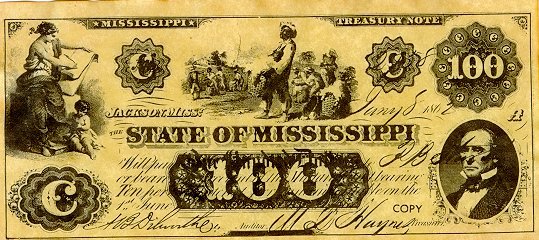
conf_money

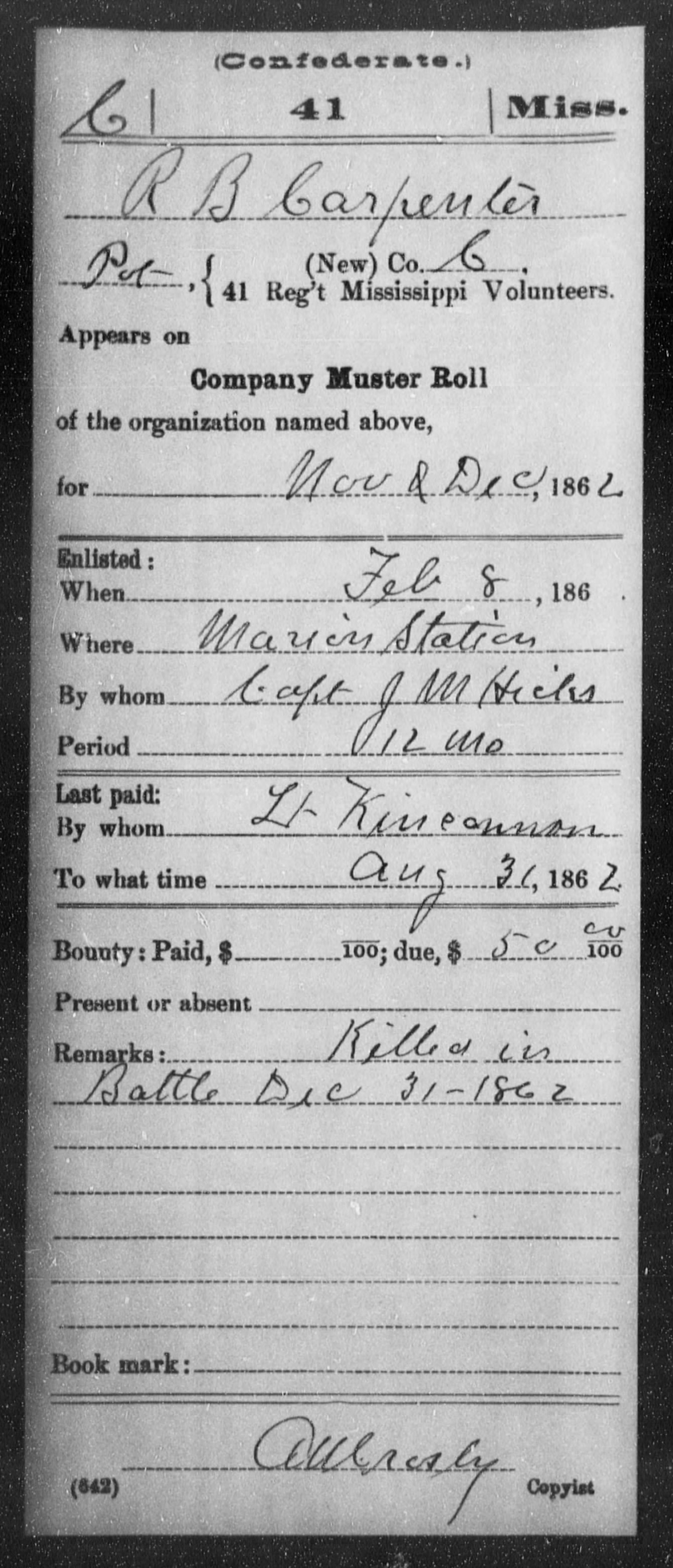
When the Civil War began, Rice signed up for the 41st Mississippi Infantry, Company C on February 8, 1862. This must have been a frightening time for the family, as Mary Ann was eight months pregnant with their last child who was born March 12th, 1862.

dec 2012 388

At dawn on December 31, 1862, amid limestone boulders and cedar forest, his infantry attacked the Union soldiers at the Battle of Stones River in Murfreesboro, Tennessee.

port-hudson

Private Rice Benjamin Carpenter died on that day on the battlefield at the age of 34, leaving behind his wife and children.

Page 5

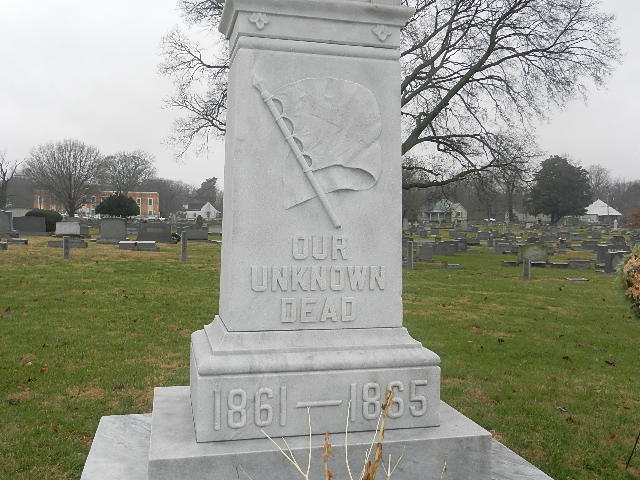
He is laid to rest at Confederate Circle, Evergreen Cemetery, Murfreesboro, Tennessee. RIP 3rd great grandpa. Rest well soldier, your job is done.

dec 2012 407

A portion of his story is told in my book, “Okatibbee Creek.” Available at Amazon.

okatibbee_cover front

Wednesday Writer’s Corner – Aug 7, 2013

In honor of my coming October book release of “Elly Hays,” today’s Writer’s Corner will be about the book’s heroine, Elizabeth Hays Rodgers, and how she came to be the center of a novel.

She was the only daughter of Samuel Hays and Elizabeth Priscilla Crawford, born in North Carolina in 1774. She spent her young childhood in the unrest of the Revolutionary War. She married when she was sixteen, and after twenty-one years of marriage and eleven children, her husband decided to uproot the family from Tennessee and start a new life in the Mississippi Territory. Considering what they were walking into, I had to write her story. A portion of it is below. It will help you understand that area of the country at that time in history.

The (unedited) Prologue

In 1811, America was on the verge of war. The victory in the Revolutionary War gave Americans their independence, but the newly formed country had many unresolved issues. Americans had a vast frontier to settle and they considered the land now known as Canada to be part of their land. They wanted to expand northward and westward, but the British joined forces with the Native Indians in an attempt to prevent the Americans from expanding in either direction.

The British had also begun restricting America’s trade with France and the mighty Royal Navy ruled the seas. The Royal Navy had more than tripled in size due to their war with France, and they needed sailors. They captured American merchant ships off the coast of America and forced the men with British accents to join the ranks of the Royal Navy, proclaiming they were not American, but indeed British. Kidnappings and power struggles in shipping ports like New Orleans loomed over the newly formed United States.

The British not only invaded the southern coastal cities of the United States, but also the eastern seaboard, attacking Baltimore and New York, and burning Washington D.C. to the ground. The War of 1812 is historically referred to as the second war for independence. It was the battle for boundaries and identity for the Americans.

Sadly, the Native American Indians had the most to lose in the power struggle. Shawnee warrior Tecumseh was but a child when he witnessed his father brutally murdered by a white frontiersman. His family moved from village to village and witnessed each destroyed at the hands of the white men during and after the American Revolution. As a young teen, following the Revolution, he formed a band of warriors who attempted to block the expansion of the white man into their territory, but the effort saw no lasting result. Conflict with the white man was a battle he had fought all his life, and as a warrior now in his early forties, he knew the stakes were high for the Indians in the coming battle. He traveled the southeast, coaxing the numerous Indian nations to unite against the white man, promising help from the British in the form of weapons and ammunition, and offering reinstatement of the Indian’s lost lands upon victory. Tecumseh’s prophet, who traveled with him into Creek territory, forecasted a victory, foreseeing no Creeks being wounded or killed in the battle.

In the Eastern Mississippi Territory, which later became the state of Alabama, the Creek Indians were divided. Many Creek villages had been trading with the white man for years and participated in civilization programs offered by the United States government. These Creeks had been taught the ways of the white man. They spoke English, could read and write, and even incorporated white man’s tools into their daily lives. They traded or were given gifts of plows, looms, and spinning wheels, and had no qualms with the white man. Many had married whites, and they did not want to join in the fight.

In opposition, many villages joined with Tecumseh, for they wanted to maintain their way of life, claiming the white man’s ways would destroy their culture. They had witnessed the white man encroaching on their lands, destroying their forests and villages, and polluting their streams. And probably, some suspected the white man’s intent was not co-existence but domination, for they had seen this come to fruition in the treatment of the black slaves.

In 1811 and 1812, tribal tensions were growing due to these differences in beliefs, and this caused a great war in the Creek nation called The Red Stick War. It was a civil war fought between the Creek people, but by 1813, it expanded to include the American frontiersmen and the U.S. government. At the height of the War of 1812, the Creeks were at war with nearly everyone, including their own people.

It was in this turmoil that a white farming family moved from their home in Tennessee to the fertile farmlands of the eastern Mississippi Territory, a place known today as Clarke County, Alabama. James Rodgers, his wife Elly, and their eleven children unknowingly entered a hornet’s nest.

If you have read the first book in the Okatibbee Creek series, “Okatibbee Creek,” you will be familiar with its heroine, Mary Ann Rodgers. “Elly Hays” is about Mary Ann’s paternal grandmother, Elizabeth Hays Rodgers, better known as Elly. If you have not read any of the Okatibbee Creek series, they are a collection of stories about one family and the strong women of our past. These are the real-life stories of my grandmothers, aunts, and cousins, but if you live in the U. S., they could also be the stories of your female ancestors – the women who fought for us, for our safety, our lives, and our freedom, and who sacrificed everything with the depth of their love and their astounding bravery.

Elly Hays will be release October 2013 in paperback, Kindle, and Nook.

elly cover_web

Wednesday Writer’s Corner – Book Release Day Ugh

You know what’s really strange? The feeling you get on release day.

One would think that after the effort and confusion of toiling over a story line, endless months of rewrites and revisions, editing, doubting everything including your writing abilities, correcting, changing, seeing all the red marks on the editor’s copy, more revisions, and tons and tons or proofreading, that one would feel a huge sense of accomplishment and anticipation. If nothing else, just a sense of satisfaction or relief that the project is finished.

But no…

I always feel like I just sent my kindergartner off to her first day of class without her lunch. I know she’s going to get on the wrong bus, the teacher won’t like her, and she’ll be picked on by the other kids.

It’s not a good feeling.

That being said…here’s my new release. Sigh. Pout. Whine. Fingers crossed.

Stuckey's cover_web

Also, today I’m leaving the country until August 1st – not because of the book – I actually have a job and am going to work. So, Stuckey, play nice with the other kids until I get home. I hope to see a good report card when I return.

“The Legend of Stuckey’s Bridge” is available in paperback and Kindle at Amazon HERE.

Here’s the video trailer:

“The Legend of Stuckey’s Bridge”

My new book “The Legend of Stuckey’s Bridge” is due to be released June 21, 2013. It will be available in paperback, Kindle, and Nook at Amazon, Barnes & Noble, and other online retailers. Here’s the hot-off-the-presses video trailer which will give you a shiver up your spine.

Stuckey's cover_webIn 1901, the Virginia Bridge & Iron Company began re-building a fifty-year-old Mississippi bridge. In the middle of the project, they began discovering bodies buried on the banks of the river.

Legend has it, he was so evil, he was even thrown out of the notorious Dalton Gang. Years later, he opened an inn near the river, and on foggy nights, boatmen witnessed him pacing back and forth across the bridge, waving his lantern, offering travelers a hot meal and a soft bed.

Those unfortunate enough to take him up on the hospitality were often never seen again.

To this day, eerie experiences are still reported around the bridge that now bears his name. If you travel down to Stuckey’s Bridge, be careful, for not much else is known about the man locals refer to as Old Man Stuckey…until now.