Wednesday Writer’s Corner – Concept to Self-Published

Wednesday Writer’s Corner

Want to self-publish? Here’s how to write a novel and publish it.

Concept – You need a story—a beginning, a middle, an end. By beginning I don’t mean, “She was born on a stormy night in a small hamlet in Germany.” Yeah, we were all born. I hope you have something better than that. By beginning I mean, set up your story/problem/drama in the first fifty pages. Get my interest.
3529127156_a2cdd0bab3_z

Outline – Amateur writers LOVE to skip this step. They like to give the story the freedom to wander where it wants. Their finished product always ends up reading exactly like that—a jumbled mess of confusion. Draw a definitive line in the sand. Write an outline. Who are your characters? Full names. Ages. Physical features. Personality. Vocation. What town do they live in? In what year? How does the story start? What are the key elements you need to include to make the ending make sense? Even if you never mention the heroine’s middle name in the book, at least you have a solid concept of who she is before you even start writing. Write a mock Table of Contents and a sentence or two describing what will happen in each chapter. Of course you can and will change it as your story develops. I always end up adding chapters when I realize I can’t get there from here, but at least I’m not starting with a jumbled mess and ending with worse.

Rough Draft – Some writers like to add the five senses and character development as they go. That makes for a long time to finish the rough draft. Whatever works for you is fine. Personally, I don’t have that kind of patience. I like to get the story down on paper—beginning to end. I go back later and add all the details.

tumblr_m7c909flJ91qiohmio1_500

Rewrite – No matter how complete your rough draft is, your story will change as you write, so you have to go back to the beginning and adjust the details. Did attitudes change? Did ages change? Does it make more sense to have her hair blowing in the tornado-like wind during the dramatic climax, or does the happy, sunny day still work? 

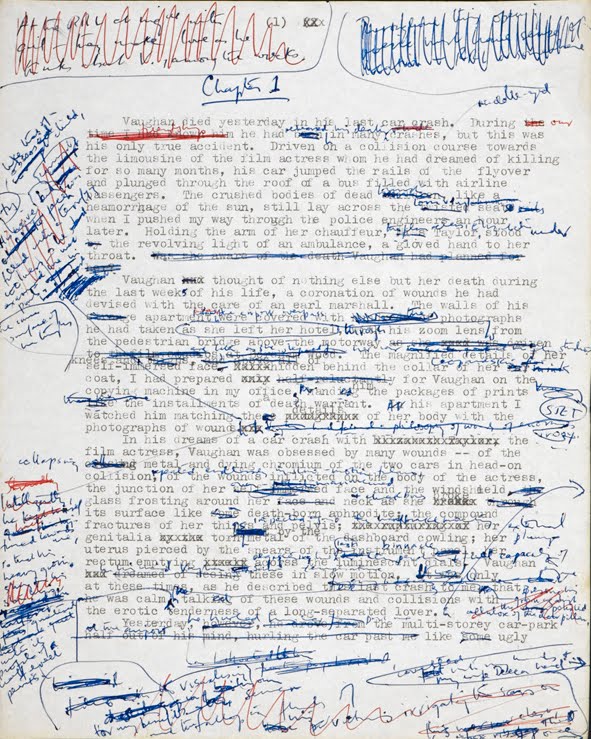
Revisions – Use this time to make sure the scenes and characters match the movie playing in your head. Little things like ‘he yelled,’ ‘he bellowed,’ or ‘he barked,’ make all the difference. Did spittle fly from his mouth? Was his forehead wrinkled? Revise, revise, and revise some more.
jgballard_crash_originalmanuscript

Beta readers – Find a couple friends/writers/teachers to read your story. You don’t want to know about grammar and typos, only about the story line. If they have questions about why or how something happened, then your story is wrong. Period. Anything that pulls the reader out of the moment is wrong. Ask them to write down any place they got lost or anything they did not understand. Give them a time frame for completion. Tell them you need their feedback within two weeks.  (I know it’s hard to allow people to read unfinished work, but this is a necessary step.)

More Revisions – If your reader got lost at any point, fix it. You did not relate the story well enough at that point. If your reader gives you advice on anything, look at it with a critical eye. They may be right or wrong. If they thought something specific about the story, so will hundreds of other people. You don’t necessarily have to jump on every suggestion. You may like the way the main character got lost in Chapter 6. At least you can make a conscious decision about it, so when someone gives you 1-star review because your character got lost in Chapter 6, you can hold your head up high, knowing you made the decision for a specific reason. You wanted to leave her lost in Chapter 6–on purpose. It’s a lot easier to shrug off a bad review over a decision you made than to cry over a bad review about your storytelling abilities.

Chapter6

Editor – DON’T SKIP THIS STEP. Get a professional editor, and know in your heart she is going to make you change Chapter 6. Her red pen is your friend. It’s hard to see her comments, but it’s harder to face 1-star reviews. And, yes, you can afford her. Financial example: If you make a profit of $2 per book and your editor charges you $800, you will need to sell 400 books to break even. If your book is good (and you have a strong author platform – discussed below), you will achieve that within a short amount of time. Then for the rest of your life, you have the potential to sell a good book to a lot of people. If you don’t get a professional editor, you will NEVER sell 400 books to anyone. The first and only review will be a 1-star complaining that you should have hired an editor. Now, you’re dead in the water. Editors are worth their weight in gold. Pay them. Listen to them. They know what they are doing. Stephen King has an editor. You should too!

Proofread – Now you have a finished manuscript with a good story line and solid grammar and sentence structure. Proof it!! If your editor is a fabulous professional, you will not find many typos in your edited manuscript. It’s tough to proof yourself, because you will be tired of working on the story at this point, but even if you have someone else do it, you still have to go through it one more time—for your own sanity. It’s your name on the finished product.

Self-Publishing – There are a few things you need to do to self-publish:

1) Build an author platform – What is an author platform? Basically, it’s a number. It’s the number of people you can reach today to tell them about your new book. Goodreads, Facebook, Pinterest, Twitter, blog, LinkedIn, website, etc. Find the ones you’re comfortable with and use them. Don’t say, “Hey, buy my book.” Nobody cares about your book, they only care about you. If you only try to sell something, your audience will turn you off instantly. Talk about your genre, your characters, your expertise, your love of dogs. Write about your writing/researching/publishing experience/anything else to connect. If you were on Stephen King’s webpage and everyday he posted a link to his book on Amazon, you wouldn’t go to his page anymore. You want to TALK to him. People want to TALK to you.

2) Learn how to format—KDP, Smashwordspaperback, and others have different formats. It’s not hard to learn. If you can work Microsoft Word even a little bit, you can go to the above sites and find step-by-step tutorials. It will take you a few hours, a pot of coffee, and a lot of patience to learn it, but once you’ve mastered it, you can format a book for all of the above in less than an hour.

3) Create a great cover and title—A majority of your work will be sold through online outlets, and some pretty covers don’t necessarily transfer to those little thumbnail-sized pictures. If you are not graphic design/Photoshop savvy, hire someone. Choose a title with five words or less. Google your title ideas before you choose one. “Gone with the Wind” is probably not a good title. Run ideas through the search box on Amazon. Make sure there aren’t ten other books with the same name. If people can’t find your book, they can’t buy your book. Look through other covers in your genre. What do they all have in common? Look through the best sellers. Anything sticking out to you? Do that! Make your cover tell the story–with a clear font. A pretty font is not your friend. If you have not been professionally trained to create designs, hire someone. Your cover is your first impression. An amateur cover means an amateur book to buyers.

4) Read everything possible about self-publishing. There are books and blogs out there on formatting, marketing, covers, blurbs. (Blurb hint: Write two or three paragraphs in past tense on what your book is about. Now delete all the adjectives. There! Good blurb. Don’t bore me with flowery bullshit, just tell me what the book is about.) Read everything you can about how to market yourself and your book. You can have the best book in the whole world, but if no one knows it’s out there, no one will buy it. Nobody cares about your book more than you do, so YOU have to do the marketing. If you’re not willing to do the work, then take up painting or something.

Now, go finish writing your book.

Lori Crane is the self-published, bestselling, award-winning author of the Okatibbee Creek Series, the Stuckey’s Bridge Trilogy, and the Culpepper Saga. 

Saturday Snippet – May 4, 2013

Here’s a snippet from my AWARD-WINNING book “Okatibbee Creek.” Haha. Yes, award winning! It was recently named the bronze medal winner in the 2013 eLit Book Awards in Literary Fiction. That’s funny, because I’m sure it was entered as Historical Fiction, but whatev. An award is an award. We take ’em any way we can get ’em! 😛

~~~~~~~~~~~~~~~~~~~~~~~~~~~~~~~~~~~~~~~~~~~~~~~~

Set up – January 1863 Mississippi. The Civil War is in full swing. Mary Ann Carpenter owns an old general store in town where the war’s casualty lists are periodically posted. Four of her brothers and her husband, Rice, are off fighting in the war, and she has not heard from any of them in a while and is understandably worried.

~~~~~~~~~~~~~~~~~~~~~~~~~~~~~~~~~~~~~~~~~~~~~~~~

Martha Jane yells up the stairs, “Mary, there’s a gentleman here. He says he has to see you.”

I return to my room to get my day cap. I smooth down my wrinkled dress and head downstairs.

When I reach the bottom of the stairs, I see him. I do not recognize his face, but I recognize his clothing. He is a Confederate soldier. He is standing in the open doorway of the store with the gray, cloudy sky at his back. He is dressed in a wrinkled gray uniform with a dirty yellow cummerbund. His trousers have holes in them, with mud caked around the bottoms of his pant legs. His jacket is missing some buttons, and he looks quite thin and weary. He is wearing shoes that are covered in red Mississippi mud and probably have no soles on the bottom. He is holding his tattered hat and a piece of paper in his dirty hands.

“Hello, sir, what can I do for you?” I ask as I approach.

“Hello, ma’am.” He nods. “Are you Mrs. Carpenter?”

“Yes, I am. And who are you, may I ask?”

“Private Joseph Brown, ma’am. Captain asked me to deliver the latest casualty list to you in person.” He holds the folded piece of paper toward me and looks down at the floor, like a child in trouble for doing something wrong.

“Why are you delivering this? It usually comes by a mail carrier,” I ask as I reach for the paper. I look at the boy’s face. He nervously avoids my eyes and keeps staring at the floor.

“Why are you delivering this to me?” I repeat.

“I promised I would. I’m sorry, ma’am. Goodbye, ma’am,” he murmurs, and backs out the open door.

I look at the piece of paper in my hand for a long time, wondering if I can open it. I don’t know whose names are on this paper, but I suspect the worst, and I don’t want to read it. My eyes sting with tears as I dread a simple piece of paper. I try to unfold it, but my hands are shaking, so I stop and hold it to my chest. I take a deep breath.

Martha Jane stands behind me, not saying a word or making a sound.

“Martha Jane, will you please go upstairs and mind the children for a few minutes?” I ask her.

She nods and quietly heads up the stairs.

I walk outside across the wooden porch and down the two stone steps onto the ground. I walk across the dirt road that is now filled with puddles of red mud from the rain. I keep walking straight ahead. I walk into the overgrown field across the road. I walk with purpose, with determination, like I have somewhere important to go. I want to run. I want to run away and never come back. I keep walking.

In the middle of the field, the thunder sounds above my head. I stop and look up at the ominous clouds that are almost as threatening as the piece of paper I hold in my hand. My hands are shaking as I slowly unfold it and smooth it open. My stomach feels like it has a hole in it. My eyes fill with tears. My hands are now trembling so violently, I almost can’t read it. The name at the top is the only name I see.

“Carpenter, Rice Benjamin: killed in battle 31 December, 41st Mississippi Infantry, Co C.”

Drops of water fall onto the page, but I can’t tell if they are raindrops or teardrops. Even God Himself is crying.

All I’ve wanted the last seven months is for my husband to come home and hold me and tell me everything will be all right. All I’ve done for the last seven months is managed the store and the family, and I’ve waited—waited for Rice to come home. I’ve waited and I’ve prayed and I’ve done everything possible in preparation for him to come home to me.

I’ve dreamed of his homecoming. I’ve dreamed of taking up our lives where we left off. I’ve imagined us having more children. I’ve wished for his arms around me. I’ve seen his blue eyes in my dreams so often and heard his laughter ringing in my head over and over. I’ve pictured his beautiful Carpenter smile as he runs up the road and takes me in his arms. My heart always feels like bursting at the thought of seeing him again. I’ve imagined our happy reunion hundreds of times.

Now what?

There will be no homecoming. There will be no funeral. There will be no body. There will be no goodbye. It’s just over. My heart is ripping out of my chest in a pain I can’t even try to describe. My future is gone. My past is gone. My present is gone. Everything is gone. It all died with Rice.

I stand in the middle of the field in a blinding thunderstorm, holding a wet piece of paper that is all that is left of my husband, and I scream at the top of my lungs.

~~~~~~~~~~~~~~~~~~~~~~~~~~~~~~~~~~~~~~~~~~~~~~~

okatibbee_cover front

“Okatibbee Creek” is available in Kindle and paperback at Amazon, and Nook and paperback at Barnes & Noble.  Also in ebook at Sony and Kobo.

Lunch and Literature in 1812

Tomorrow I’m having lunch at the Sawyer House.

800px-SawyerHouse4

The property is located in Monroe, Michigan. There have been two homes built on the property. The original house was built by Francois Navarre on land given to him by the Potawatomi Tribe. The house is named after one of its residents, Dr. Alfred Sawyer, who lived there from 1859-1870. The original house was demolished and a new one built in 1873. Dr. Sawyer never lived in the current house, but it remained in his family until his daughter donated it to the city of Monroe in 1973.

Following lunch, my ladies from the United States Daughters of 1812 are having a bench dedication at the River Raisin National Battlefield, commemorating the bicentennial of the War of 1812.

small logo

My 1812 soldier is Hays Rodgers.

While I was writing this little blurb, my phone rang and a lady told me my book “Okatibbee Creek” won the bronze medal in Literary Fiction at the 2012 eLit Book Awards. Check the book out on Amazon. The book is about Hays Rodgers’s daughter. “Wow, that’s a weird coincidence,” said the award-winning author. 🙂

okatibbee_cover front

A to Z Challenge – H is for Hays

Blogging from A to Z April 2013 Challenge

H is for Hays

I write a lot about my Rodgers ancestors, but playing just as an important role in the fact that I am sitting here are my Hays ancestors.

My fifth great grandma was Elizabeth “Elly” Hays. She was born just before the start of the Revolutionary War either in Tennessee or North Carolina to Samuel Hays and Elizabeth Pricilla Brawford. Records say North Carolina, but her father was born and died in Davison County, Tennessee, so NC seems strange. Her little brother, Charles, was also born in NC, so it is possible the family lived there for a while. And her paternal grandfather died in NC, so the family definitely had a connection there. I haven’t researched her thoroughly (yet), but it looks like she was the only girl with at least four brothers.

Elly was sixteen when she married James Rodgers in Tennessee on 20 Dec 1790. She birthed twelve children. In 1811, the family packed up and moved to the eastern Mississippi Territory – a place called Alabama, which wouldn’t become a state for a few more years. You know how difficult it is going on a road trip with little kids in the car? Imagine being on a wagon for days with a dozen of the little rug rats and not a McDonalds in sight.

Map06-17

ban-mcdonalds

This was a time in history when the U. S. was flexing its political muscle and tensions were escalating, leading up to the War of 1812. And little did the Rodgers family know, they were moving into Creek territory. Not only were the Creek Indians fighting the U.S. Government, they had also broken into two sanctions and were fighting amongst themselves. The Rodgers family moved into the middle of a rat’s nest. They were harassed for years by the marauding Indians, taunting them and stealing their livestock, and the final straw, burning down their home.

In 1815, her two eldest sons, Hays (named after momma’s family) and Absolom, joined the Mississippi Militia to help fight off the hostile Creek Indians, and following the boy’s discharges in 1818, the family moved west to Lauderdale County, Mississippi.

Her husband died in Mississippi eight years later, and she moved back to Clarke County, Alabama and probably lived with her daughter Elizabeth. She died in Alabama in 1839 at the age of 65.

Elizabeth Hays Rodgers is the heroine of my coming book “Elly Hays” which is the third book in the Okatibbee Creek Series. It will be released Winter 2013.

A to Z Challenge – G is for Ghost Stories

Blogging from A to Z April 2013 Challenge

G is for Ghost Stories 

I am delighted and overjoyed to announce the best collaboration in the history of publishing—well, in my little world anyway.

I am currently finishing a ghost story/Mississippi legend called “The Legend of Stuckey’s Bridge” and the foreword will be penned by none other than Mr. Ghost Story himself, Pat Fitzhugh, the author of “Ghostly Cries from Dixie” and “The Bell Witch: The Full Account.” I have been a long-time admirer of Mr. Fitzhugh and his ghost stories and am excited to share this story with you through his eyes as well as mine.

In his words, “Lori and I share a passion for Southern history and legends, and our works complement each other nicely. Lori writes about the people, places, and events that made history. I write about the spiritual residue they left behind. Our collaboration comes naturally.”

~ or supernaturally ~ hehe.

Click on the links above to visit Stuckey’s facebook page and like it to stay up to date, and to visit Mr. Fitzhugh’s blog and book pages. Tell him Stuckey sent you.

Stuckey's cover_web“The Legend of Stuckey’s Bridge” coming June 2013 to Amazon.

A to Z Challenge – F is for Formatting

Blogging from A to Z April 2013 Challenge

F is for Formatting 

In the publishing world – formatting is the Devil.

The following is a story of aggravation, so my indie author friends can point and laugh.

When I self-published “Okatibbee Creek,” I knew I would need someone to format it for me. There were two reasons. A) It had a lot of photographs and documents that needed to be included. B) I didn’t know squat about formatting. So, I paid a reputable (insert shitty) company to do the grunt work. I was told it was a six-week process, beginning with a mock-up, followed by a full format, followed by a paperback proof, followed by the finished product. The six weeks included the week-long time to incorporate any changes I would make at each stage of the process.

I requested a few specific things upfront: 1) I wanted the chapter titles to be the same font as the cover, 2) I wanted drop caps at the beginning of each chapter, 3) I wanted fleurons (the little fancy squiggles separating times or at the end of a chapter), and 4) there were letters included in the story, so I wanted those indented and a different font, perhaps something in the neighborhood of handwriting.

The first week became twelve days, and the mock up contained ZERO items on my above wish list.

Back to the drawing board.

The revisions (insert starting over from scratch) were supposed to take a week, and ended up taking another ten days, but the mock up came back perfect, except I didn’t get a sample of the indented, handwriting font for the letters, nor did I see one fleuron. Oh, well, take what you get at this point. We’re now well into November and I’d like to get this book out before the holidays.

The completed full format, supposedly a 10-day process, took another couple weeks, and it looked good…until the last 50 pages. Photos were in the wrong places with the wrong captions, single lines were left lonely at the bottom of a page when they obviously should have been at the top of the next page. One page actually had a paragraph in a totally unrelated font in a strange size just looming there for no reason at all. Apparently the formatter grew tired after lunch, or got into a fight with her boyfriend, or needed a Pepsi, or was anxious to get out the door and go on her Thanksgiving break.

I emailed the corrections – which would take another week (but probably more because of Thanksgiving).

After two weeks, I called them because I hadn’t heard back. Apparently, someone over there didn’t click the right button, and my file was hanging in limbo with no one working on it. They were sorry. How nice.

After another week, I received a paperback copy in the mail. It only needed two or three minor changes. Would they let me request those over the phone or by email and call it good? No. They needed me to download the full format, make the changes on the document, email it back to them, and they would incorporate the changes, and send me yet another paperback copy. Another ten days of waiting.

Finally, after ten weeks, it was finished. Of course it would take another week or so for it to appear on any of the online retailer’s sites. Being too late for holiday sales, I guess it didn’t really matter at this point. Sigh.

I received an email from them a month later asking me to fill out a survey about their services. Well, you can imagine what I wrote. Actually, I was very nice (insert a little bitchy) and told them specifically where things had fallen apart.

Here’s the rub. I got an email back, telling me I was WRONG. It explained that they were well within the six-week time frame they initially told me. They said I uploaded my manuscript on Oct 12, 2012, and they published the finished product on Dec 21, 2012. I don’t know how they figure that was six weeks. They must be using that Mayan calendar.

The moral of the story: I’ve spent the last three months learning how to format for paperback, Kindle, and Smashwords. I finished the formatting for my next book for all mediums in five days. 🙂

Book Giveaway

April 4, 1853 

She was born in Lauderdale County, Mississippi to James Rodgers and Martha Sanderford Rodgers. She had a five-year-old brother and a two-year-old sister, and two more children would follow her. She grew up in a farming community, surrounded by loving grandparents and more than a dozen aunts and uncles, along with their respective spouses and children. Her father and a slave named Bill built the log home she grew up in. Her childhood was ideal.

In 1861, Mississippi seceded from the Union and Civil War broke out. Though she had many uncles go off to fight in the war, her brothers were too young and her father was too old, so they remained safely at home with her.

In the fall of the following year, a typhoid epidemic invaded her community, killing her grandparents, many aunts, uncles, and cousins, and her parents. Her father died October 12, 1862. Her mother died a few short weeks later.

She was nine.

Her given name was Martha Ellen Rodgers, but she was simply known as Ellen.

“An Orphan’s Heart” is her story.

Happy birthday, Ellen! We honor and remember you on this day, 160 years after your birth.

In honor of Ellen Rodgers’s birthday and the May 1st release of “An Orphan’s Heart,” I am hosting a giveaway. One randomly selected person from all the people who LIKE “An Orphan’s Heart” facebook fan page will be chosen on May 1st to receive signed paperback copies of BOTH “An Orphan’s Heart” and “Okatibbee Creek.” Spread the word to your friends. All they have to do is LIKE the page. No purchase necessary. One winner will be chosen. Winner will be notified on or about May 1st. Prizes will be shipped on or about June 1st. Click here to visit “An Orphan’s Heart” facebook fan page. 

AOH%20cover_webokatibbee_cover front

“An Orphan’s Heart” new video trailer

My new book, “An Orphan’s Heart,” is currently at the editor, who is going to perform a modern-day miracle and turn my rough edges into a diamond.

I ♥ My Editor!!!

When I get the manuscript back, I will proof, proof, proof, format, format, format, then I will proof some more and finally, format again. Then we’ll call it done. It will be available around May 1, 2013 in Kindle, Nook, Smashwords, and other eBook formats. The paperback will follow within a few weeks at Amazon, Barnes & Noble, and Create Space.

Somewhere on page 154, you’ll undoubtedly find a typo. Somewhere around page 97, you’ll wonder if the timeline is going where the author meant for it to go. That’s the way of the writing world. No matter how careful you are, you will miss something. No matter how much you love it right now, you will look back in a few years and wonder how you had the bravery to release that piece of crap into the world and the audacity to call yourself a writer. But, that’s how you know you are improving. You can look back on everything you’ve ever done and know you would do it better if you had a second chance. Too bad. One chance is all you get.

That being said, here’s the new video trailer for my fabulous, tear-jerking new novel,

“An Orphan’s Heart.”

It is the second book in the Okatibbee Creek series. If you read the first story,

“Okatibbee Creek,”

and shed a few tears, I am warning you now, you’ll need a whole box of tissue for this one.

“The Legend of Stuckey’s Bridge” Sneak Peek

Anyone want a sneak peak of “The Legend of Stuckey’s Bridge?” Okay, hold your pants on. Here’s the commercial first: “The Legend of Stuckey’s Bridge” by Lori Crane will be available Fall 2013 at Amazon, Barnes & Noble, and other online retailers.

Okay, then. I’m working on a new book based on historical fiction and Mississippi legend. Since the ghost of Old Man Stuckey has apparently taken over my computer and seems to have written the opening chapter all by himself, here it is. It is not revised or edited, but it is too fun not to share. 😉 Enjoy!

1925

Bobby saw his little brother yank up on his fishing pole. “Did you catch somethin’?”

Billy frowned as he watched the tip of his pole arc and the line grow taut. “Naw, I think I’m just snagged,” he grumbled.

“Oh, I though you got a catfish.”

“I wish. I think I’m just stuck on somethin’.” He lifted his pole again, reeling in an inch or two of the line.

“Maybe you caught one of Old Man Stuckey’s boots.”

“Don’t even say that, Bobby. It gives me the creeps.”

The warm afternoon sun quickly disappeared behind ominous dark clouds and the wind rustled the tops of the trees.

Bobby looked up. “It’s gonna rain. You better get that line in so we can go.”

Billy looked up. A gust of wind caught the front wisp of his brown hair and gave him a chill.

“You know he’s still here,” Bobby snickered.

“Who?”

“Old Man Stuckey.”

“Yeah, I know, but I’d rather not think about it. Besides, I’m a little busy at the moment.” Billy wrinkled his forehead as he tugged on the line again, ever so slowly bringing it closer.

Bobby yelled into the air. “Old Man Stuckey! Jump in there and unhook that line.” Bobby giggled.

Billy didn’t think it was funny and gave his brother a nasty look. “Don’t call him,” he whispered as if someone might hear him, even though he knew there wasn’t a soul within miles of them.

Bobby rose from his seat on the bank, leaving his line dangling in the murky water. “Here, let me help you.” He walked in front of Billy and reached out over the river, trying to grab the clear fishing line.

Billy lifted the pole into the air a third time, bending the tip. “Whatever it is, it’s coming, Bobby. It’s just slow.”

“Maybe it’s the rope they hung him with.” Bobby giggled.

Billy didn’t.

The sunny afternoon transformed itself into an eerie dusk that one usually witnesses just before nightfall, and the clouds were rolling in fast—gloomy, thick, menacing clouds. The breeze rustled Billy’s hair again, making him shiver.

To the right of the boys stood Stuckey’s Bridge —a seventy year old bridge, one hundred twelve feet long, with a plank bottom and iron rails and bars across the top. Some people fished from the top of the bridge, but Billy refused to step onto it. Bobby teased him incessantly about his fear of Old Man Stuckey’s ghost, but Billy accepted the teasing and firmly stayed on the bank. The only reason he came out here at all was to catch the big catfish, and they lived under the bridge. As far as he knew, across the river stood nothing but trees and brush and the occasional woodland animal. He never dared to go across the bridge to see if there was more.

Bobby grabbed the line and took a step back, pulling it as he moved. “What the heck you got on here, Billy?”

Billy spun the reel, bringing in the line a foot or so. “I don’t know, probably just a branch or some leaves from the bottom.”

“Well, whatever it is, it’s heavy.” Bobby stepped forward to get another handful of the line.

A crow flew overhead, trying to maintain its airborne status in the strong gusts of wind. Billy looked up for a moment, thinking the crow to be a bad omen. His hand began to sweat on the cork handle of his fishing pole. He decided at that very moment it was time to go, and they both needed to bring their lines in quickly. “Bobby, I got it from here. You should pull in your line so we can get goin’. Looks like a big storm comin’.”

Bobby looked up at the sky. “Yeah, okay.” He let go of Billy’s line and walked back over to his fishing spot. A quick movement on the other side of the river caught his eye. “What was that?”

“What was what?” said Billy, still concentrating on his line.

“Over there.” Bobby pointed to the left across the river. “I saw somethin’ in the trees.”

Billy looked over but didn’t see anything. “Probably just a possum or somethin’.” Then Billy heard something in the brush. He froze.

Bobby heard it too. “I told you I saw somethin’. Maybe a bobcat?”

Thunder sounded above the boy’s heads as loud as cannon fire and made them both jump. Bobby grabbed his pole and frantically reeled in the line. It was quickly growing darker and the wind was increasingly stronger. He knew they would get soaked long before they got home. He watched impatiently as Billy pulled and tugged at the line.

“It’s almost free,” Billy assured him. “It’s comin’ faster.”

Bobby nervously looked at the other side of the river. Something caught the corner of his eye a little to the right. “Dang! There’s somethin’ over there all right.”

Billy anxiously glanced across the river, but with the dimming light, he couldn’t see anything even if it was there. He pulled his line harder. A twig snapped across the river. Both boys darted their heads in the direction but saw nothing but darkening woods.

“Maybe it’s him!” Bobby said.

“Stop it! Don’t be stupid, Bobby.”

Billy slowly but deliberately reeled in the line. He pointed the tip of his pole toward the water to keep it from snapping at the weight of the mystery catch, and he kept turning the handle. A drop of rain fell on his forehead and mingled with the nervous sweat on his brow and gave him another shiver.

“Hurry up, Billy. We got to go.”

“I am hurrying. I don’t want to break my line.”

A loud crow sounded from across the river and shot straight up above the tree line as fast as an arrow released from a bow. Both boys looked that way, knowing something was in the woods, just out of sight. Another branch snapped.

“What the hell is that?” Bobby sounded nervous, staring into the near blackness on the other side.

Billy didn’t answer. He was absorbed in the blob he was pulling across the top of the murky water.

Bobby looked out at the greenish brownish blob. “You got nothin’ but leaves. Let’s go.”

Billy pulled the blob onto the edge of the bank and laid his pole on the ground. He moved toward the blob to dislodge his hook, but as he reached for it, he noticed something shiny. What is that? It’s shimmering. What the…?

Another branch snapped across the river.

“Come on, Billy. We got to go now.”

“Hold on,” Billy said as he grabbed a stick and poked into the blob, separating the leaves and muck.

Yes, there was something shiny. Something gold.

Thunder rumbled above their heads. A rustle sounded from across the river, making Bobby look in that direction again. Heavy, fat raindrops started to fall on their heads. It’s something gold. The crow cawed loudly. Another twig snapped. It’s a watch. Thunder roared again. On a gold chain. The wind was intensifying. It’s a pocket watch.

“What is that?” Bobby asked, just spotting the gold item.

“It’s a pocket watch.” Billy reached down and rubbed the mud off the front of the watch. He cocked his head to the side and read a single T embossed in the gold. Simultaneously, the thunder roared, the crow cawed, the rustle across the river grew louder. To their right, directly beneath the bridge, a giant splash scared both of the boys into standing straight up and looking toward the bridge. Right under the bridge, the water rippled as if something very, very large had just been dropped off the side. Thunder sounded again. The water rippled more. The boys froze. An inch above the water in the center of the ripple was an eerie green glow. The water rippled higher in its ever-growing circle as if the ocean tide was causing waves to come ashore. The boys didn’t look at each other. They did not communicate. They both turned at the same time and ran as fast as their feet would carry them. They did not take their fishing poles. They did not look back.

The thunder boomed and the raindrops splattered on the rocks, turning them from gray to brown. As the storm grew, the ripples inched up onto the bank and little by little pulled the gold pocket watch back into the murky depths.

Stuckey's cover_web

“The Legend of Stuckey’s Bridge” facebook fan page.

Update: Now available at Amazon, Barnes & Noble, iBooks.