A to Z Challenge – J is for James C Howington

Blogging from A to Z April 2013 Challenge

J is for James C Howington 

James was my 3rd great grandfather. He was born in Wake County, NC on 15 Jan 1823 to Nimrod Howington and Milbury Bradley.  He was the second born of thirteen children. He was 5′ 11″ and had auburn hair and gray/blue eyes.

At some point, he ended up in Sumter Co, AL and married Amelia “Ann” Smith on 24 Sept 1843. His son also married a Smith (my great great grandparents), and I heard through family members that she was a Choctaw Indian. The Indians were all but run out of MS and AL in the 1830s following the signing of the Treaty of Dancing Rabbit Creek. The ones who stayed changed their names to assimilate into the white European culture. They chose names like Smith, so there is a good chance Amelia was an Indian also.

By 1850, they had taken up residence in Newton Co, MS and had ten children before the start of the Civil War. James signed up with the 5th Mississippi Infantry, Co. A, on 7 July 1862. He was captured 15 Jun 1864 and held prisoner at Rock Island, Illinois. When the war ended, he returned home and they had two more children.

james c howington pow

His great grandparents (my 6th greats) were Robert and Mary Morris. I’ll let you look them up yourself, but it is proof we have been here in the U.S. for a very long time. Oh, all right, I know you won’t go look. He was one of the signers of the Declaration of Independence. You’ll go look now, won’t you? Yeah, that was my pappy. We seem to have a rebellious streak in our family.howington james c great grandparents robert and mary morris

James died around 1880 at the age of 57 and is buried in Pleasant Grove Missionary Baptist Church Cemetery, a few miles from his home.

howington James C Howington Headstone

A to Z Challenge – H is for Hays

Blogging from A to Z April 2013 Challenge

H is for Hays

I write a lot about my Rodgers ancestors, but playing just as an important role in the fact that I am sitting here are my Hays ancestors.

My fifth great grandma was Elizabeth “Elly” Hays. She was born just before the start of the Revolutionary War either in Tennessee or North Carolina to Samuel Hays and Elizabeth Pricilla Brawford. Records say North Carolina, but her father was born and died in Davison County, Tennessee, so NC seems strange. Her little brother, Charles, was also born in NC, so it is possible the family lived there for a while. And her paternal grandfather died in NC, so the family definitely had a connection there. I haven’t researched her thoroughly (yet), but it looks like she was the only girl with at least four brothers.

Elly was sixteen when she married James Rodgers in Tennessee on 20 Dec 1790. She birthed twelve children. In 1811, the family packed up and moved to the eastern Mississippi Territory – a place called Alabama, which wouldn’t become a state for a few more years. You know how difficult it is going on a road trip with little kids in the car? Imagine being on a wagon for days with a dozen of the little rug rats and not a McDonalds in sight.

Map06-17

ban-mcdonalds

This was a time in history when the U. S. was flexing its political muscle and tensions were escalating, leading up to the War of 1812. And little did the Rodgers family know, they were moving into Creek territory. Not only were the Creek Indians fighting the U.S. Government, they had also broken into two sanctions and were fighting amongst themselves. The Rodgers family moved into the middle of a rat’s nest. They were harassed for years by the marauding Indians, taunting them and stealing their livestock, and the final straw, burning down their home.

In 1815, her two eldest sons, Hays (named after momma’s family) and Absolom, joined the Mississippi Militia to help fight off the hostile Creek Indians, and following the boy’s discharges in 1818, the family moved west to Lauderdale County, Mississippi.

Her husband died in Mississippi eight years later, and she moved back to Clarke County, Alabama and probably lived with her daughter Elizabeth. She died in Alabama in 1839 at the age of 65.

Elizabeth Hays Rodgers is the heroine of my coming book “Elly Hays” which is the third book in the Okatibbee Creek Series. It will be released Winter 2013.

A to Z Challenge – G is for Ghost Stories

Blogging from A to Z April 2013 Challenge

G is for Ghost Stories 

I am delighted and overjoyed to announce the best collaboration in the history of publishing—well, in my little world anyway.

I am currently finishing a ghost story/Mississippi legend called “The Legend of Stuckey’s Bridge” and the foreword will be penned by none other than Mr. Ghost Story himself, Pat Fitzhugh, the author of “Ghostly Cries from Dixie” and “The Bell Witch: The Full Account.” I have been a long-time admirer of Mr. Fitzhugh and his ghost stories and am excited to share this story with you through his eyes as well as mine.

In his words, “Lori and I share a passion for Southern history and legends, and our works complement each other nicely. Lori writes about the people, places, and events that made history. I write about the spiritual residue they left behind. Our collaboration comes naturally.”

~ or supernaturally ~ hehe.

Click on the links above to visit Stuckey’s facebook page and like it to stay up to date, and to visit Mr. Fitzhugh’s blog and book pages. Tell him Stuckey sent you.

Stuckey's cover_web“The Legend of Stuckey’s Bridge” coming June 2013 to Amazon.

Book Giveaway

April 4, 1853 

She was born in Lauderdale County, Mississippi to James Rodgers and Martha Sanderford Rodgers. She had a five-year-old brother and a two-year-old sister, and two more children would follow her. She grew up in a farming community, surrounded by loving grandparents and more than a dozen aunts and uncles, along with their respective spouses and children. Her father and a slave named Bill built the log home she grew up in. Her childhood was ideal.

In 1861, Mississippi seceded from the Union and Civil War broke out. Though she had many uncles go off to fight in the war, her brothers were too young and her father was too old, so they remained safely at home with her.

In the fall of the following year, a typhoid epidemic invaded her community, killing her grandparents, many aunts, uncles, and cousins, and her parents. Her father died October 12, 1862. Her mother died a few short weeks later.

She was nine.

Her given name was Martha Ellen Rodgers, but she was simply known as Ellen.

“An Orphan’s Heart” is her story.

Happy birthday, Ellen! We honor and remember you on this day, 160 years after your birth.

In honor of Ellen Rodgers’s birthday and the May 1st release of “An Orphan’s Heart,” I am hosting a giveaway. One randomly selected person from all the people who LIKE “An Orphan’s Heart” facebook fan page will be chosen on May 1st to receive signed paperback copies of BOTH “An Orphan’s Heart” and “Okatibbee Creek.” Spread the word to your friends. All they have to do is LIKE the page. No purchase necessary. One winner will be chosen. Winner will be notified on or about May 1st. Prizes will be shipped on or about June 1st. Click here to visit “An Orphan’s Heart” facebook fan page. 

AOH%20cover_webokatibbee_cover front

“An Orphan’s Heart” new video trailer

My new book, “An Orphan’s Heart,” is currently at the editor, who is going to perform a modern-day miracle and turn my rough edges into a diamond.

I ♥ My Editor!!!

When I get the manuscript back, I will proof, proof, proof, format, format, format, then I will proof some more and finally, format again. Then we’ll call it done. It will be available around May 1, 2013 in Kindle, Nook, Smashwords, and other eBook formats. The paperback will follow within a few weeks at Amazon, Barnes & Noble, and Create Space.

Somewhere on page 154, you’ll undoubtedly find a typo. Somewhere around page 97, you’ll wonder if the timeline is going where the author meant for it to go. That’s the way of the writing world. No matter how careful you are, you will miss something. No matter how much you love it right now, you will look back in a few years and wonder how you had the bravery to release that piece of crap into the world and the audacity to call yourself a writer. But, that’s how you know you are improving. You can look back on everything you’ve ever done and know you would do it better if you had a second chance. Too bad. One chance is all you get.

That being said, here’s the new video trailer for my fabulous, tear-jerking new novel,

“An Orphan’s Heart.”

It is the second book in the Okatibbee Creek series. If you read the first story,

“Okatibbee Creek,”

and shed a few tears, I am warning you now, you’ll need a whole box of tissue for this one.

If you’re lucky enough to be Irish, you’re lucky enough

My great great grandfather, John Francis Burke. Born 27 Feb 1847 in Dublin, Ireland.

tumblr_m10cm7o9fx1rpv9aho1_400

Family stories say he stowed away alone on an America-bound ship when he was 15 years old. The captain found him en route and told him he could not be taken back. He told the captain, “If I wanted to go back, I wouldn’t have stowed away.” So, they dropped him off in Miami in 1862, in the middle of the Civil War.

There are a few John Burkes in Confederate military records and census records from 1862 to 1870, but I don’t know which one, if any, is him. There is one in particular in the 1870 census listed as a farmhand in Alabama that I am leaning toward, but I’m not sure.

The next record of him was his marriage in 1879 to Nancy Didama Spencer of Mississippi. He is shown living with her family in the 1880 census and is listed as a “ditcher.”

He and “Grandma Damie” had six children between 1880 to 1894. There are no other records of him. Strangely, Damie is listed as a widow in the 1900 census, though John Francis did not die until 1909. Family members tell me Damie did not believe in divorce, and Damie and John spent the last ten years of their marriage under the same roof, but not speaking. When Damie spoke to the census-taker, she said she was a widow. I don’t know what he did to make her so angry, but it must have been a doozey. This explains why they are not buried next to each other at the cemetery. I always wondered why they are in different rows.

burke JP Burke Sr headstone 2

On a side note: Grandma Damie was a doctor and rode around the community side-saddle taking care of the sick. My mother told me a story about a grandmother who was a “medicine woman” who knew every plant and tree and how it could be used to heal people. She told me it was my other grandmother who was a Choctaw Indian, but I believe she got the women confused, and she was speaking of Grandma Damie.

Family members told me John Francis left home because he was angry with his father. I don’t know who his parents were, but if I ever venture into Dublin, Ireland records, I should be able to find him because his children were named after his siblings. His children were John Patrick “Pat”, Robert Emmett “Bob”, George Washington (probably won’t find a sibling with that name, that was his father-in-law’s name), Nina Virginia, Kathlene L, and David Edmund.

I don’t know what kind of childhood my great grandfather, John Patrick “Pat” Burke, had as he died four years before I was born, but I do know he played fiddle every Saturday night at the community barn dances. A cousin has his fiddle and the family pump organ stored away. Being a professional musician, I would give anything to get my hands on those. I wonder where my great grandfather learned to play fiddle. It’s such an Irish thing to do, don’t you think? Perhaps his father taught him. Perhaps his father learned from his grandfather. Hmmm.

I’m not sure I will ever find my Irish ancestors, and I feel sorry for his mother, never knowing what happened to her rebellious fifteen-year-old son. John Francis Burke could have pulled that name out of the sky or it could have been Bourke or O’Byrne or something. Either way, here’s a toast to my grandfather, John Francis Burke. For without his braveness at the tender age of fifteen, I would not be here.

shamrocksHere’s to the land of the shamrock so green,

Here’s to each lad and his darling colleen,

Here’s to the ones we love dearest and most.

May God bless old Ireland, that’s this Irishman’s toast!

“The Legend of Stuckey’s Bridge” Sneak Peek

Anyone want a sneak peak of “The Legend of Stuckey’s Bridge?” Okay, hold your pants on. Here’s the commercial first: “The Legend of Stuckey’s Bridge” by Lori Crane will be available Fall 2013 at Amazon, Barnes & Noble, and other online retailers.

Okay, then. I’m working on a new book based on historical fiction and Mississippi legend. Since the ghost of Old Man Stuckey has apparently taken over my computer and seems to have written the opening chapter all by himself, here it is. It is not revised or edited, but it is too fun not to share. 😉 Enjoy!

1925

Bobby saw his little brother yank up on his fishing pole. “Did you catch somethin’?”

Billy frowned as he watched the tip of his pole arc and the line grow taut. “Naw, I think I’m just snagged,” he grumbled.

“Oh, I though you got a catfish.”

“I wish. I think I’m just stuck on somethin’.” He lifted his pole again, reeling in an inch or two of the line.

“Maybe you caught one of Old Man Stuckey’s boots.”

“Don’t even say that, Bobby. It gives me the creeps.”

The warm afternoon sun quickly disappeared behind ominous dark clouds and the wind rustled the tops of the trees.

Bobby looked up. “It’s gonna rain. You better get that line in so we can go.”

Billy looked up. A gust of wind caught the front wisp of his brown hair and gave him a chill.

“You know he’s still here,” Bobby snickered.

“Who?”

“Old Man Stuckey.”

“Yeah, I know, but I’d rather not think about it. Besides, I’m a little busy at the moment.” Billy wrinkled his forehead as he tugged on the line again, ever so slowly bringing it closer.

Bobby yelled into the air. “Old Man Stuckey! Jump in there and unhook that line.” Bobby giggled.

Billy didn’t think it was funny and gave his brother a nasty look. “Don’t call him,” he whispered as if someone might hear him, even though he knew there wasn’t a soul within miles of them.

Bobby rose from his seat on the bank, leaving his line dangling in the murky water. “Here, let me help you.” He walked in front of Billy and reached out over the river, trying to grab the clear fishing line.

Billy lifted the pole into the air a third time, bending the tip. “Whatever it is, it’s coming, Bobby. It’s just slow.”

“Maybe it’s the rope they hung him with.” Bobby giggled.

Billy didn’t.

The sunny afternoon transformed itself into an eerie dusk that one usually witnesses just before nightfall, and the clouds were rolling in fast—gloomy, thick, menacing clouds. The breeze rustled Billy’s hair again, making him shiver.

To the right of the boys stood Stuckey’s Bridge —a seventy year old bridge, one hundred twelve feet long, with a plank bottom and iron rails and bars across the top. Some people fished from the top of the bridge, but Billy refused to step onto it. Bobby teased him incessantly about his fear of Old Man Stuckey’s ghost, but Billy accepted the teasing and firmly stayed on the bank. The only reason he came out here at all was to catch the big catfish, and they lived under the bridge. As far as he knew, across the river stood nothing but trees and brush and the occasional woodland animal. He never dared to go across the bridge to see if there was more.

Bobby grabbed the line and took a step back, pulling it as he moved. “What the heck you got on here, Billy?”

Billy spun the reel, bringing in the line a foot or so. “I don’t know, probably just a branch or some leaves from the bottom.”

“Well, whatever it is, it’s heavy.” Bobby stepped forward to get another handful of the line.

A crow flew overhead, trying to maintain its airborne status in the strong gusts of wind. Billy looked up for a moment, thinking the crow to be a bad omen. His hand began to sweat on the cork handle of his fishing pole. He decided at that very moment it was time to go, and they both needed to bring their lines in quickly. “Bobby, I got it from here. You should pull in your line so we can get goin’. Looks like a big storm comin’.”

Bobby looked up at the sky. “Yeah, okay.” He let go of Billy’s line and walked back over to his fishing spot. A quick movement on the other side of the river caught his eye. “What was that?”

“What was what?” said Billy, still concentrating on his line.

“Over there.” Bobby pointed to the left across the river. “I saw somethin’ in the trees.”

Billy looked over but didn’t see anything. “Probably just a possum or somethin’.” Then Billy heard something in the brush. He froze.

Bobby heard it too. “I told you I saw somethin’. Maybe a bobcat?”

Thunder sounded above the boy’s heads as loud as cannon fire and made them both jump. Bobby grabbed his pole and frantically reeled in the line. It was quickly growing darker and the wind was increasingly stronger. He knew they would get soaked long before they got home. He watched impatiently as Billy pulled and tugged at the line.

“It’s almost free,” Billy assured him. “It’s comin’ faster.”

Bobby nervously looked at the other side of the river. Something caught the corner of his eye a little to the right. “Dang! There’s somethin’ over there all right.”

Billy anxiously glanced across the river, but with the dimming light, he couldn’t see anything even if it was there. He pulled his line harder. A twig snapped across the river. Both boys darted their heads in the direction but saw nothing but darkening woods.

“Maybe it’s him!” Bobby said.

“Stop it! Don’t be stupid, Bobby.”

Billy slowly but deliberately reeled in the line. He pointed the tip of his pole toward the water to keep it from snapping at the weight of the mystery catch, and he kept turning the handle. A drop of rain fell on his forehead and mingled with the nervous sweat on his brow and gave him another shiver.

“Hurry up, Billy. We got to go.”

“I am hurrying. I don’t want to break my line.”

A loud crow sounded from across the river and shot straight up above the tree line as fast as an arrow released from a bow. Both boys looked that way, knowing something was in the woods, just out of sight. Another branch snapped.

“What the hell is that?” Bobby sounded nervous, staring into the near blackness on the other side.

Billy didn’t answer. He was absorbed in the blob he was pulling across the top of the murky water.

Bobby looked out at the greenish brownish blob. “You got nothin’ but leaves. Let’s go.”

Billy pulled the blob onto the edge of the bank and laid his pole on the ground. He moved toward the blob to dislodge his hook, but as he reached for it, he noticed something shiny. What is that? It’s shimmering. What the…?

Another branch snapped across the river.

“Come on, Billy. We got to go now.”

“Hold on,” Billy said as he grabbed a stick and poked into the blob, separating the leaves and muck.

Yes, there was something shiny. Something gold.

Thunder rumbled above their heads. A rustle sounded from across the river, making Bobby look in that direction again. Heavy, fat raindrops started to fall on their heads. It’s something gold. The crow cawed loudly. Another twig snapped. It’s a watch. Thunder roared again. On a gold chain. The wind was intensifying. It’s a pocket watch.

“What is that?” Bobby asked, just spotting the gold item.

“It’s a pocket watch.” Billy reached down and rubbed the mud off the front of the watch. He cocked his head to the side and read a single T embossed in the gold. Simultaneously, the thunder roared, the crow cawed, the rustle across the river grew louder. To their right, directly beneath the bridge, a giant splash scared both of the boys into standing straight up and looking toward the bridge. Right under the bridge, the water rippled as if something very, very large had just been dropped off the side. Thunder sounded again. The water rippled more. The boys froze. An inch above the water in the center of the ripple was an eerie green glow. The water rippled higher in its ever-growing circle as if the ocean tide was causing waves to come ashore. The boys didn’t look at each other. They did not communicate. They both turned at the same time and ran as fast as their feet would carry them. They did not take their fishing poles. They did not look back.

The thunder boomed and the raindrops splattered on the rocks, turning them from gray to brown. As the storm grew, the ripples inched up onto the bank and little by little pulled the gold pocket watch back into the murky depths.

Stuckey's cover_web

“The Legend of Stuckey’s Bridge” facebook fan page.

Update: Now available at Amazon, Barnes & Noble, iBooks.

The Legend of Stuckey’s Bridge

I’m working on a book called “The Legend of Stuckey’s Bridge” and just tickled over the goose bumps I’m giving myself. As fast as it’s writing itself, it will probably be released by Sept 2013, Amazon and Kindle.

I grew up in Meridian, Mississippi and have family who live just off Stuckey’s Bridge Road. I’ve heard the legend my whole life.

Welcome to MS

Legend

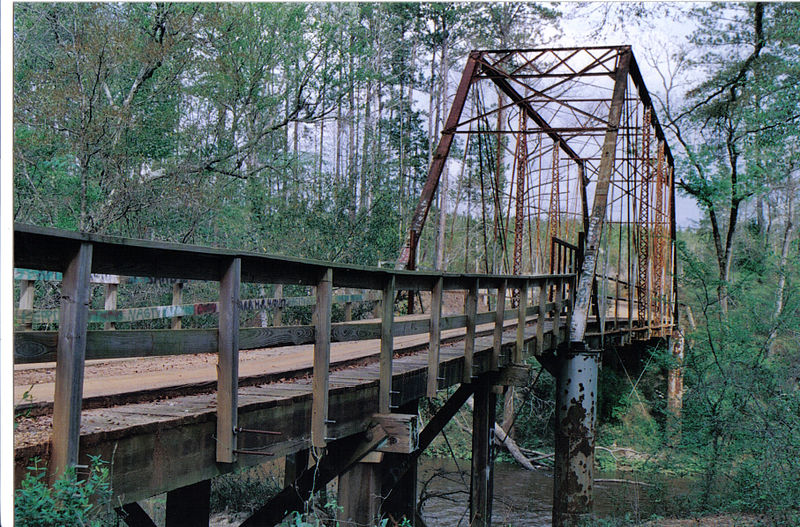
In the late 1800s, Old Man Stuckey ran an inn on a stagecoach route along the Chunky River. He could often be seen on the bridge, waving his lantern to passing flatboats, carrying produce and cotton up and down the river, and flagging down coaches who had been traveling all day. He offered weary travelers a soft bed and a hot meal.

According to legend, he buried their bodies along the banks of the river.

In 1901, the Virginia Bridge & Iron Company began rebuilding the dilapidated bridge and found the remains of Stuckey’s victims. The sheriff and his posse hung Stuckey from the very bridge he used to attract his victims. They left his body hanging for five days before the noose was cut and his body splashed into the cold water below.

stuckey's bridge from VA Iron and Bridge Co on wiki

Ghost?

To this day, there are rumors of the bridge being haunted by his ghost. A man carrying a lantern has been seen on the banks. An image of a lifeless corpse hanging from the bridge has been witnessed. The sound of a large splash under the bridge has been heard.

Today

Stuckey’s Bridge is currently closed to automobile traffic due to needing repairs. As remote as the location is, I doubt it will ever be repaired, but it is on the National Register of Historic Places, so maybe someday it will get the attention it needs.

stuckey large-L

Two things strike me about the story.

1)      Old Man Stuckey must have been a serious psychopath or sociopath (Psychopaths are genetic, sociopaths are created, but both have the same personality traits). Since there are no records of his existence and no Stuckey family name in the county at that time, I wonder where he came from and what kind of background he had that made him so nuts. I think he was even crazier than Norman Bates—more along the lines of Hannibal Lecter. Yikes!

2)      I’m almost half-way through writing the story, and I still haven’t given him a proper name. My heart and mind are wide open to discovering/creating his given name, and hopefully it will hit me before I finish the book. I’m also a little nervous about opening up my psyche to such an evil presence. Heebie Jeebies!

If you visit Lauderdale County, Mississippi and venture out to Stuckey’s Bridge,

once you’ve crossed it, DON’T TURN AROUND!

“The Legend of Stuckey’s Bridge” facebook fan page.

(Photo credits in order as they appear: Lori Crane 2012, Wikimedia Commons 2008, Nathan Culpepper Photography 2006.)

And now back to my regularly scheduled life…

I’ve been working on a book since October and just clicked that fabulous little “send” button to ship the manuscript off to my editor. That is one of the two instances when an author can breathe for a moment. The other is when you click the “publish” button. Sigh.

Every time I reach either moment, I am reminded of the movie, “Romancing the Stone,” where Kathleen Turner places a five-inch thick, type-writer written, finished manuscript on her kitchen table, lights a candle, and pours herself a glass of wine. Maybe that is why I’m tempted to open that bottle of Crown Royal sitting in my cabinet.

Candle_and_Wine_Glass_by_TaoDragon

But do I relax and bask in the glow of the finished product?

No, of course not. I’ve spent the last four hours researching the Dalton Gang for my new book.

But, hey, I’ve learned a ton about the Dalton Gang today!

Dalton Gang

What I found interesting about them is they did not set out to be outlaws. They were all initially U.S. marshals. There were four brothers in the gang. One lived in California on his successful farm with his beautiful wife. His name was Bill, and he is not in the above Wanted Poster. I assume his wife wouldn’t let him go that day.

Anyhoo, he was involved in politics, and the local farmers were trying to keep the railroads from running through their farms. When his three brothers (the hotties pictured above) showed up, their manly testosterone levels escalated, and they came up with a plan to teach the railroads a thing or two. They attempted to rob a train, but being inexperienced, bumbling train robbers, the result was a total fiasco. They fled empty handed under gunfire.

Somewhere between that humiliating failure in 1890 and their terrible deaths in 1892 while trying to rob TWO banks – across the street from each other – at the same time – in broad daylight – which resulted in a shoot out – and most of the gang dying, their fine morals and upbringing obviously went astray. Boys will be boys.

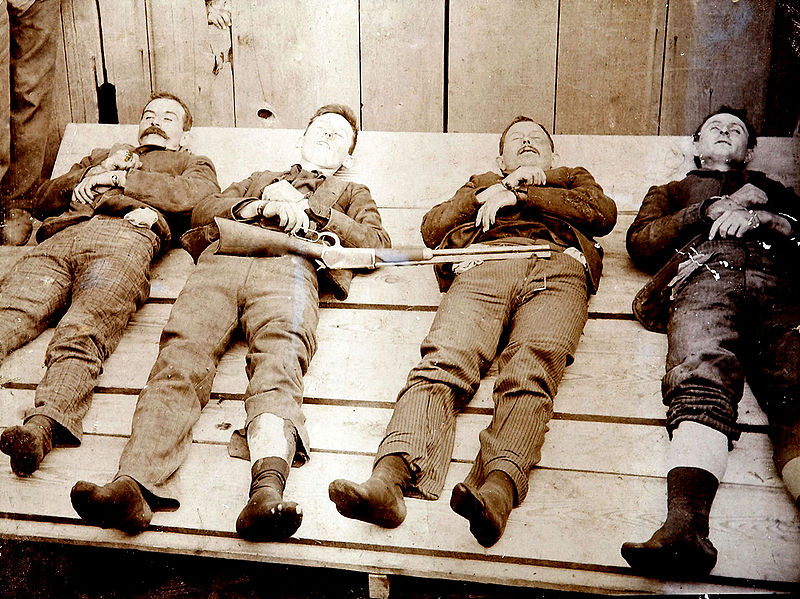
800px-Dalton_Gang_memento_mori_1892

The photo above is from Wikipedia. The middle two are Bob and Grat. (Emmett did not die that day, but he was shot over 20 times, survived, and spent 14 years in prison.) These boys were killed in the 1892 shoot out. Their boots were removed. They are all in handcuffs. Who took their boots?? And why are they handcuffed?? And what’s up with the gun in the photo?? So, they had a town photographer, but no town doctor to know if they were dead or not, hence the handcuffs??

Anyway, the book is not about them, it only starts with them. But I’ve had an interesting day researching them nonetheless.