52 Ancestors #38 Favorite Place

52ancestors-2015

This challenge is set forth by No Story Too Small and this week’s theme is “Favorite Place.”

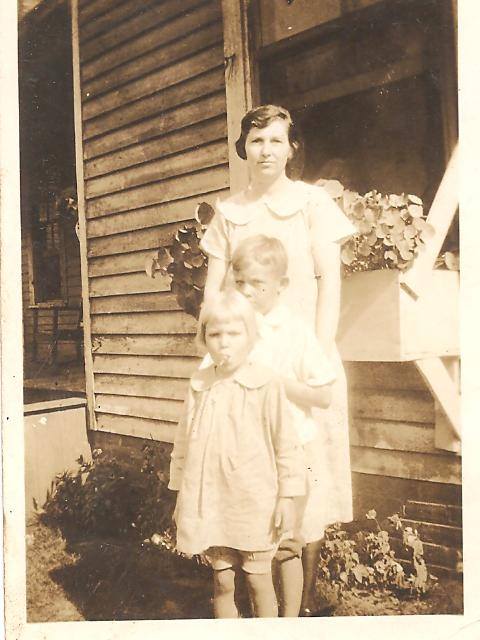
Eula Keene Pickett with Howard and AzaleaMy favorite place was my great grandmother’s house. She lived in Zero, Mississippi, just south of Meridian. This photo, courtesy of my cousin P. Grayson, is around 1925. She is with her son Howard and her daughter Azalea, my grandmother.

Grandma Pickett’s home wasn’t grand, but it was awesome. She had chickens who used to peck at my toes when I went out to collect the eggs. She had a cow that appeared as a calf each spring and disappeared each winter. I supposed we had lots of roasts because of that, but I never thought to ask what happened to the cows. I seem to remember a horse or two. I also remember five little ceramic pigs that held seasonings, salt, and pepper. They sat on the shelf above the kitchen sink. The house always smelled like sweet tea and green beans. My cousins lived next door, and I would run back and forth between playing with them and spending time with my great grandmother. Eula Ouida Keene Pickett 1899-1981 spent a lot of her time sewing quilts. I never thought much of it, but she was always in her chair, working on a new quilt with her glasses resting on the end of her nose.

IMG_20150908_180218183_HDRWhen I turned sixteen, Grandma Pickett gave me one of those quilts, just as she did for each of her six great-grandchildren. The pink one was for my birthday. The blue one was given to me later, just before she died. I was seventeen years old. I still use the quilts in our guest rooms and think of her every time I make the beds.

IMG_20150908_180223409_HDR

On This Day in 1985 William Clinton Culpepper

William Clinton CulpepperOn This Day, September 14, 1985, William Clinton Culpepper died.

Uncle Clinton, as he was known to me, was my great uncle, brother of my grandfather. He lived next door to my grandparents and I have many fond memories of his kindness and love and especially his hugs.


culpepper Sam and Annie CulpepperClinton was born in Kemper County, MS on May 11, 1900 to William Samuel Culpepper and Annie Josephine Blanks (photo). He was the eldest of nine children totaling five boys and four girls. His father was a sawyer who followed the saw mill business, gone from home for great lengths of time, so the boys were taught to run the farm when their father was away. I imagine, being the eldest child, most of the responsibility fell to Clinton.

In 1922, when Clinton was 22, he married Miss Eloise Snowden. Following the birth of their two daughters, Eloise came down with breast cancer. For a man who was used to running the family, Clinton took the illness terribly. He put a gun to his head and pulled the trigger. Eloise survived the illness and Clinton survived the gunshot wound, but he now had a severely reduced mental capacity, and their marriage couldn’t stand the strain. They divorced.

William Clinton Culpepper and Thelma Smith CulpepperIn 1945, Clinton found love for the second time and married Miss Thelma Edna Annie Smith (photo). Again disaster struck. Thelma was diagnosed with breast cancer. Again Clinton put a gun to his head. Again they both survived the disasters. Thelma took care of Clinton for the rest of her life. She died 9 May 1984. Clinton died a year later 14 Sept 1985.

dec 2012 212


They are both buried near Thelma’s parents in Mt. Pleasant Cemetery in DeKalb, Kemper County, MS.

Rest in peace, Uncle Clinton. ♥


This post is brought to you by On This Day: A Perpetual Calendar for Family Genealogy.


52 Ancestors #37 Seventy-one Grandchildren!!

52ancestors-2015

This challenge is set forth by No Story Too Small, and this week’s prompt is “Large Family.”

Hays Rodgers and Marey A Scott Rodgers

 14 children 

71 grandchildren!

il_570xN.449898023_h4w0

  1. Lewis Rodgers 1817-1890 m. Nancy Powell Ward, nine children
  2. James Rodgers 1818-1862 m. Martha A Sanderford, five children
  3. Allen Rodgers 1820-1894 m. Judith Walker McGehee, seven children, m. Nancy Abigail Chatham, six children
  4. Jackson Rodgers 1821- unknown
  5. Susannah Rodgers 1822-1904 m. Elijah Jackson Chatham, twelve children
  6. Stephen Rodgers 1824-1834 died young
  7. William Hays Rodgers 1826-1834 died young
  8. Mary Ann Rodgers 1828-1898 m. Rice Benjamin Carpenter, five children, m. William Eades Jolly, three children
  9. Timothy Rodgers 1830-1862
  10. Hays Rodgers Jr 1832-1913 m. Lucinda Graham, ten children
  11. Wilson Rodgers 1834-1864 m. Sarah Jane Graham, one child
  12. John W Rodgers 1836-1864
  13. Elizabeth Rodgers 1839-1875 m. George Malon Graham, ten children
  14. Martha Jane Rodgers 1844-1880 m. Martin V Warren, m. James Knox Meeks, m. Adam James Edgar, three children

Hays and Marey were my 4th great grandparents. #8 Mary Ann and Rice were my 3rd great grandparents.

1840810882_Thanksgiving20Dinner_xlargeOne can only imagine what Christmas would look in a house like this. After a while, the birth of a new child would be common place, and one might even have to decide which birth to attend and which one to not attend. There must have been a lot of love and a lot of chaos, but large families also have the potential for great tragedy. Hays and his large family lived in Mississippi, and when the Civil War broke out in 1862, they had no idea what was to come.

#9, #10, #11, and #12 served in the Confederacy. Only #10 returned home, and he came home with a useless arm that had taken a mini ball.

#8, #13, and #14 had husbands who served. As a matter of fact, #14 had two husbands who served. The only one who came home was #13’s. #14 was twice widowed by the age of twenty.

#5 had an eldest son who served. He was the first-born grandson in the family. He died at the age of 18 of illness at the training camp, one of the first casualties of the war.

If losing seven men in a single family wasn’t bad enough, typhoid also swept through the county the winter of 1862/63. During that terrible winter, Hays and Marey died within months of each other. Others lost to the disease were #2 and his wife within days of each other, leaving five orphans. #8’s infant son was also lost.

Looking at it from #8’s perspective. She lost three brothers, three brothers-in-law (one being her husband’s brother), four sisters-in-law (three were her husband’s sisters), an 18-year-old nephew, her husband, her infant son, and both parents within a seventeen month period. FIFTEEN PEOPLE! It turns my stomach to think about it.

Mary Ann seemed to be the one who held the family together after the tragedy. She was an amazing woman who had no idea how capable she was. Not only did she see the family through the tragedy, she came out on the other side a strong woman with an amazing story. Her story is detailed in my book Okatibbee Creek. 

Rodgers, Mary Ann Rodgers Carpenter Jolly

52 Ancestors #36 Working for a Living

52ancestors-2015

This challenge is set forth by No Story Too Small and this week’s prompt is Workin’ for a Living.

I have at least six nurses, one doctor, two cops, a seamstress, a school teacher, and a bunch of farmers in my family, but the one that comes to mind is my 2nd great grandfather, the treasurer of Lauderdale County, Mississippi 1904-1907, Thomas Gilbert Lafayette Keene.

plaque in Lauderdale Co Court House in MeridianTGL Keene was born 20 Apr 1859. It took me years to find information about his family and I had to piece it together through other family names, but the 1860 census shows TGL living with his father Green, his mother Sarah, his aunt Elizabeth (dad’s sister), his other aunt Catherine (dad’s other sister) and his seventy-year-old grandpa Gilbert Keene. TGL’s older siblings include John, Martha, Minerva Ellen, and Mary. TGL was the baby at only a year or so old.

Sometime before the 1870 census, his mom and dad died. The 1870 census shows Minerva Ellen, Mary, and TGL (now 11) living with their 50-year-old aunt Elizabeth. Not only are his parents noticeably absent, but grandpa isn’t listed either.

The 1880 census shows TGL at the age of 21 living with his eldest sister Martha and her husband Charles Pierce and their children and working as an assistant on their farm. I assume old aunt Elizabeth was dead by this time. This poor boy just keeps losing the adults in his life.

In Aug 1890, TGL married Sarah Elizabeth “Bettie” Brown, and over the next ten years, they had seven children, one being my great grandmother Eula Ouida Keene Pickett, whom I loved dearly. Too bad she never spoke to me of her family. All of TGL’s children survived him except for a boy who died as an infant.

Records show TGL worked in the county system since at least 1900, becoming the county treasurer 1904-1907, and the marble plaque above still stands in the Lauderdale County Courthouse in Meridian, Mississippi. In 1910, TGL was listed on the census as a Justice of the Peace. In 1918, he returned to his roots and is listed in the Mississippi census as a farmer. Upon his death in 1921 at the age of 62, he was a member of the Lauderdale County Board of Supervisors.

TGL Keene death certStrangely, with all of his public service, there are very few records of him, and his parents are not listed on his death certificate. Perhaps the Keene family never spoke of those who came before. Or perhaps, TGL was a private man. How could his wife and his grown children not know the names of his parents to list on the certificate? His wife outlived him by five years, and they are both buried at Oak Grove Baptist Cemetery in the Bonita Community, Lauderdale County, Mississippi.

t g l keene headstone


52 Ancestors #35 School Days with George Washington Spencer

52ancestors-2015

This challenge is set forth by No Story Too Small and this week’s challenge is “School Days.”

geo wash spencer

My 3rd great grand-father became a Confederate soldier in 1862, but in 1860, he was listed on the U.S. Census as a school teacher in Newton County, Mississippi.

church of rev william saladin spencerGeorge Washington Spencer was born in Alabama in June 1829, the son of preacher William Saladin Spencer and his wife Martha Didama Gross. GW grew up around the Shake Rag Church (photo) in Tuscaloosa, AL as one of eleven children. His last sibling was born in 1835, his father died in 1841, and his mother died in 1867 all in Alabama, but at some point GW moved west to Mississippi. At the age of 29 in 1858, he married Nancy Virginia “Jenny” Holdcroft, and in 1859, they had their first child, my 2nd great grand-mother Nancy Didama Spencer. (She was followed by six siblings.)

The Spencers made their home in Newton County, MS, and with a wife and a baby at home, GW needed a job, so he became a school teacher. There was no organized education at the time, so communities and churches usually gathered up some money and asked someone to educated their children. Teachers were generally left to their own devices to create a curriculum, and classrooms usually held children of all ages in one room. But the good news is that twelve-year-old children at the time were educated with books we would consider college level today. GW spent his days with the local kids, expanding the minds of the next generation.

Then the war began.

He enlisted 1 Mar 1862 at Scooba, Mississippi with Co.B 35th Mississippi Infantry. According to family members, he was sick most of the war from a leg infection and was medically discharged 10 Jan 1864. Rosters show him in Confederate hospitals in Jackson, Marion, and Lauderdale Springs, Mississippi. The passed-down family story is that his wife went by horse and wagon to pick him up from a Confederate hospital to bring him home. This was just before General Sherman’s march from Vicksburg to Meridian in Feb 1864.

Following the war, he is listed on all census records as a farmer until his death 22 Jul 1901. His career in education was a short-lived one.

GW and his wife Jenny are buried in unmarked graves at Hickory Cemetery, Newton County, Mississippi.

(photos courtesy of my cousin M. Baucum)

Saturday Snippet of An Orphan’s Heart

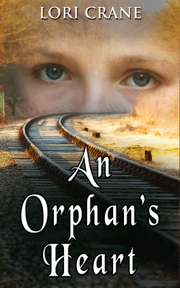
AOH%20cover_webThe second book in the Okatibbee Creek Series is the tale of one of the orphans lost in the shuffle in Okatibbee Creek, Martha Ellen Rodgers Meek, simply known as Ellen. In An Orphan’s Heart, nine-year-old Ellen’s family has been decimated by the civil war and a typhoid epidemic that swept through the county. She and her siblings are now forced to live with other family members, and Ellen finds herself longing for the love of her mother. She is relocated from Mississippi to Alabama, and upon reaching maturity, she decides to go back to Mississippi. Things are certainly not the same as they were in her childhood. She eventually travels to the great plains of Texas to visit her brothers, and immediately upon her arrival, she meets the man of her dreams and plans for a bright future – but has everything torn from her in a shattering turn of events.

An Orphan’s Heart is based on a true story. The names are real. The events are real. The story is told in first person, present tense. The photo at the bottom of this page is the real Martha Ellen Rodgers Meek, taken sometime around 1880.

Below is a snippet of when Ellen met handsome Sam Meek. The electricity was evident from the first moment.

**************

The inside of the house is as charming as the outside. A blazing fire warms the room, and the air smells of freshly made coffee. Mollie introduces me to their daughters: Minnie, who is five, and Willie Jo, who is two. What cute little girls! Judging by their nightdresses, they were about to go to bed. They both run up and wrap their arms around my neck as I bend down to say hello.

“Aunt Ellen, how long did it take you to get here?” Minnie asks.

“A couple of days. I traveled on three different trains.”

“Did you bring us any presents?” Willie Jo asks.

I laugh. I didn’t even consider doing so, but I pull two pieces of candy from my bag and they’re happy with that.

I’m so wrapped up in the little girls, I don’t even notice him sitting quietly at the table.

“Ellen, I’d like to introduce you to my brother. This is Sam Meek.”

The man rises from the table to greet me, and I’m immediately taken aback by his rugged good looks and warm smile. Our eyes meet and lock. Suddenly I feel as if I’m drowning in a pool of green—the richest green of a mountainside, the darkest green of the deepest water. Everyone and everything else disappears.

He offers me his hand as I rise from the floor. “It’s very nice to meet you.”

“And you, sir.” I take his hand and feel electricity flow through every vein in my body. I pull my hand away, and just as quickly regret the action. I wish to feel that sensation again, but there is no way to touch him again now. I glance down and admire his tan forearm, half covered by his rolled-up sleeve. “I am very sorry about the loss of your mother,” I offer as I try to compose myself.

He doesn’t respond for a moment, and stares deeply into my eyes. “Thank you. It’s very sad for all of us.” He doesn’t pull his eyes away.

Mollie brings some coffee to the table, breaking the spell Sam Meek has created, and she motions for us to have a seat.

“Would you like something to eat?” she asks.

“No, thank you.” I shake my head, finding it hard to look away from the exquisite creature in front of me.

“Sam?”

“No, I’m fine, but thank you,” he says, not breaking our gaze. “I’ll have to get to sleep in a little bit. I’m exhausted.”

I sink into the chair but have no idea if I’m actually sitting. The thought of him leaving the room is disheartening, and I’m surprised a man I just met is having this kind of effect on me.

“So, how was your trip?” He turns toward his coffee cup as Mollie fills it.

“It was amazing. When I was younger, I traveled through a small town in Alabama that had a train station. I was so enchanted by the women in their fancy hats coming and going, I vowed to myself I would someday travel on a train to a distant place.” I smile. “And here I am.”

“Sounds nice.” He takes a sip of his coffee, watching me over the brim of his steaming cup. His voice sounds like silk.

I watch the way he sips. I watch his strong, callused hands place the cup back down on the table. I watch his tongue lick a stray drop from his lips. I watch his tanned throat as he swallows.

“Did you sleep on the train or did you stop somewhere?”

“I spent the night in Mobile and New Orleans, but the rest of the trip was on a sleeper train that had bunks. The rocking motion of the train was actually very soothing.” I sip the strong, bitter coffee, then glance at him as I place the cup back on the table.

“Well, I’m glad you had a good journey.” He stands. “I’m sorry to interrupt our coffee and conversation, but I really need to get some sleep. I can hardly keep my eyes open. It’s going to be a long day tomorrow with the funeral and all.” He grabs his hat from the side table. “Relatives have been coming into town all day.” He nods to me. “It was a pleasure to meet you, ma’am. I’d love to speak with you more about your journey, and I’ll see you again tomorrow.”

“Nice to meet you, too, Mr. Meek.” His movements are like a stallion running through a field, like an eagle catching its prey, like a…

“Please, call me Sam.” He grins, showing the slightest dimple under his dark stubble. His eyes sparkle in the firelight.

I nod and smile. I can’t stop staring at him.

He bids a good evening to Mollie and Willie, and just as instantly as he appeared, he is gone.

My heart is pounding in my ears. My palms are sweating. I can’t seem to catch my breath. I wish I could follow him. I look down at my coffee cup and shake my head. When I look up, Mollie and Willie are both staring at me, and I blush.

************

James daughter Martha Ellen Rodgers MeekAn Orphan’s Heart is available in paperback and Kindle at Amazon.

An Orphan’s Heart was a finalist in the 2014 Eric Hoffer Awards. The cover was also named a top-ten finalist in the 2013 Authorsdb Book Cover Contest. It was also awarded a Five-Star Review at Readers’ Favorite. It is the second book in the Okatibbee Creek Series. The first book is Okatibbee Creek. The third is Elly Hays.

Saturday Snippet of Okatibbee Creek

okatibbee creek cover front JPEGOkatibbee Creek is the story of Mary Ann Rodgers Carpenter Jolly and her trials and tribulations in Mississippi during the Civil War. As her brothers and husband went off to war, a devastating typhoid epidemic swept through the county and decimated what was left of her family. Following the loss of so many loved ones, including both parents, she took in her orphaned nieces and nephews and focused on survival. When the war finally ended, she had to pick up the pieces of her shattered life and begin anew. But how?

Okatibbee Creek is a real place. The characters are real. The events are real. The book will leave you crying and cheering. It is written in first person, present tense, diary-style, allowing you to see inside of Mary Ann’s heart and experience every emotion she felt.

The following is a snippet of the scene when Mary Ann received word that her husband had been killed in the war.

**********

When I reach the bottom of the stairs, I see him. I do not recognize his face, but I recognize his clothing. He is a Confederate soldier. He is standing in the open doorway of the store with the gray, cloudy sky at his back. He is dressed in a wrinkled gray uniform with a dirty yellow cummerbund. His trousers have holes in them, with mud caked around the bottoms of his pant legs. His jacket is missing some buttons, and he looks quite thin and weary. He is wearing shoes that are covered in red Mississippi mud and probably have no soles on the bottom. He is holding his tattered hat and a piece of paper in his dirty hands.

“Hello, sir, what can I do for you?” I ask as I approach.

“Hello, ma’am.” He nods. “Are you Mrs. Carpenter?”

“Yes, I am. And who are you, may I ask?”

“Private Joseph Brown, ma’am. Captain asked me to deliver the latest casualty list to you in person.” He holds the folded piece of paper toward me and looks down at the floor, like a child in trouble for doing something wrong.

“Why are you delivering this? It usually comes by a mail carrier,” I ask as I reach for the paper. I look at the boy’s face. He nervously avoids my eyes and keeps staring at the floor.

“Why are you delivering this to me?” I repeat.

“I promised I would. I’m sorry, ma’am. Goodbye, ma’am,” he murmurs, and backs out the open door.

I look at the piece of paper in my hand for a long time, wondering if I can open it. I don’t know whose names are on this paper, but I suspect the worst, and I don’t want to read it. My eyes sting with tears as I dread a simple piece of paper. I try to unfold it, but my hands are shaking, so I stop and hold it to my chest. I take a deep breath.

Martha Jane stands behind me, not saying a word or making a sound.

“Martha Jane, will you please go upstairs and mind the children for a few minutes?” I ask her.

She nods and quietly heads up the stairs.

I walk outside across the wooden porch and down the two stone steps onto the ground. I walk across the dirt road that is now filled with puddles of red mud from the rain. I keep walking straight ahead. I walk into the overgrown field across the road. I walk with purpose, with determination, like I have somewhere important to go. I want to run. I want to run away and never come back. I keep walking.

In the middle of the field, the thunder sounds above my head. I stop and look up at the ominous clouds that are almost as threatening as the piece of paper I hold in my hand. My hands are shaking as I slowly unfold it and smooth it open. My stomach feels like it has a hole in it. My eyes fill with tears. My hands are now trembling so violently, I almost can’t read it. The name at the top is the only name I see.

“Carpenter, Rice Benjamin: killed in battle 31 December, 41st Mississippi Infantry, Co C.”

Drops of water fall onto the page, but I can’t tell if they are raindrops or teardrops. Even God Himself is crying.

*********

Rodgers, Mary Ann Rodgers Carpenter JollyOkatibbee Creek is available in paperback, Kindle, and audiobook at Amazon. CLICK HERE. It is the first of three Okatibbee Creek Series books, but they are stand-alone stories. The second is An Orphan’s Heart. The third is Elly Hays.

Okatibbee Creek was the bronze medal winner of the 2013 eLit Book Awards in literary fiction. It also received honorable mention in the 2013 Great Midwest Book Festival for regional fiction and was a nominee in the 2013 Global eBook Awards for historical fiction. It was also awarded Five-Stars at Readers’ Favorite.

52 Ancestors #23 Florence J Smith Howington

52ancestors-2015

This challenge is set forth by No Story Too Small and this week’s theme is “Challenging.”

john thomas howington florence j smith marriage recordThe most challenging ancestor for me to trace is not only challenging and frustrating, but darned near impossible.

Florence J Smith Howington was my 2nd great-grandmother. The only thing I know for sure is she married John Thomas Howington in Newton County, Mississippi on 1 Aug 1892. The marriage record (photo, click to enlarge) says she was sixteen years old, making her birth around 1876, although the 1900 U.S. census says she’s white and 28. The 1910 census says she’s 36. Her husband was married previously in 1880 to Ellen Raynor who died in 1891. There is no record of any children. Once John and Florence married, they had eight children between 1893 and 1910, the eldest being my great grandmother Mary Elizabeth Howington.

howington, john thomasJohn Thomas Howington died in 1913 and Florence never remarried. She died at the age of 93 in 1969. There is a blank spot in the Pine Grove Cemetery in Collinsville, Mississippi next to John’s headstone (photo). If Florence is buried there, she has no marker.

The frustrating thing about tracing her is that I was always told I had a grandmother who was of Choctaw Indian descent, and if that’s true, she has to be the one. The Choctaw were run out of Mississippi at the signing of the Treaty of Dancing Rabbit Creek in the 1830s. They migrated to Oklahoma. The ones who stayed changed their names to assimilate into the white European culture. Of course, there would be no prior record of them, and seeing as they probably couldn’t read or write English, there wouldn’t be a record of their name change.

There are a lot of Smiths listed in the Choctaw registries in Mississippi from 1847-1933, but I haven’t been able to trace Florence without knowing at least one of her parent’s names. There are also census records of Choctaw families residing east of the Mississippi River and in the states of Mississippi, Louisiana, and Alabama. One such record is a census called the “Cooper Roll,” made by Douglas H. Cooper, US Agent for Choctaws, in conformity with the order of  the Commissioner of Indian Affairs dated 23 May 1855.

The following is part of the Cooper Roll naming the Chunkee Clan (Chunky is the town in Newton County, Mississippi where Florence lived.) Obviously the names were spelled phonetically. I have no clue which one, if any, could be Florence’s family, but seeing that the list was made twenty years before her birth, I wonder if one of the names is her grandfather.

Alsh-fra-sa-hubbee (?)
On-tah-cha
A-no-la-honnah
Nok-ne-to-nubbee
Me-ha-tut-tubbee
File-ka-tubbee
Hit h-la-ho-ka
Oka-fa-mah
Lal-a-tubbee
In-co-chubbee
Tak-lam-bee (or Tok-lam-bee)
Me-lo-tubbee
Ho-tubbee
Lou-a-chubbee
I-ath-le-fiah
Anah-chi-hat-tah Co-chin-tubbee
Mok-ah-ho-ka
Ston-a-chubbee
Me-hah-tubbee
Co-mo-tubbee
Con-chi-ho-ka
File-kah-tubbee
Tub-bish
Me-asho-cubbee
Ish-tah-ah-ho-nah
Ho-ti-lubbee
Eah-hoka-tubbe e
Co-chubbee
Pa-la-tubbee
Emah note:..and off hunting about 20 families; and about the same number living near Harrisons who refused to give their names.

52 Ancestors #29 The Musical Earl Culpepper

52ancestors-2015

This challenge is set forth by No Story Too Small and this week’s theme is “musical.”

Being a professional musician all my life, I’ve always given thought to where my musical talents came from. My mother sang in church. I have a great grandmother and a great great grandfather (different lines) who played a pump organ. I also have a great grandfather from Ireland who played the fiddle. But the one who usually comes to mind is my maternal grandfather Earl Culpepper.

culpepper Earl Culpepper

I have many fond memories of sitting on the front porch with him as he played his guitar and sang. Sometimes he’d even pull out his harmonica and use some contraption around his neck to hold it up to his mouth. He always sang “Hey Good Lookin'” by Hank Williams and sounded a lot like him.

Earl was born in Mississippi on Christmas Eve of 1914 to Sam Culpepper and Annie Blanks. He was the eighth child of the union and a girl follow him. At age 21, he married Ina Inez Burke and they had two daughters – one being my mother. Earl worked his whole life at the Burnley Shirt Factory in Meridian. After his wife died in 1975, he married a lady from the factory who was widowed. They married in 1977. Earl died 5 Mar 1994 at the age of 79 at Anderson Hospital following respiratory failure/aspiration pneumonia following a stroke. He was buried next to Ina at Liberty Baptist Cemetery, Duffee, Newton Co, MS. MS death cert no 9405973.

RIP pawpaw and thanks for the music! ♪♫♪

52 Ancestors – #28 Elly Hays

52ancestors-2015

This challenge is set forth by No Story Too Small and this week’s theme is Road Trip.

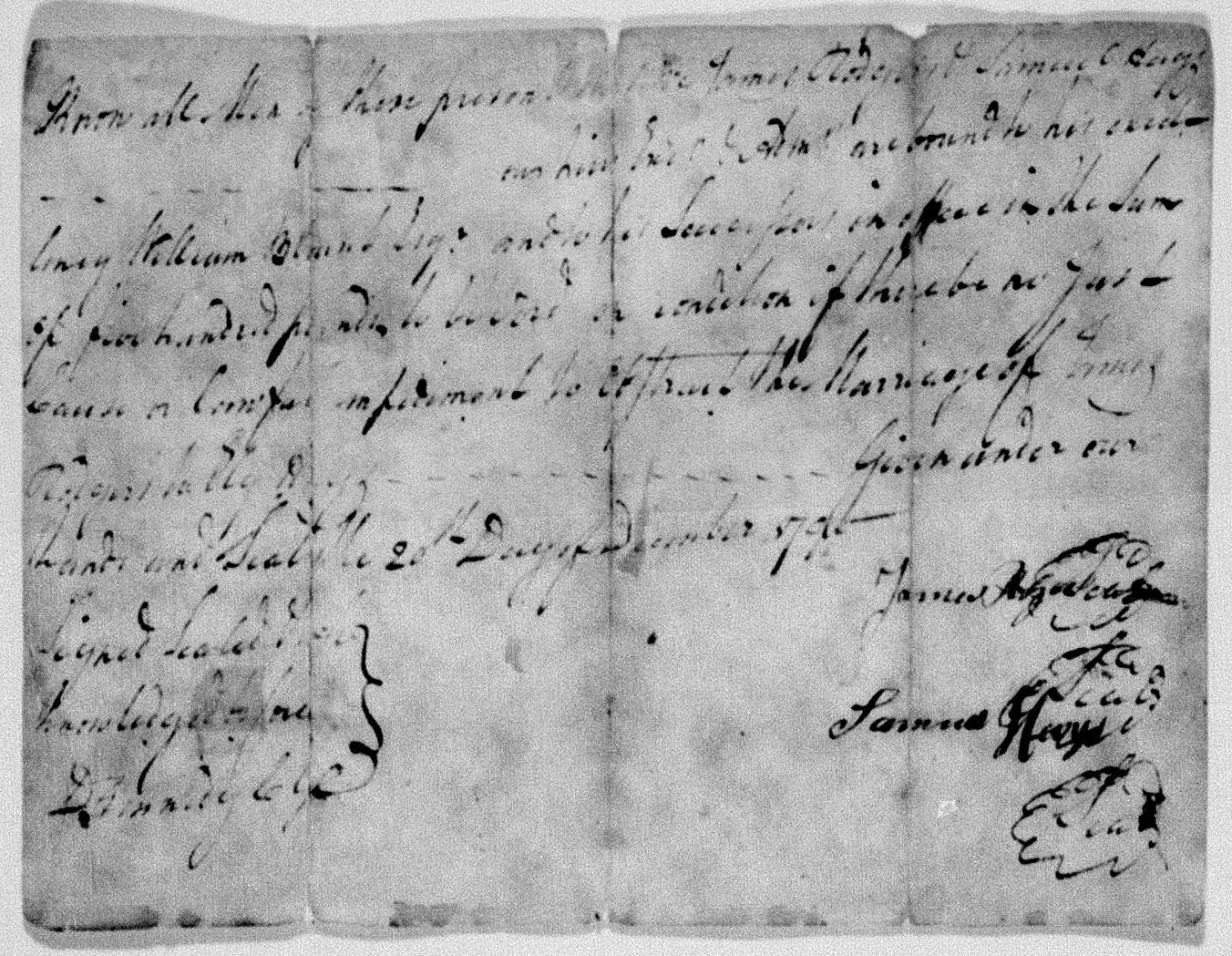
Marriage document James Rodgers and Elizabeth Hays GreeneCoTN1790Elly Hays was sixteen when she married James Rodgers in Tennessee on 20 Dec 1790. The document to the left is their marriage license. She birthed twelve children.

In 1811, the family packed up and moved to the eastern Mississippi Territory – a place now called Alabama, which wouldn’t become a state until 1819.

You know how difficult it is going on a road trip with little kids in the car? Imagine being on a covered wagon for two months with a dozen of the little rug rats and not a McDonalds in sight.

ban-mcdonalds

This was a time in history when the U. S. was flexing its political muscle and tensions were escalating, leading up to the War of 1812. And little did the Rodgers family know, they were moving into Creek territory. Not only were the Creek Indians fighting the U.S. Government, they had also broken into two factions and were fighting among themselves in a civil war called the Red Stick War. The Rodgers family moved into the middle of a hornet’s nest. They were harassed for years by the marauding Indians, who taunted them and stole their livestock, and the final straw, burnt down their home.

Eventually, in 1818 the family took another long road trip and moved west to Lauderdale County, Mississippi, to the land of the friendly Choctaw Indians.

James died in Mississippi eight years later, and Elly moved back to Clarke County, Alabama and probably lived with her daughter. She died in the 1830s in her 60s in Grove Hill, Alabama. The exact date of her death is unknown. Her burial place is unknown.

Her story is told in detail in my book Elly Hays available at Amazon.