Ina Inez Burke’s birthday?

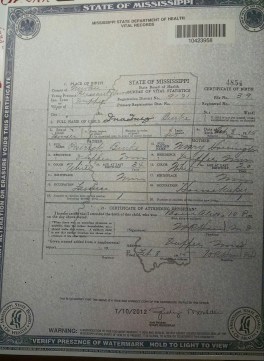
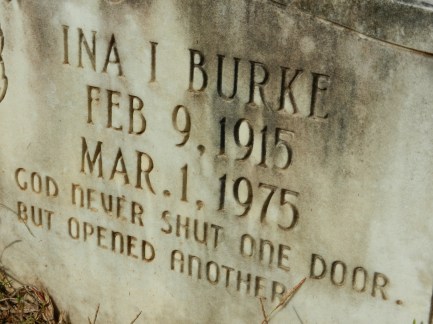
earl culpepper and ina burkeMy grandmother, Ina Inez Burke Culpepper, was a warm and wonderful woman. We always celebrated her birthday on February 9, her death certificate lists her birth as February 9, her tombstone is chiseled February 9. Imagine my surprise when I received her birth certificate stating she was born at 10:00 pm on February 8!

ina burke birth cert

She was born in Mississippi in 1915 to John Patrick “Pat” Burke and Mary Howington Burke. She was the eldest of seven children, one dying as an infant. She grew up with three brothers and two sisters.

marriage license earl culpepper and ina burke

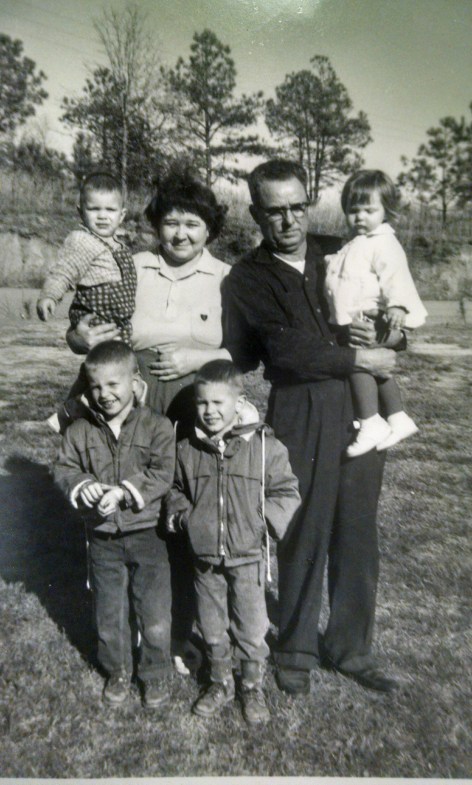
She married Earl Culpepper at the age of 21 on 1 Aug 1936. The union produced two daughters and four grandchildren. (The little girl is me!)

earl, ina, and grandchildren

Ina was a great cook and a professional seamstress, working at Meridian’s Burnley Shirt Factory. She spent many hours teaching me to sew when I was small. I was too young to get under her feet in the kitchen and still regret not being able to make biscuits as good as hers.

She died in 1975 of complications of aortic valve replacement. I always thought she died at the age of 59, but now I wonder if she was only 58.

She is laid to rest at Liberty Baptist Church Cemetery in Newton County, Mississippi, not far from where she was born.

burke Ina Inez Burke headstone


Happy 223rd Birthday!

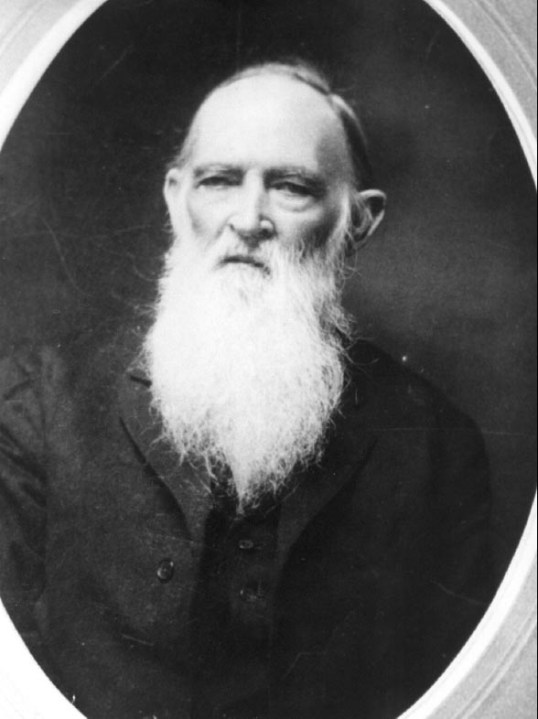
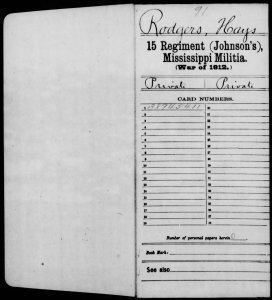
Rodgers Hays Sr

Hays Rodgers Sr was my 4th great grandfather. He was born in Greene Co, Tennessee in February of 1793 to James Rodgers and Elizabeth “Elly” Hays. (Elly was the heroine of my book “Elly Hays.”) Hays was Elly’s eldest son and he had at least ten siblings. Just before the War of 1812 began, the family moved from Tennessee to the Mississippi Territory, today known as Clarke Co, Alabama. Alabama didn’t become as state until 1819.

Page 11814 – When Hays was 19, he and his brother, Absolom, signed up for the Mississippi Militia and were assigned to Captain Evan Austill’s company of volunteers in Major Sam Dale’s Battalion to fight against the hostile Creek Indians. Hays remained in the Militia until October 1818, but was only called out once for a two-month tour. Today, I am a member of the United States Daughters of 1812 under his patriotism.

On December 11, 1816, he married Marey Ann Scott, who was from Georgia.

Winter of 1818, following the end of his military service, Hays, Marey, and first-born Lewis, moved to Copiah Co, MS (what later became Simpson, MS). He started buying land and farming. Over the next two decades, the couple had a total of 14 children. Some died young, but the final tally of grandchildren was 71!

In 1834, the US Government began selling off land it had obtained from the Choctaw Indians in the 1830 signing of Dancing Rabbit Creek. Hays went to Pine Springs in Lauderdale County before the land was surveyed and built a small cabin overlooking Rogers Creek bottom so he could claim the land the moment it went up for sale. He was a squatter for all purposes.

September 26, 1836 – A deed was recorded for 80 acres in Pine Springs which he bought from the government.

October 1836 – He bought 160 acres next to his 80 acres from John Calhoun. Mr. Calhoun moved to the Martin Community to open a leather tannery.

1839 – He bought 80 acres from Alex McMullen and 80 acres from Jeremiah Howell. He also began buying slaves and producing cotton.

1856 – He was granted public land adjoining his plantation from the US gov’t in payment for his military service.

MS Cemetery 0761857 – He built the “Ole Stennis House” at the age of 61. I took this photo in 2012 when I visited the house.

In 1860, the U.S. Census states Hays owned 13 slaves, a 640 acre (square mile) plantation, 2 horses, 3 mules, 10 cows, 4 oxen, 16 sheep, 60 swine, and $600 in farming instruments, for a total worth of $8400. A person’s total worth did not include the price of the slaves they owned, and most of his wealth was tied up in slaves that were worth more than $1000 each – that’s probably a million bucks in today’s money.

dec 2012 3881862 – When the Civil War began, Hays sent four of his sons to fight. Three never returned. Also, during the winter of that year, a typhoid epidemic hit his family, killing the only son who didn’t go off to war. Fortunately, Hays was not around to witness the deaths of his sons as he was the first in the family to died of typhoid that winter in December of 1862. He was 66 years old. His wife died shortly after him in March of 1863, also of typhoid.

Upon his death in December 1862, he owned 690 acres of land and stock in the Mobile and Ohio Railroad, which sat unattended until the end of the war, and then for more time as they awaited the boys return at the close of the war in 1865. The boys didn’t return. Finally, the property went to probate in 1869 and was sold at public auction on the steps of the Meridian Courthouse to Major Adam T Stennis, hence the name “Ole Stennis House.” The home remained in the Stennis family for 100 years until 1970 when it was bought by the Hover family.

The story of the time of war and Hays’ death is told through his daughter, Mary Ann’s, eyes in my book “Okatibbee Creek.”

Interesting note: The only son to return home from the war was Hays Jr, albeit with an injured, useless arm and a wilted spirit. Since he no longer had a large family in Mississippi, Hays Jr. sold his farm and moved to Alabama to be near his wife’s family. He sold his farm to a man named Tom Stennis. Tom Stennis was a former slave to Major Adam T Stennis.

This story is brought to you courtesy of “On This Day: A Perpetual Calendar for Family Genealogy.”

52 Ancestors #40 – On This Day – James Otis Burke

I’ve been participating in the “52 Ancestor” challenge all year, following along with the weekly themes and having a great time. BUT…I work out of the country for months at a time and generally write and schedule the blogs in advance. APPARENTLY, someone has dropped the ball in getting the October themes posted. As I type this in the real word today is Sept 24 and I leave for the month of October on Sep 26. I have today and tomorrow to write and schedule October’s ancestry blogs. SO, I’m forced to blog without themes.

I also write a blog called “On This Day,” which takes place on the day of the birth/death/anniversary/etc. of an ancestor, BUT I’ve not posted many “On This Day” blogs this year because I’ve been doing “52 Ancestors.”

Guess we’ll have to combine the two for the month of October.

James Otis Burke and son Jerry BurkeTHEREFORE, I present to you “52 Ancestors” “On This Day in 2003”

James Otis Burke

James Otis Burke (photo with infant son), whom we loving called Uncle Otis died on this day in 2003. He was my grandmother’s younger brother, my great uncle, born 14 Feb 1922 to John Patrick Burke and Mary Elizabeth Howington. He was the middle child of seven children, one who died as an infant. He was born and raised in Little Rock, Newton County, MS. There’s not much in Newton County but farmland, but the city of Meridian isn’t far away.

In 1941 at the age of 19, he served in the United States Army during WWII.

When he returned from the war, he married Luna Marie Arledge and they had three children. One boy and two girls. I remember my mother speaking of her cousins so lovingly. They were products of the 50s generation. I’m sure they spent many nights at the drive-in in town, and I picture them hanging out together just like the “Happy Days” TV show.

Uncle Otis buried his wife in 1990. She died at the age of 66. He never remarried.

PhotoELF Edits: 2009:11:10 --- JPG Compressed 96 % YUV444 EXIF --- gamma; despeckle; resize

He died on October 1, 2003 at the age of 81 and is buried with his wife at Pleasant Grove Baptist Church Cemetery in Newton County.

PhotoELF Edits:2009:11:10 --- JPG Compressed 95 % YUV444 EXIF --- resize


52 Ancestors #37 Seventy-one Grandchildren!!

52ancestors-2015

This challenge is set forth by No Story Too Small, and this week’s prompt is “Large Family.”

Hays Rodgers and Marey A Scott Rodgers

 14 children 

71 grandchildren!

il_570xN.449898023_h4w0

  1. Lewis Rodgers 1817-1890 m. Nancy Powell Ward, nine children
  2. James Rodgers 1818-1862 m. Martha A Sanderford, five children
  3. Allen Rodgers 1820-1894 m. Judith Walker McGehee, seven children, m. Nancy Abigail Chatham, six children
  4. Jackson Rodgers 1821- unknown
  5. Susannah Rodgers 1822-1904 m. Elijah Jackson Chatham, twelve children
  6. Stephen Rodgers 1824-1834 died young
  7. William Hays Rodgers 1826-1834 died young
  8. Mary Ann Rodgers 1828-1898 m. Rice Benjamin Carpenter, five children, m. William Eades Jolly, three children
  9. Timothy Rodgers 1830-1862
  10. Hays Rodgers Jr 1832-1913 m. Lucinda Graham, ten children
  11. Wilson Rodgers 1834-1864 m. Sarah Jane Graham, one child
  12. John W Rodgers 1836-1864
  13. Elizabeth Rodgers 1839-1875 m. George Malon Graham, ten children
  14. Martha Jane Rodgers 1844-1880 m. Martin V Warren, m. James Knox Meeks, m. Adam James Edgar, three children

Hays and Marey were my 4th great grandparents. #8 Mary Ann and Rice were my 3rd great grandparents.

1840810882_Thanksgiving20Dinner_xlargeOne can only imagine what Christmas would look in a house like this. After a while, the birth of a new child would be common place, and one might even have to decide which birth to attend and which one to not attend. There must have been a lot of love and a lot of chaos, but large families also have the potential for great tragedy. Hays and his large family lived in Mississippi, and when the Civil War broke out in 1862, they had no idea what was to come.

#9, #10, #11, and #12 served in the Confederacy. Only #10 returned home, and he came home with a useless arm that had taken a mini ball.

#8, #13, and #14 had husbands who served. As a matter of fact, #14 had two husbands who served. The only one who came home was #13’s. #14 was twice widowed by the age of twenty.

#5 had an eldest son who served. He was the first-born grandson in the family. He died at the age of 18 of illness at the training camp, one of the first casualties of the war.

If losing seven men in a single family wasn’t bad enough, typhoid also swept through the county the winter of 1862/63. During that terrible winter, Hays and Marey died within months of each other. Others lost to the disease were #2 and his wife within days of each other, leaving five orphans. #8’s infant son was also lost.

Looking at it from #8’s perspective. She lost three brothers, three brothers-in-law (one being her husband’s brother), four sisters-in-law (three were her husband’s sisters), an 18-year-old nephew, her husband, her infant son, and both parents within a seventeen month period. FIFTEEN PEOPLE! It turns my stomach to think about it.

Mary Ann seemed to be the one who held the family together after the tragedy. She was an amazing woman who had no idea how capable she was. Not only did she see the family through the tragedy, she came out on the other side a strong woman with an amazing story. Her story is detailed in my book Okatibbee Creek. 

Rodgers, Mary Ann Rodgers Carpenter Jolly

52 Ancestors # 34 Alma Saterfiel

52ancestors-2015

This challenge is brought forth by No Story Too Small and this week’s challenge is “Non-population.”

Non-population refers to using a schedule that is not a populating-counting survey, such as an agricultural schedule. I’ve searched and searched, but all of the information I possess about my ancestors besides their personal records or land records involves them being counted for something. So… I’ve decided to forego the real meaning and twist the challenge into something I can do. I’ve decided to write about someone who created no population – someone who either never had children or perhaps died young – I’ve opted for Alma Saterfiel.

alma saterfiel

Alma was born to Mary Eudora Culpepper and William Bartley Saterfiel on 28 Jul 1907 in Lauderdale County, Mississippi. (Eudora was my great grandfather’s sister.) Alma was the last child of Eudora and William’s union, following two girls and three boys. She died at the age of four on Valentine’s Day 1912. She is laid to rest at Zion Cemetery in Kemper County, Mississippi with her father and her grandparents.

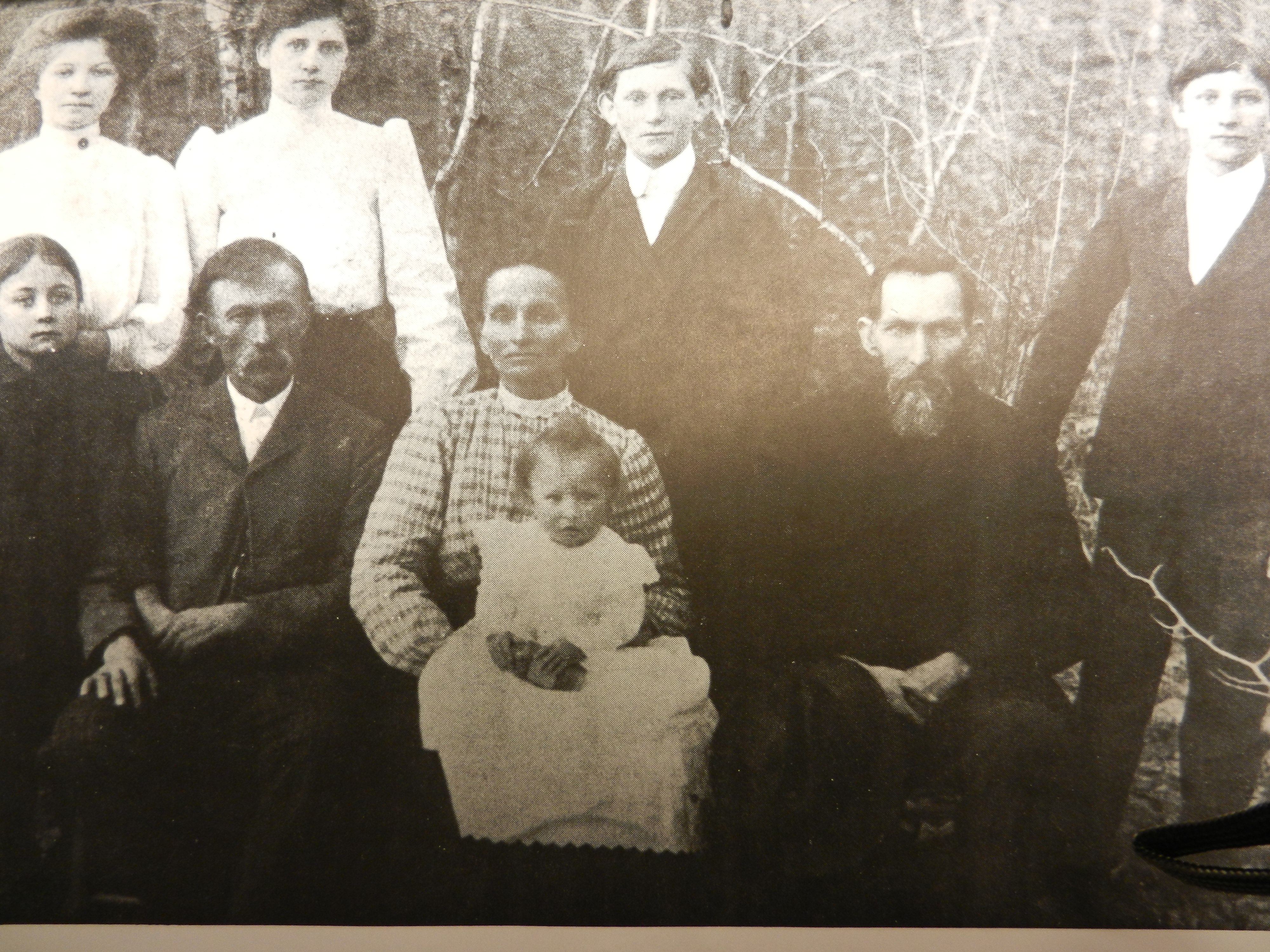
Her family is pictured below in a photograph taken in 1909.

Front row left to right: Dewey Oliver Saterfiel 1901-1968, Will B Saterfiel 1862-1925, Mary Eudora Culpepper Saterfiel 1871-1950, Alma 1907-1912, grandfather Joel B Culpepper 1848-1911.

Back row left to right: Evie Mae Saterfiel 891-1957, Indeola Saterfiel 1893-1956, Willie Carlos Saterfiel 1898-1955, Adie Joseph Saterfiel 1895-1954.

Joel B, Will B and baby Alma are buried at Zion Cemetery, Kemper Co, MS. All others are buried at Pine Grove Cemetery in Lauderdale, MS.

culpepper mary eudora culpepper saterfiel family

Saturday Snippet of Okatibbee Creek

okatibbee creek cover front JPEGOkatibbee Creek is the story of Mary Ann Rodgers Carpenter Jolly and her trials and tribulations in Mississippi during the Civil War. As her brothers and husband went off to war, a devastating typhoid epidemic swept through the county and decimated what was left of her family. Following the loss of so many loved ones, including both parents, she took in her orphaned nieces and nephews and focused on survival. When the war finally ended, she had to pick up the pieces of her shattered life and begin anew. But how?

Okatibbee Creek is a real place. The characters are real. The events are real. The book will leave you crying and cheering. It is written in first person, present tense, diary-style, allowing you to see inside of Mary Ann’s heart and experience every emotion she felt.

The following is a snippet of the scene when Mary Ann received word that her husband had been killed in the war.

**********

When I reach the bottom of the stairs, I see him. I do not recognize his face, but I recognize his clothing. He is a Confederate soldier. He is standing in the open doorway of the store with the gray, cloudy sky at his back. He is dressed in a wrinkled gray uniform with a dirty yellow cummerbund. His trousers have holes in them, with mud caked around the bottoms of his pant legs. His jacket is missing some buttons, and he looks quite thin and weary. He is wearing shoes that are covered in red Mississippi mud and probably have no soles on the bottom. He is holding his tattered hat and a piece of paper in his dirty hands.

“Hello, sir, what can I do for you?” I ask as I approach.

“Hello, ma’am.” He nods. “Are you Mrs. Carpenter?”

“Yes, I am. And who are you, may I ask?”

“Private Joseph Brown, ma’am. Captain asked me to deliver the latest casualty list to you in person.” He holds the folded piece of paper toward me and looks down at the floor, like a child in trouble for doing something wrong.

“Why are you delivering this? It usually comes by a mail carrier,” I ask as I reach for the paper. I look at the boy’s face. He nervously avoids my eyes and keeps staring at the floor.

“Why are you delivering this to me?” I repeat.

“I promised I would. I’m sorry, ma’am. Goodbye, ma’am,” he murmurs, and backs out the open door.

I look at the piece of paper in my hand for a long time, wondering if I can open it. I don’t know whose names are on this paper, but I suspect the worst, and I don’t want to read it. My eyes sting with tears as I dread a simple piece of paper. I try to unfold it, but my hands are shaking, so I stop and hold it to my chest. I take a deep breath.

Martha Jane stands behind me, not saying a word or making a sound.

“Martha Jane, will you please go upstairs and mind the children for a few minutes?” I ask her.

She nods and quietly heads up the stairs.

I walk outside across the wooden porch and down the two stone steps onto the ground. I walk across the dirt road that is now filled with puddles of red mud from the rain. I keep walking straight ahead. I walk into the overgrown field across the road. I walk with purpose, with determination, like I have somewhere important to go. I want to run. I want to run away and never come back. I keep walking.

In the middle of the field, the thunder sounds above my head. I stop and look up at the ominous clouds that are almost as threatening as the piece of paper I hold in my hand. My hands are shaking as I slowly unfold it and smooth it open. My stomach feels like it has a hole in it. My eyes fill with tears. My hands are now trembling so violently, I almost can’t read it. The name at the top is the only name I see.

“Carpenter, Rice Benjamin: killed in battle 31 December, 41st Mississippi Infantry, Co C.”

Drops of water fall onto the page, but I can’t tell if they are raindrops or teardrops. Even God Himself is crying.

*********
Rodgers, Mary Ann Rodgers Carpenter JollyOkatibbee Creek is available in paperback, Kindle, and audiobook at Amazon. CLICK HERE. It is the first of three Okatibbee Creek Series books, but they are stand-alone stories. The second is An Orphan’s Heart. The third is Elly Hays.

Okatibbee Creek was the bronze medal winner of the 2013 eLit Book Awards in literary fiction. It also received honorable mention in the 2013 Great Midwest Book Festival for regional fiction and was a nominee in the 2013 Global eBook Awards for historical fiction. It was also awarded Five-Stars at Readers’ Favorite.

52 Ancestors #23 Florence J Smith Howington

52ancestors-2015

This challenge is set forth by No Story Too Small and this week’s theme is “Challenging.”

john thomas howington florence j smith marriage recordThe most challenging ancestor for me to trace is not only challenging and frustrating, but darned near impossible.

Florence J Smith Howington was my 2nd great-grandmother. The only thing I know for sure is she married John Thomas Howington in Newton County, Mississippi on 1 Aug 1892. The marriage record (photo, click to enlarge) says she was sixteen years old, making her birth around 1876, although the 1900 U.S. census says she’s white and 28. The 1910 census says she’s 36. Her husband was married previously in 1880 to Ellen Raynor who died in 1891. There is no record of any children. Once John and Florence married, they had eight children between 1893 and 1910, the eldest being my great grandmother Mary Elizabeth Howington.

howington, john thomasJohn Thomas Howington died in 1913 and Florence never remarried. She died at the age of 93 in 1969. There is a blank spot in the Pine Grove Cemetery in Collinsville, Mississippi next to John’s headstone (photo). If Florence is buried there, she has no marker.

The frustrating thing about tracing her is that I was always told I had a grandmother who was of Choctaw Indian descent, and if that’s true, she has to be the one. The Choctaw were run out of Mississippi at the signing of the Treaty of Dancing Rabbit Creek in the 1830s. They migrated to Oklahoma. The ones who stayed changed their names to assimilate into the white European culture. Of course, there would be no prior record of them, and seeing as they probably couldn’t read or write English, there wouldn’t be a record of their name change.

There are a lot of Smiths listed in the Choctaw registries in Mississippi from 1847-1933, but I haven’t been able to trace Florence without knowing at least one of her parent’s names. There are also census records of Choctaw families residing east of the Mississippi River and in the states of Mississippi, Louisiana, and Alabama. One such record is a census called the “Cooper Roll,” made by Douglas H. Cooper, US Agent for Choctaws, in conformity with the order of  the Commissioner of Indian Affairs dated 23 May 1855.

The following is part of the Cooper Roll naming the Chunkee Clan (Chunky is the town in Newton County, Mississippi where Florence lived.) Obviously the names were spelled phonetically. I have no clue which one, if any, could be Florence’s family, but seeing that the list was made twenty years before her birth, I wonder if one of the names is her grandfather.

Alsh-fra-sa-hubbee (?)
On-tah-cha
A-no-la-honnah
Nok-ne-to-nubbee
Me-ha-tut-tubbee
File-ka-tubbee
Hit h-la-ho-ka
Oka-fa-mah
Lal-a-tubbee
In-co-chubbee
Tak-lam-bee (or Tok-lam-bee)
Me-lo-tubbee
Ho-tubbee
Lou-a-chubbee
I-ath-le-fiah
Anah-chi-hat-tah Co-chin-tubbee
Mok-ah-ho-ka
Ston-a-chubbee
Me-hah-tubbee
Co-mo-tubbee
Con-chi-ho-ka
File-kah-tubbee
Tub-bish
Me-asho-cubbee
Ish-tah-ah-ho-nah
Ho-ti-lubbee
Eah-hoka-tubbe e
Co-chubbee
Pa-la-tubbee
Emah note:..and off hunting about 20 families; and about the same number living near Harrisons who refused to give their names.

52 Ancestors #24 The Heirloom

52ancestors-2015

This challenge is set forth by No Story Too Small and this week’s theme is “Heirloom.”

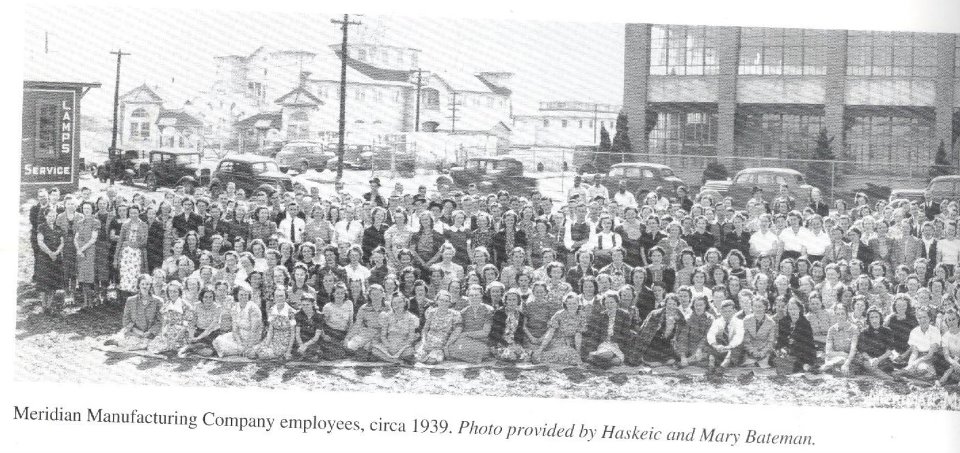
I wish I could say I have lots of old stuff, but alas, I have nearly nothing. I have my maternal grandfather’s old cigar box, and a silver makeup compact from my paternal great grandmother, but the most prize possession is now gone. For a while I had possession of my maternal grandmother’s sewing machine, but it was lost in a move years ago. She was an amazing seamstress and worked for the Burnley Shirt Factory in Meridian, Mississippi. I’m certain she’s in this Burnley employee picture taken in 1939, but it’s so small, I haven’t been able to find her. I don’t even know that I could even recognize her in a picture from 1939.

Burnley Shirt Factory 1939

She died at the age of 59 in 1975 and is still greatly missed. This is her, holding me.

Ina Inez Burke Culpepper 1915-1975

burke ina and gdaughter lori

52 Ancestors #20 Horace Pappy Crane

52ancestors-2015

This challenge is set forth by No Story Too Small,

and this week’s challenge is “Black Sheep.”

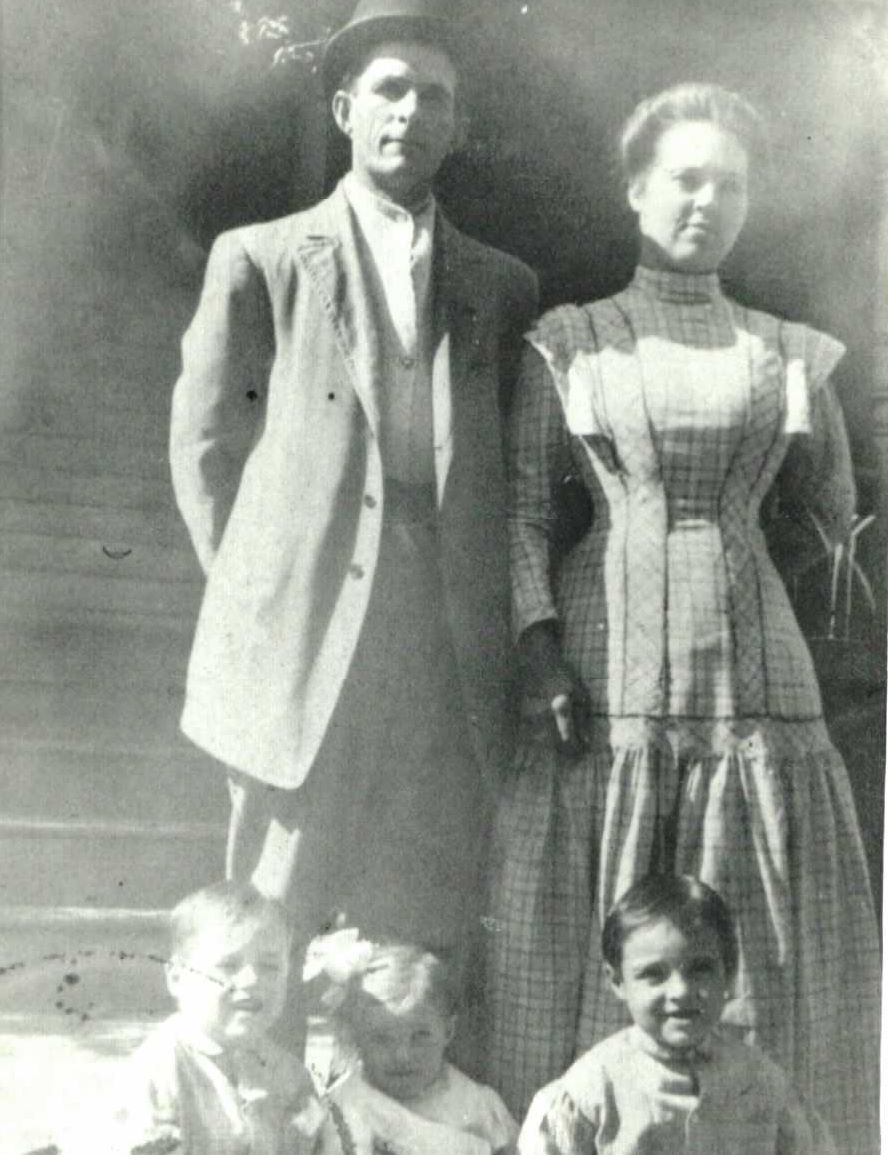
This topic made me laugh as the first person to come to mind was my great uncle Horace “Pappy” Crane. Uncle Horace was born 2 February 1905 to Amos Bolivar Crane and Mary Elizabeth “Minnie” White in Lauderdale County, Mississippi. He was the second of six children. In the following photograph, he is on the bottom far left. The boy on the far right is my grandfather Andrew Franklin Crane.

Amos Crane and Minnie White with Horace, Minnie Ellen, and Frank

Uncle Horace’s claim to fame was driving car #58 in Nascar and surviving a roll-over crash at Daytona in 1960.

This funny black sheep story about him has been pieced together from various relatives and may be a little fuzzy as I have no documentation of the events.

Uncle Horace lived in a modest home in Mississippi and sold off the acres of his property to a builder. The sale did not include his own home, of course. The builder constructed beautiful, expensive homes on the land and eventually came to Uncle Horace to ask when he was going to rebuild. Uncle Horace didn’t realize it at the time, but he had apparently signed a paper stating he would tear down his shack and build a larger, more expensive home in its place. Well, he didn’t have the money to build a new home, so he figured he could make it happen through insurance money and he burnt his own home down.

The arrest happened when the arson investigators found the home was set ablaze with the same mixture of fuel he used to race with. Ooops.

Fortunately for him, he only received probation for the arson, but a while later, he got into a drunken fight in a bar and had a pistol on him – which was against his probation. He spent time behind bars for violating probation.

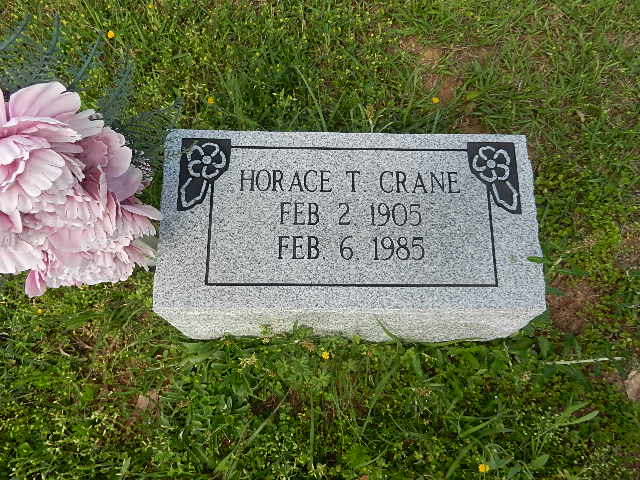
Uncle Horace was the family character everyone has stories about, and the above tale is just the tip of the iceberg. He was very loved. He died 6 February 1985 and is laid to rest at Pleasant Hill Cemetery in Zero, Lauderdale County, Mississippi.

crane, horace t

52 Ancestors #19 Martha Ellen Rodgers

52ancestors-2015

This challenge is set forth by No Story Too Small,

and this week’s challenge is “There’s a Way” which I’ve translated into “travel.”

Years ago I came across a cousin born 4 April 1853. Her father and my 3rd great-grandma were siblings. She was the middle child of five born to James Rodgers and Martha Sanderford in Lauderdale County, Mississippi. When the Civil War began in ’62, her father was too old to serve, so he safely stayed home with her. Yet, things don’t always turn out for the best. The winter of ’62/63 saw a typhoid epidemic in the county and her parents died within days of each other. She was nine. Her name was Martha Ellen Rodgers, known simply as Ellen.

James daughter Martha Ellen Rodgers Meek

Due to all of her uncles fighting the war, she and her siblings moved in with her aunt Mary. Mary had four children of her own and her husband had just been killed in the war 31 December 1862. I can imagine how devastated the family was at that time, and probably hungry and scared.

When the war ended, Ellen was transferred to the custody of her only surviving uncle, Hays Rodgers, who packed up the family and moved to Alabama. The journey there would have been by ox-pulled wagons and would have taken a week. For someone who had never been more than a mile from her childhood home, this must have been quite an adventure. There was also another aunt living in Alabama at the time, Elizabeth, and at some point, Ellen moved in with her.

When I found Ellen had returned to Mississippi alone in 1875, I didn’t understand why, but soon found out that Aunt Elizabeth died that year at the young age of 36. I assume Ellen returned home to stay with her aunt Mary, as she was only 22 years old. The only way to travel from AL to MS at the time was by wagon train as most of the railroad lines were still under repair from their destruction by Sherman’s army. Traveling alone with a bunch of people in a wagon train must have been quite an experience.

The next record of Ellen is found ten years later in 1885. She appears in Texas and is married to Sam Houston Meek. How did she end up there? I found her two brothers had moved there at the end of the war with some other family members (apparently the children were separated), and she probably went out to visit them. One of her brothers was married to Sam’s sister, which explains how she met Sam. From my research, I found the travel from MS to TX would have involved three trains and about ten days. Imagine a young woman traveling alone on three different trains across the 1800s wild west.

Ellen and Sam were only married five years. She died in childbirth at the age of 37. She is buried at Pleasantville Cemetery in Nolanville, Bell County, Texas.

Her story is told in detail in my book An Orphan’s Heart.

rodgers martha ellen rodgers meek, dau of james rodgers