Saturday Snippet – I, John Culpepper

Culpepper_1My new book, I, John Culpepper, has just hit the shelves! I’m so excited.

If you haven’t heard anything about it yet, John Culpepper is my 10th great-grandfather, born in England in 1606 and the progenitor of the modern-day American Culpeppers. The book is the first of four in the Culpepper Saga, the story of John’s life, beginning on the day of his birth, through the settlement of the American colonies, the turbulence of the English Civil War, and the rebellions in Virginia and Carolina which one-hundred years later would lead to the Revolution. It is a series of historical fiction, filled with drama and danger. Yet, there are moments of lightness and humor in John’s life.

When John was fifteen, he attended law school in England, and he was under the understandable impression that his headmaster resembled a goat. The joke between him and his friends carries on for quite a few chapters, as young boys typically can’t let a good laugh go without beating it to death with a stick. At one point, they played a prank on the man just as John’s father stormed into the school, angry about John’s behavior.

Below is one of my favorite scenes featuring John, his brother Thomas, his father Johannes, and Headmaster Barnaby.

**************************************************

Johannes Culpepper stomped in through the archway of the library door. His heavy boots echoed off the stone floor and paneled walls and disturbed the quiet room, causing every student to look up from their studies. Johannes’s sheer size was daunting, and in his broad-shouldered jerkin with his large hat, he looked even more intimidating. His face was red and his eyes were narrowed. His jaw twitched in anger. He marched straight to the table in the center of the room where John, Thomas, and their friends sat.

Thomas looked up in surprise. “Father! What brings you here?”

“I’ve gotten word in London that someone is misbehaving.” He glared across the table at John.

“No, Father, that’s not true,” countered John.

“We will discuss this outside. Both of you, come with me.” He marched out the back door and into Temple Garden with John and Thomas trailing close behind. By the time they reached the middle of the yard, faces of schoolboys had pressed against the diamond-shaped panes of glass, watching and listening for the heated argument that was surely to begin.

Johannes stood with his hands on his hips, chastising the boys about something, but the students inside the library couldn’t make out what he was saying. Johannes’s face was red and veins bulged from his temples, but John didn’t look angry. As a matter of fact, he looked quite amused.

John and Thomas faced their father, and directly behind him, picketed in the middle of the garden, was a white goat, dressed in a black robe with gold cords around its neck. Next to the goat stood Barnaby, his hands on his hips, his face purple with anger as he glared at the goat. The goat looked up at Barnaby and let out a loud “baaaa!” John couldn’t stifle his laughter. He turned away from his father and pretended to have a coughing fit.

****************************************

I, John Culpepper is available at Amazon.

Please stop by the Culpepper Saga Facebook page to see photos and to find more information about the settings and characters.


Katherine St. Leger – Culpepper Saga

Culpepper_1This is the third installment about the people and places in my upcoming series, The Culpepper Saga. You can read the first and second installments here and here.

Katherine St. Leger’s relationship to the Culpeppers is a little hard to explain, so bear with me. She was born in 1602 and was the daughter of Warham St. Leger who was a ship captain and sailed on expeditions with Sir Walter Raleigh. Since her father was absent most of the time, she lived with her grandmother, Mary St. Leger, and her step-grandpa, Alexander Culpepper.

Alexander Culpepper had no children and married the St. Leger widow when he was thirty-three years of age. She was quite a bit older than him and was probably already done birthing children by then. That being said, Alexander loved his step-granddaughter, Katherine, and raised her as if she was his own, actually naming her as his daughter in his will.

When Katherine was twenty-six years old, she married Thomas Culpepper, Alexander’s nephew. Thomas was the son of John Culpepper, whom we call Johannes in the book because there are way too many Johns. Johannes was Alexander’s brother. Johannes had two sons, John (our hero) and Thomas. Thomas married Katherine. Did you catch all that?

Katherine and Thomas grew up as cousins, but they really weren’t. Try explaining all that in a book. Go ahead. I dare ya. You’ll have to read the book and see how the heck I did it. 🙂

So, now that you have a slight grasp on who Katherine is, here’s a snippet from the first book, “I, John Culpepper.” Thomas and John are very close, but John has always felt Thomas was their father’s favorite. Maybe he’s right.

***************************************

At the conclusion of the first family supper in their new home, Thomas tapped on the rim of his glass to get everyone’s attention.

“Katherine and I are so pleased that you all could join us in our new home. We trust you all had a pleasant journey getting here, and please know that you are welcome to stay for as long as you like. We invited everyone because we have some news.” He gestured for Katherine to stand by his side. “We would like to inform you that Katherine is with child and we are expecting the first Culpepper grandchild.” Thomas beamed like a ray of sunshine.

Johannes rose and patted him on the back. “Thomas, Katherine, we are overjoyed by this news, and let me be the first to wish you a healthy son.” Johannes raised his glass and the gathering followed his lead.

From across the table, John watched the interaction between his brother and his father, and wondered if he would have received the same hearty congratulations if it were him announcing the arrival of the first grandchild. He glanced at Mary and found her staring at him. He smiled faintly, but knew by the way she cocked her head that she recognized something was amiss.

*********************************************

“I, John Culpepper” will be released April 10, 2015.

Ursula Woodcock Culpepper – Culpepper Saga

Culpepper_1This post is in place of my usual “Saturday Snippets,” and is the second installment of the background of the people and places in my coming series, The Culpepper Saga. You can read the first installment here.

Ursula Woodcock Culpepper is one of the more sentimental characters in my coming series. She was our hero’s mother, and sadly, is only in the first book, “I, John Culpepper.” She was my 11th great grandmother.

astwoodUrsula was born to Ralph Woodcock, the Alderman of London, and his wife Good Bower in 1566. She was baptized at St. Lawrence Jewry in London on January 27, 1566. Her father’s will describes her as “my daughter Ursula, wife of Solomon Pordage.” Ursula and Solomon married in 1581, when Ursula was a child of fifteen.  Solomon Pordage died September 12, 1599 and his will commended his wife to his kinsman, William Stede of Harrietsham. Solomon’s sister, Joan Pordage, was married to a Culpepper and Ursula probably met her second husband, John Culpepper of Feckenham, at family gatherings long before she was widowed. Note: This is John Sr., not our hero John, and in the book I refer to him as Johannes, as that is what is written on his tombstone.

Ursula and Johannes had four children: Thomas, Cicely, John (our hero), and Frances. When the children were small, between the ages of four and ten, the family left their home in Kent and moved to Astwood Court in Feckenham (photo) so Johannes could retire and become a “country gentleman,” but they lived there for less than a year when Ursula took ill and died. She was buried at St. John the Baptist Church in Feckenham on June 2, 1612 as “Ursula, the wife of John Culpepper, Esquire.” She was forty-six years old.download

In the first book in the Culpepper Saga, “I, John Culpepper,” the following is what Johannes thought of his lovely wife. The book will be released April 10, 2015.

*****************************************************************

He pushed open the heavy door a few inches and peeked through the crack. The room was dim with all the heavy curtains drawn. It was quite different up here than the sunshine-filled bustle of the rest of the house. The room was quiet and warm, with the soft flickering light of candles dancing on the tapestries that covered the walls. He called out, “Ursula?”

“Johannes? Is that you? Please, please, come in.”

Her golden voice was as sweet as an angel’s, and that made him smile. He’d married her because of her cheerful voice—well, that and her family’s money. The Woodcock family had more manors and land than the Culpeppers, and the time-honored tradition of marrying heiresses and widows was generally the way the Culpepper men gained their fortunes. But Ursula had something else about her that Johannes loved. She was warm-hearted, with a gentle smile and soft manner. He had initially been attracted to her by the way she said, “Good morning,” and “Good evening,” and particularly the way she said, “Johannes.” Words floated from her lips as if they were lyrics she was singing just for him. Her voice had a happy lilt that filled his heart the way nothing else did. Today, it made him happy to be home.

He swung the door wide, entered the lavishly appointed room, and found Ursula sitting up in the four-poster bed, wearing a soft white gown that floated over her petite frame. A stack of pillows rested behind her back and her legs were covered with a brightly colored velvet quilt. Her hair was plaited on either side of her face, and Johannes was momentarily awed by how peaceful she looked. Childbirth agreed with her.

Her expression was one of excitement and anticipation as she held their newborn in her arms, and her smile grew more radiant as he approached the bed. “It’s a son,” she said.

***************************************************************

Sir William Berkeley – Culpepper Saga

Culpepper_1For the next few Saturdays, in place of my usual “Saturday Snippets,” I’m going to give you some background into some of the people and places in my new series, The Culpepper Saga. The series consists of four books which will be released between April and September.

One of the main characters is Sir William Berkeley. I write stories of my ancestors, but Berkeley is not one of my ancestors. He was, however, a life-long friend of our hero and my 10th great grandpa John Culpepper.

In the 1st book, Berkeley and John are young law students in England. In the 2nd and 3rd books, Berkeley plays a daily role in John’s life and is the Governor of Virginia. In the final book, Berkeley is married to John’s niece and is at the center of a deadly rebellion.

SirWilliamBerkeley2William Berkeley, referred to as “Will” by his family and friends, was born in England in 1605. He was the colonial governor of Virginia from 1642 until his death in 1677. Upon his arrival in Virginia, he built a plantation called Green Spring House and planted corn, wheat, barley, rye, and tobacco, though he despised tobacco. In 1670, he wed thirty-six-year-old Frances Culpepper, the niece of our hero John. Historical records show him fleeing Jamestown during Bacon’s Rebellion in 1676 and taking refuge in Accomac, Virginia. Most people leave it at that, but in my writing world, I happen to know that John had a house in Accomac, so it is obvious he went to John’s. After all, they had been friends for many years, and they were family through marriage. I’ll let you read the rest of his story in the Culpepper Saga, but I’ll leave you with a tidbit from the day he and John met as young boys at law school–a place called Middle Temple.

Note: Wikipedia does not confirm that Berkeley attended Middle Temple, but in “The History of Middle Temple” by Hart Publishing, records of Middle Temple show Berkeley as a student. He also wrote and published a few plays in the 1630s, which was a large part of the curriculum at the school.

The following is an excerpt from “I, John Culpepper.”

**************************************

John clapped along with the other boys as the headmaster strolled toward the center of the room. The man looked as stern as JC had warned. A pair of spectacles rested on the tip of his pointed nose, and his rather large ears stuck out from under his cap. He began stroking his goatee as if caressing the family pet. For a moment, John couldn’t put his finger on what was so amusing about the man’s appearance, then it struck him—the man looked like a goat. John tried unsuccessfully to stifle a giggle.

Barnaby’s brow wrinkled and the corners of this mouth turned down like a fish as he scanned the group of boys. He looked at each one as if viewing a repulsive heap of trash. He cleared his throat and his Adam’s apple bobbed up and down. Just as he opened his mouth to speak, a frizzy-headed boy ran into the room, allowing the door to slam behind him. The sound echoed loudly within the stone walls and the tardy boy’s face turned red with embarrassment. Barnaby followed the boy’s movement with his narrowed eyes as the boy took the only empty seat in the room—right next to John. John felt a trickle of sweat drip down his back as the headmaster slowly walked toward them.

“You’re tardy for my class,” the man scoffed, his eyes filled with hostility. When he said the word class, he drew out the a for an inappropriate amount of time, and John was again reminded of a goat, but with the man standing directly in front of him, he didn’t dare giggle.

“My apologies. I just arrived, sir.”

“What is your name, boy?” Barnaby growled.

“William Berkeley, sir.”

“William Berkeley.” He stared at Berkeley for a long time, as if attempting to memorize every feature of the boy’s face. He then repeated the name. After what seemed like an hour of uncomfortable silence, with the tension in the room growing by the second, Barnaby said, “William Berkeley, I will speak with you in private following this evening’s supper.”

“Yes, sir.” William lowered his eyes to the floor.

As Barnaby turned his back on Berkeley and returned to the center of the room, Berkeley glanced around the room at the other boys. John wondered if Berkeley’s humility was in respect for the headmaster or due to his embarrassment for being late, or both.

Berkeley leaned over to John and whispered, “Who’s that old goat?”

John almost laughed out loud and his hands flew up to his mouth.

Berkeley winked at him and grinned.

******************************************

The first book in the Culpepper Saga, “I, John Culpepper,” will be released April 10, 2015.

Saturday Snippet – I, John Culpepper

Here’s a bit of my work-in-progress, “I, John Culpepper.” For you ancestry/genealogy readers, John Culpepper is my 10th great grandpa. Release date will be April 10, 2015.

****************************************************

Culpepper_1Fall 1626, England

“No! For the hundredth time, no!”

John looked down at the intricate grain of the walnut desk beneath his fingertips and shifted his weight to his other foot. He sighed, feeling his dreams disintegrate before his very eyes. The snap of the white sails, the taste of the salty spray on his lips, the smell of the tar that sealed the decks—the visions were quickly vanishing behind the thick fog of his father’s adamant disapproval. He pictured his mighty ship sinking into the black waters of condemnation, bubbling like a cauldron as it disappeared from sight. There was nothing he could do to change his father’s mind, and he wondered whatever possessed him to come to this man for assistance. He should have known better.

His father glared at John from behind the desk. He propped his elbow on the scrolled arm of the chair as his large hand methodically stroked his pointed beard. “Is there anything else?” he snapped.

John didn’t look up. He shook his head and mumbled, “No.” He turned and padded across the thick rug toward the door, listening to the man’s heavy breathing behind him. He reached for the brass doorknob, paused, and turned back. “You know I’ve always done everything you’ve asked of me. I went to school. I studied to be a lawyer. I did it all for you. I never wanted to practice law. I’d never be happy on the bench.”

“Happy? What makes you think life has anything to do with being happy? You are a Culpepper, and as such, you have an obligation to serve your family and your king in a manner befitting your station. This childish notion of owning a ship is nothing but rubbish.”

John released the doorknob and walked back toward his father’s desk. The intimidating man dwarfed the desk, his size exaggerated by the broad shoulders of his leather jerkin, yet he sat up taller in his chair in preparation for the quarrel to continue. It was a wasted gesture, as his opponent already knew the battle was lost.

John made sure he didn’t raise his voice. “Father, you have financed merchant ships for as long as I can remember. What difference does it make if I’m the one who owns the ship?”

“Culpeppers don’t own ships. I funded those expeditions as an investment—a losing investment, I might add.” He rose from his chair and his voice grew louder, echoing off the oak panels that lined the walls. “There has never been a Culpepper placed in a position to experience hunger and savages and shipwrecks, and there won’t be one now, not with my blood written on the purchase. I will not fund a ship for you, John, not now, not ever.” He pointed his finger in John’s face. “And if you somehow find a way to procure a ship, mark my words—I will disinherit and disown you. No son of mine will become a common sailor. I am finished with this conversation once and for all. Have I made myself clear?”

John exhaled, beaten. His shoulders slumped as he broke his father’s glare and dropped his eyes to the floor.

“John? Have I made myself clear?”

“Completely.”

Saturday Snippet – John Culpepper the Merchant

culpepper book 2 cover ideaThe second book in The Culpepper Saga takes place in the mid-1600s. John Culpepper finally got himself the boat he wished for throughout the first book (“I, John Culpepper”) and has fulfilled his dream of sailing to the new colony of Virginia. However, while he was away, civil war broke out at home in England, and John is in an understandable hurry to get back to his wife and family.

Here’s a scene from “John Culpepper the Merchant.”

***************************************************

November 1642, The Doldrums


The Thomas and John sat idle, unmoving in the dim morning light. Her sails hung limp, as they had for the last two days. John ran his hands through his hair and impatiently tapped his foot as he stared across her bow at the unending sea of glass before him. The water blended with the sky, creating a mist as far as the eye could see. There was no horizon, just an endless mirror of foggy steel blue.

He never thought this place existed and had never experienced it on any of his prior journeys, but now, when he most needed to make haste, he found his ship stuck in the middle of it. They called it the doldrums—the place in the ocean where no wind billowed sails, no waves lapped against hulls, and no mighty vessels leapt across the breakers. John had heard tales of ships being stuck in the doldrums for weeks at a time. He prayed this wouldn’t be the case, but on this third morning, he was beginning to wonder if they’d ever break free of it. He’d heard ancient legends of ships carrying horses beneath their decks, and when they found themselves stuck in the doldrums, the crew would build cranes, lower the horses into the water, and allow them to pull the ship. He didn’t know if those stories were true, for he had never witnessed a horse swimming, but in any case, he wasn’t carrying any horses. He was, however, carrying two small rowboats.

“Drop the boats!” he yelled to Benjamin. “We’ll row.”

“Sir?” Benjamin approached. “You want the crew to row us out of the doldrums?”

“Yes, Benjamin. Put them to oar. See to it at once.”

“Yes, sir.”

* * *

The men dropped the small boats into the water, tied them to the ship, and began to row. They struggled against the weight of their load, but ever so slowly, the majestic ship began to creep forward.

“How long do you think we’ll have to row?” one of the sailors asked another next to him.

“Until the cap’n gets her back to wind…or until we’re all dead. Whichever comes first.”

“Stop talking and keep rowing!” Benjamin bellowed from the bow.

For the next thirty hours, the sailors took turns rowing. The only movement in the water surrounding them came from the small ripples caused by their oars. After more than a day, the limp sails picked up a small draft and began swaying in the midafternoon sun.

“Sir!” yelled a sailor from one of the boats.

Benjamin turned and saw the sailor pointing up toward the sails. He looked up and saw the sails flutter in the breeze, and an uncommon grin spread across his unshaven face. He jogged to the back of the ship and descended the creaking, wooden steps to the lower deck. He dropped his head below the opening and blinked to adjust to the dim light. “Cap’n, she’s back to wind!”

“Finally!” John jumped from behind his scarred, wooden desk and followed Benjamin up the steps. On deck, he raised his hand to block the sun’s rays as he looked up at the fluttering sails. A cold, Atlantic breeze blew across John’s face, the first he had felt in four days, and he laughed out loud. “Ha! We’ve cleared the doldrums! Benjamin, hoist the sails and get us underway.”

“Aye, sir. Hoist the sails!”

Almost instantly, there was a flurry of activity on the upper deck as weathered sailors began pulling up the small boats, climbing the masts, raising the sails, and shouting commands.

“We have a lot of time to make up,” John said. “I want to be in London within the week.”

“Aye, sir!”

***********************************

John Culpepper the Merchant is now available at Amazon!

For pictures, paintings, and documents of the people and places in the Culpepper Saga, please visit the Culpepper Saga Facebook page.

Saturday Snippet – ELLY HAYS

elly cover_webElly Hays is the real-life story of a woman struggling to keep her family safe from the Creek Indians during the War of 1812. From the first few chapters, you know there is no way this story is going to end without a terrifying confrontation.

*********************************

She angrily plopped down on a rock and yanked dirty stockings from the basket. She dunked them in the water and began scrubbing them hard enough to put holes in them. She could feel her ears buzzing and her shortness of breath and realized she needed to calm down. She stopped scrubbing, closed her eyes, and took a deep breath through her nose, trying to slow her heart. She concentrated on releasing the tension in her shoulders and the knot in her stomach. She felt guilty for losing her temper with her husband, but frustration was taking over her life. Every day brought new problems—life-and-death problems. Her mounting anger was overriding her fear of the Indians and her love for her husband.

She opened her eyes when she heard him clear his throat behind her, and she turned to apologize for her harsh tone of voice. But when she saw the black eyes looking back at her that did not belong to James, she stopped and gasped. They belonged to an Indian, sitting tall on a brown and white painted horse. She hadn’t heard him approach. She jumped to her feet, wondering where she could run.

The Indian was bare-chested, wearing only tan animal hide pants and moccasins. His hair was short, shaved on the sides and sticking up higher on top. Most of the Indians she had seen had this same haircut. His face was covered with lines of red and black paint, and he wore a headband tied around his head with strips of animal fur hanging on either side of his face. His headband was not adorned with any feathers. This was not the same Indian she had seen before.

He stared at her for a long time and did not move. She glanced across the swift creek to the left and right, but there was nowhere to run. She would never be able to outrun a horse. Her heart beat wildly as beads of sweat broke out on her brow. She remained frozen.

“I came to warn you,” the Indian said in a monotone.

Elly was surprised by his English.

He sat motionless, waiting for her response.

She finally blurted out, “Warn me about what? That you want us to leave? We already got that warning.” She could feel her temper escalating again. All of the tension she had felt the last few months, all of the worry for her children, all of the stress of building a new life, was about to explode in this Indian’s face.

“Yes, I’m here to warn you that you need to leave, but not for the reason you are thinking.” He looked down at the reins in his hands, as if trying to gather his thoughts and find the correct words. “My brother and I were the ones who killed your animals.”

Elly threw a wet stocking on the ground. She hadn’t realized she was still holding it, and it had dripped down her blue linen skirt, causing the front of her dress to become dark in color. “You? You did that? How am I supposed to feed my children?” she raised her voice, her temper becoming stronger than her fear.

“This is the least of your worries. When your husband chased us away, my brother’s boy fell from his horse and snapped his neck.” His eyes carried a tint of sadness. “The boy is dead.”

Elly felt her heart soften for a young boy she didn’t even know. Her anger began to subside, as if it were being washed away by the babbling creek beside her. “I’m…I’m very sorry to hear that,” she stammered, wringing her wet hands together.

“You must understand, my brother is the great warrior of our village. He has vowed revenge on your husband and your family for the death of his son.”

Elly’s eyes widened as the Indian continued.

“He told our Great Chief your husband killed his son, and the Great Chief has given him permission to slaughter your family.”

Elly was shocked by the revelation and quickly shook her head. “No. My…my husband would never kill a boy. He’s never killed anyone, for any reason.”

“Our great warrior does not know this.”

“Please tell him. Tell him my husband didn’t kill his son.” She took a step forward as she begged.

The Indian shook his head and looked at her with compassion. “I cannot tell him anything. I can only warn you. You must leave now…before it’s too late.”

*********************************

Lori Crane Books at Amazon

Saturday Snippet – SAVANNAH’S BLUEBIRD

bluebird_small webSavannah’s Bluebird is a love story with a ghostly twist.

*************************************

The bells rang from atop the steeple as Savannah struggled to pull open the ancient wooden door of the church. When she entered, she saw the backs of the heads of dozens of people sitting in the pews. She stopped in the vestibule and awaited the organ music to announce her entrance. She ran her gloved hand over her dark brown hair, adjusted her pillbox hat, pulled the tulle veil over her face, and smoothed down her ivory wedding gown. In her other hand, she clutched a dainty bouquet of white roses with sprays of baby’s breath. The smell filled her nostrils.

After a few moments, the organist at the front of the church played a fanfare and immediately followed with the “Wedding March.” She inhaled deeply and took a small step forward. After a pause, she took another step…and another. She hesitated, thinking it strange that the crowd didn’t rise and turn to face her. She inched forward again, pausing between steps. Surely the congregation would rise when the minister instructed them to do so, but she didn’t know what he was waiting for. She put a smile on her face as she admired the sun shining through the stained-glass windows, creating a mosaic of bright colors across the room, but as she reached the halfway mark of her grand entrance, the room darkened. The sun had disappeared behind a cloud, and the vibrant colors that bathed the room turned a dismal shade of gray. Her smile vanished also.

It was difficult to see through the netted veil, but she could have sworn she saw something large sitting in the center of the altar. She narrowed her eyes and, yes indeed, something was there. At the top of three small steps that led up to the altar, a white coffin rested in front of the minister’s podium. It was surrounded by beautiful sprays of flowers—roses, carnations, chrysanthemums, daisies. The sight reminded her of her father’s funeral and her head swam with the painful memory. She looked down at her bouquet and closed her eyes for a moment. When she opened them again, her breath caught deep in her chest as she watched her beautiful white roses faded from white to gray to black—black and dead. The leaves shriveled and a few of the petals gently fell from their stems, fluttering to the floor. She tightly clutched the bouquet and quickly pulled her left hand away when a thorn poked through her glove and punctured the skin of her palm. She saw the small hole in the satin fabric, but there was no blood.

She squeezed her hand into a fist to make the pain stop, and looked back up at the altar. Why was there a coffin on the altar, and where was August? Why was her groom not there to greet her? She staggered a bit as she took another step forward. The “Wedding March” kept pounding from the organ and she kept inching forward. She placed her hand over her heart in an effort to make it beat normally. Remembering the puncture wound, she looked down at her dress to make sure there was no blood on the bodice. She stopped dead in her tracks.

Her beautiful wedding gown was no longer ivory; it was now black. She thought she would faint, and looked up to search the crowd for someone to help her. When she looked through the mesh of her veil, she noticed it too had turned black. Panic rose in her chest and her throat constricted. The next breath wouldn’t come. She felt her knees quiver and she didn’t know if she could take another step. Her mouth opened and closed like that of a fish gasping for air, but she couldn’t form any words. She looked left and right at her family and friends, but no one looked back at her. They all stared straight ahead. It was as if they didn’t see her.

She stumbled forward a few more steps and noticed her soon-to-be stepdaughter, Emma, sitting alone in the second pew. She approached Emma and noticed tears running down the girl’s face, dripping off her chin and leaving dark spots on her pink cotton dress. She reached toward Emma, but stopped when the “Wedding March” turned into Chopin’s “Funeral March.” She looked up at the organ on the right side of the altar, but the organist did not look back at her.

Was Savannah in the wrong place?

She spun around in what felt like slow motion and looked at the stained-glass windows, the pews, the high, scallop-shaped ceiling. No, this was her childhood church—Fisherman’s Church. She had been coming here since she was a baby. Was she here on the wrong date? She turned again and looked at the people. She knew every one of them. She had invited every one of them. She knew it was August 25, 1936—her wedding day. Why was Emma here at a funeral? Why was she crying? More importantly, who was in the coffin?

She spun again and faced the coffin on the altar. Was she losing her mind? Where was August? Terror filled her as adrenaline rose like flames up the back of her neck.

Two men she had never seen before, dressed in black suits, stepped forward and gently opened the coffin’s lid, and Savannah saw the inside of the lid was lined with blood-red satin. Who is in there? And why was there a funeral here on her wedding day?

She climbed the three steps to the altar and placed her hand on the side of the coffin. She reluctantly looked inside.

It was a woman—a dark-haired woman in an ivory wedding dress.

She gazed down into her own face and heard a scream escape her lips.

**************************************

Savannah’s Bluebird is available at Amazon, Barnes & Noble, and iTunes.

Saturday Snippet – STUCKEY’S GOLD

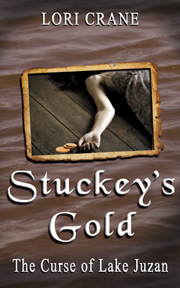
stuckey Gold Cover smallIn the second book of the Stuckey’s Bridge Trilogy, Levi met an alluring young woman named Penelope Juzan. Apparently, the Juzans have quite a past which became the third book in the trilogy. Stuckey’s Gold is the story of four generations trying to escape a curse brought on by greed. The story weaves between Penelope and her friend Luke and their fathers, grandfathers, and great grandfathers. It doesn’t much matter which one we speak of. They all suffered pretty much the same terrible fate.

*************************************

He glanced back toward the shore one more time to make sure Marguerite hadn’t followed him. But what if she had? It wasn’t like he could hide in a rowboat in the middle of the lake. But if she caught him, she would be furious, and he really didn’t want to attract her wrath. She was a mean woman when she was cross. He chuckled. Well, she’d get over it once she ran her fingers through the gold in the trunk. He smiled at the thought. They were going to be very, very rich, and she couldn’t possibly be annoyed with him for that.

He dropped the anchor over the side and let out the rope. He released more and more of the rope and was almost at the end of the line when it finally went slack and he knew it rested on the bottom. “Gee,” he mumbled to himself, “that’s a thirty-foot rope.” He knew the lake was deep in spots, but it had never before occurred to him until that moment how deep it was. “No wonder no one’s been able to retrieve the gold before.”

Suspecting the trunk of gold would be too heavy to lift to the surface by sheer manpower, he had recalled the ideas written in his father’s journal on ways to raise the trunk, and he had brought two extra ropes with him. The plan was to dive down and tie both ropes around the trunk, and then hoist it up into the boat. He hoped he could do so without capsizing the small vessel because it’d be a long swim back to the shore. He tied the ends of the two ropes to the boat and then slapped the water with his paddle to scare off any snakes that might be lurking. He glanced again at the shore, just in case his wife appeared. The coast was clear. He grabbed the loose ends of both ropes and dove into the black depths.

It had been so hot the whole summer, the cool water felt refreshing. Down, down, down he went. His ears popped with the pressure. He felt around in the blackness, hoping to find the edge of the net floating in the water. He felt nothing. When his lungs felt as if they would burst, he returned to the surface. He looked around again at the landmarks on shore to make sure he was in the crosshairs of the oak, the pines, the rocks, and the inn. Yes, the trunk had to be right here.

He took another deep breath and dove again. About half way down, he felt something brush his thigh. He figured it was one of the ropes, then realized it might be the net. Adrenaline pumped through his veins in anticipation. He grabbed in the direction where he felt the object, but nothing was there. He froze for a moment as an alarming thought came to mind. What if it had been a snake? The snakes around here could kill a man with one bite. It would be a horrific and painful death. He ignored the thought and kept swimming downward, trying not to be too disappointed that he hadn’t found the net yet.

When he reached the bottom, his ears pounded from the pressure. He could feel it in his jaw and across his whole head. He quickly groped around in the blackness, knowing he wouldn’t be able to stay down too long. There was nothing but weeds and silt. He kicked off the bottom and shot up again to the surface. He took a deep breath and turned to check the landmarks once again. When he turned to look behind him, he came face to face with the most dreaded of snakes—the cottonmouth. Its snout was not more than a foot from his face, and Gabriel saw its tail flicker in the water nearly three feet away. It was huge, solid black except for tan markings on its face. Gabriel remained as still as possible, hoping the creature was as startled as he and would turn and swim away.

The snake quickly slithered across the surface of the water, but it didn’t swim in the opposite direction. It darted directly at him and struck him on the cheek. He cried out as the serpent dashed away, disappearing as fast as lightning.

*************************************

Stuckey’s Gold is available in paperback and Kindle at Amazon and in paperback at Barnes & Noble.

Saturday Snippet – STUCKEY’S LEGACY

unnamedWhile writing The Legend of Stuckey’s Bridge, the main character came across a young boy. The boy ended up being nearly as creepy as the main character, and I received tons of emails asking me to elaborate on the boy’s life. No one is that creepy without having some sort of lurid past. So, I penned Stuckey’s Legacy. The boy’s name is Levi, and he is a dark character. Creepy doesn’t quite describe him…

**************************************

The starlit night was perfect for a romantic walk, and it would have been pleasurable to stroll the streets for a while in the balmy night air, but Levi had more immediate plans for his escort. He marched her to the nearest hotel and checked in under the name Thomas Stuckey.

“I thought your name was Joe.” The girl giggled as she entwined her arms in his.

“It is Joe, but I don’t want to put that on the hotel register.”

They kissed as they staggered up the stairs, laughing all the way up to their room on the top floor of the three-story hotel.

Following their lovemaking session, Grace lay in Levi’s arms and listened to him tell her all about the fancy people he was going to be friends with on Jekyll Island, about Cornelius Bliss’s death, and about the New Year’s Eve Gala tickets he’d found when he broke onto Mr. Pulitzer’s yacht.

She rolled over onto her stomach, crossed her arms across his bare chest, and looked at his face. Her blonde ringlets danced across her face and he softly pushed them from her temple.

“You’re really quite pretty, you know that?”

She blushed. “Then why don’t you take me with you?”

“Oh, that’s out of the question, dear. I’m going to meet wealthy society people, and I don’t think you’ll fit in.”

“Well, what makes you think you’ll fit in?” she teased.

“Don’t you think I’m one of them?” Levi frowned.

“Mister, I grew up in the Charleston Orphan House. I know a poor orphan when I see one.”

“Well, I never lived at the Charleston Orphan House, but it’s true I’m an orphan.”

She looked at him like a lovesick schoolgirl and waited for him to elaborate.

“I was orphaned years ago. My father was a drunk. He killed my mother right in front of me when I was eight years old.”

Grace gasped.

Levi continued. “He strangled her after he caught her fooling around with a man from up the road. He murdered both of them in a fit of drunken rage.” Levi looked away from her and stared at the ceiling.

“I’m sorry. You probably loved her very much, huh?”

“I don’t know. I thought I did for a long time, but my father pounded into my head that my mother was not worthy of my love. She was a whore.”

Grace grinned. “Well, I’m a whore. It’s not all bad.”

He looked at her with surprise. He didn’t think of her like that, but it was true. “I guess you are, aren’t you?”

“What happened to your father?”

“I killed him,” Levi said flatly and looked back at the ceiling.

After a few uncomfortable seconds, Grace giggled. “No, really, what happened to your father?”

He looked her in the eye. “I killed him.” He paused to watch her expression and was satisfied with the look of fear in her eyes.

***************************************

Stuckey’s Legacy is available at Amazon.