Can you come up with 23 ancestors? Do you have family stories, photos, documents? Are you a history/genealogy/ancestry buff?
Then please join us for the October Ancestry Challenge 2013!!
The goal is to write 23 posts (Monday through Friday) in October about a different ancestor each day.
If you travel back in time so far that you only have a birth date and place, you can transform your story into a history lesson. As a history buff, I love reading about the clothing styles, means of transportation, and local flavor of the past, so be creative with your ancestors. Where did they live? What did they do? Where did they travel to and from? My great grandmother said about my great grandfather, “He had rosy cheeks and teeth as white as pearls.” Maybe white teeth were rare in 1900. 🙂
Let me know in the comments if you’d like to join us, and I’ll add you to the list below. And feel free to steal the challenge banner from this page.
Everyone, please stop by during the month of October and share the past with us.
I was looking for a blog challenge in which to participate in October and didn’t come across anything I liked, so I decided to create my own challenge. Do you study genealogy? Do you have tons of ancestry info and no place to share it? If you read further and decide you’d like to join me, please do so. Help yourself to the official banner and let me know that you’d like to participate. I will post a link to your page as a participant on the “official kick-off blog” the weekend of Sept 27 and update it as anyone joins us.
The October Ancestry Challenge 2013 will be 23 posts (Monday through Friday) in October about a different ancestor each day. If you can find 23 ancestors, you can rock this challenge. It will also be a lesson in history, clothing, culture, and world events. You may include yourself and your parents if you choose.
I’m going to blog about the Culpeppers. I have 25 Culpepper ancestors ranging from my maternal grandfather Earl Culpepper who died in 1994 in Mississippi…
all the way back to my 23rd great grandfather John Culpepper who was born around 1140 in Kent, England.
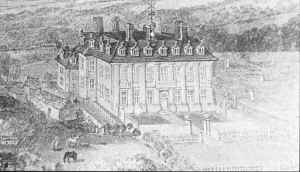
(This was his house called Bayhall Manor in Pembury, Kent. Remains of the building were visible until 1960, when one of the national newspapers told a rather exaggerated story of its being haunted. People coming to see it made themselves such a nuisance and rendered it so unsafe, that the owner of the land cleared the ruins away. The ghost was supposed to be that of Anne West, the last person to reside in the mansion. See? It’s already an interesting ancestry blog.)
My Culpepper ancestors lived through the 2nd Crusade, Genghis Kahn, Marco Polo, gunpowder, the Bubonic plague, Joan of Arc, Henry VIII, Christopher Columbus, Isaac Newton, The Revolutionary War, The War of 1812, Napoleon, Louis Pasteur, Charles Darwin, railroads, The American Civil War, Thomas Edison, Alexander Graham Bell, Model T, Albert Einstein, WWI, airplanes, Titanic, WWII, Vietnam War, not to mention, Victorian dresses, Hobble skirts, ragtime music, smoking jackets, and the first television.
I’m looking forward to putting together these blogs beginning with my grandfather and working back in time. Please join me beginning October 1st to participate and/or to visit.
I met (online) a cousin on my dad’s side. We share a great grandfather, who I haven’t written about in my blog yet, but I guess I’ll have to get on that now. She showed me a picture of a plaque located in the Lauderdale County Courthouse in Meridian, Mississippi. Our mutual grandfather, Thomas G Lafayette Keene, was apparently the treasurer of Lauderdale County from 1904-1907.
That was awesome! But that wasn’t the funny part.
The book I released in June is called “The Legend of Stuckey’s Bridge.” It takes place in Lauderdale County and you can click on “my books” at the top of the page to read all about it. The man chasing the evil Old Man Stuckey throughout the book was Sheriff J.R. Temple. Go back to the picture and look at the top name.
You probably heard me scream from my office last night when I saw that! My books are historical fiction, based on real people and real events, but it is still strange to see his name etched out in marble and to be reminded that he was indeed a real person and not just a character in my head. And that he knew my great grandfather. 🙂
I had so much fun doing this interview. Elizabeth is a warm and gracious hostess, and also a busy teacher, librarian, historical fiction author, and reader. I don’t know where she finds the time to do things like chat with me, but the pleasure was all mine.
Like I don’t have enough to do, I’ve decided to make Ancestry Scrapbooks for my grown children. Our family is traced so far back, there are almost 9000 people in our family tree, and when I speak about it to my children, they get that glassy-eyed glaze-thing happening. And it doesn’t help matters that since the early 1500s, most of our family have lived in the southeast part of the United States. You know what they say about the south being all intermarried? It’s true! So, when I try to explain that someone on mom’s side is the sister of someone on dad’s side, I lose the kids. Don’t even try to tell them grandpa’s little sister married grandma’s uncle, making my grandma’s uncle also my momma’s uncle. Forget it. They don’t care.
Well, I want them to care!
So, I’ve decided to put together a fun and colorful book they can look through and connect their own dots. There’s a company called My Canvas, that will make a real printed book. You upload all your stuff, arrange it anyway you want, and for a fairly decent price, they will print a real book. They are beautiful books, but the largest is only big enough for 4 or 5 generations. I think I want a little more.
How about a digital scrapbook from DSP?? You make as many pages as you want, print them, and put them in any book you want.
Check out this cover with all the family names! I’m in love with this!!
Apparently you need a photo program like Photoshop (which I suck at) and a layout program like “My Memories Suite” or “Nova Scrapbook Factory Deluxe.” Then you can purchase page kits online or a whole CD of designs. I don’t know that I want to put time into learning a new program. I think I may stick with the old fashion scrap-booking process. Cutting, gluing, adding embellishments.
…but I do LOVE that cover! I might try it.
************************
Update Sept 1st – I did it. I buckled under the pressure and bought “My Memories Suite” and tons of ancestry/genealogy/heritage paper and embellishments to play with. I’ll let you know how it turns out! 🙂
Rice Benjamin Carpenter was born August 15, 1828 in Greene County, Alabama to Benjamin Carpenter and Nancy Rice Carpenter. He was the eighth of ten children.
In 1834, his family moved to Pine Springs, Lauderdale County, Mississippi for the low-cost land and fertile soil. Rice was six years old.
He married Mary Ann Rodgers in 1846. They were both seventeen.
They had five children – Martha Lettie, Benjamin Hays, William Travis, Charles Clinton, and MF – one girl and four boys.
After living with his friends Ebenezer and Sarah Miles in Pine Springs for a few years, in 1853 they bought 80 acres of land from Mary Ann’s father and began farming, but within a few short years, Rice realized he was a better merchant than a farmer, and by 1860 they had opened a general store in Marion Station, Mississippi.
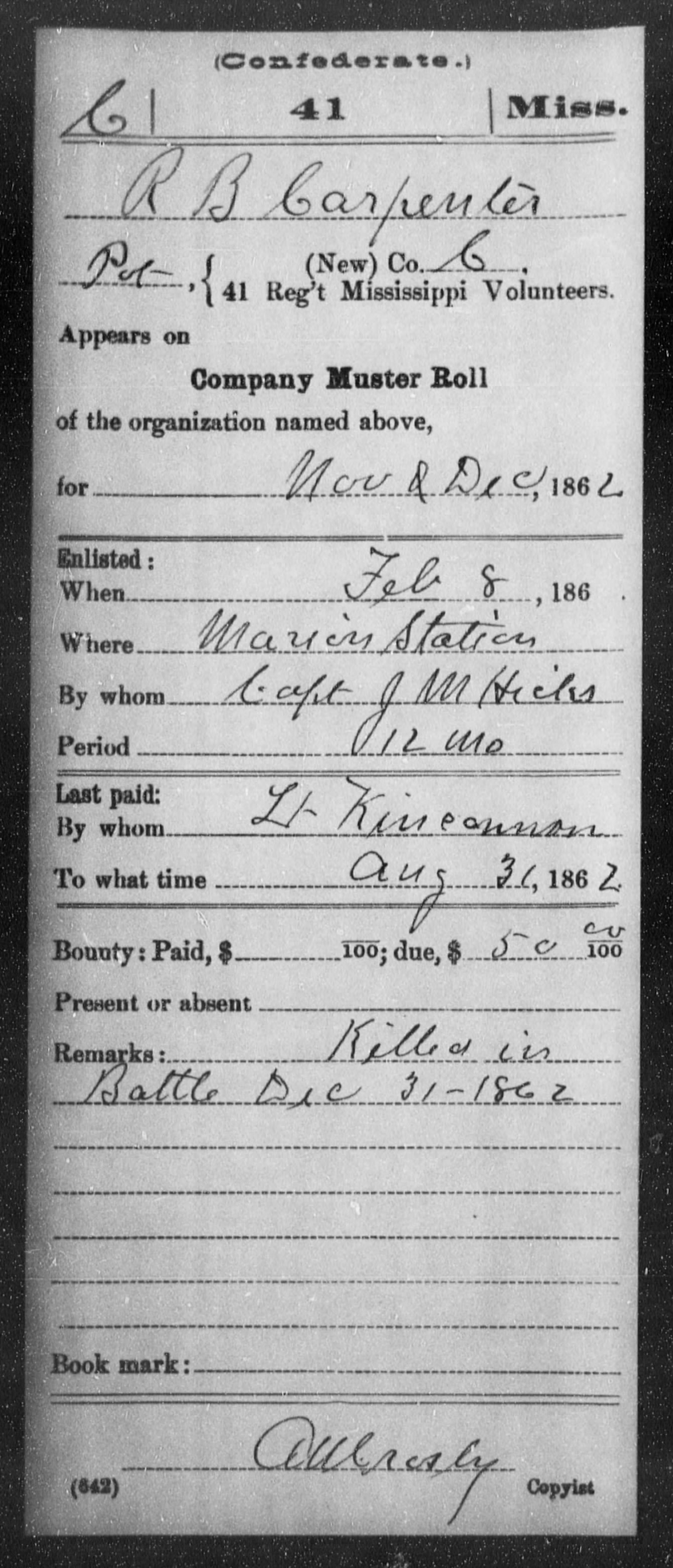
When the Civil War began, Rice signed up for the 41st Mississippi Infantry, Company C on February 8, 1862. This must have been a frightening time for the family, as Mary Ann was eight months pregnant with their last child who was born March 12th, 1862.
At dawn on December 31, 1862, amid limestone boulders and cedar forest, his infantry attacked the Union soldiers at the Battle of Stones River in Murfreesboro, Tennessee.
Private Rice Benjamin Carpenter died on that day on the battlefield at the age of 34, leaving behind his wife and children.
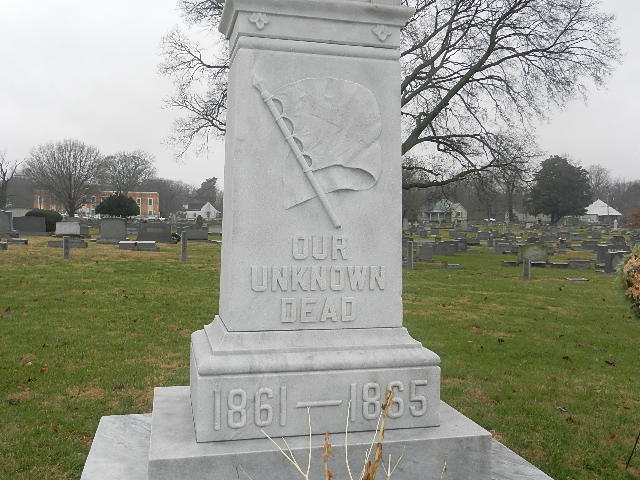
He is laid to rest at Confederate Circle, Evergreen Cemetery, Murfreesboro, Tennessee. RIP 3rd great grandpa. Rest well soldier, your job is done.
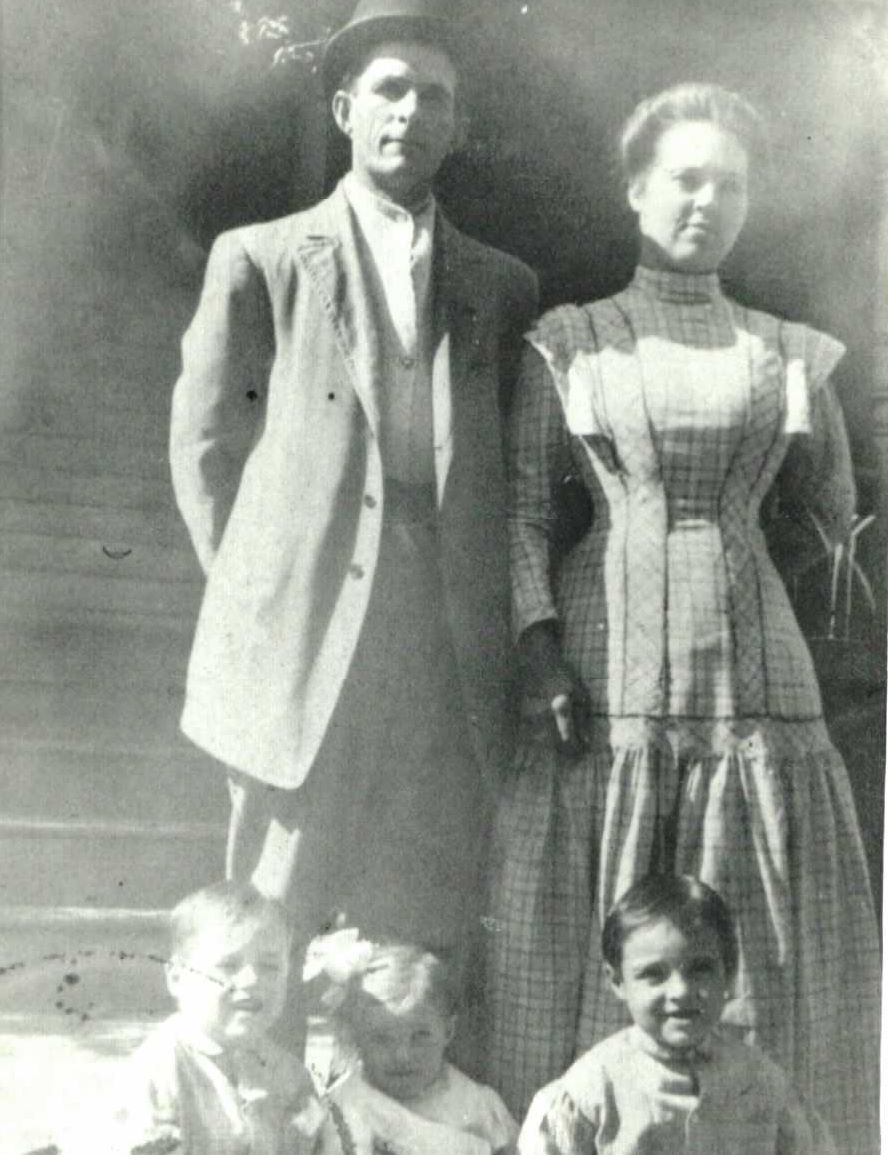
The first part of this blog was written on February 20, 2013. You can see it HERE if you wish. However, the most amazing thing happened this week. I just received a photo in the mail from my cousin. It is my paternal great grandparents!!! I have a picture of her, but I have NEVER seen him before. He was quite dapper, no? 🙂 This is Amos and Minnie Crane and three of their six children, from left to right: Horace, Evelyn, and my grandfather Frank. The photo must be around 1912. Evelyn was born Oct 1910.
Amos Bolivar Crane and Mary Elizabeth “Minnie” White married in Mississippi on August 10, 1902. He was twenty and she was seventeen. In 1903, they had their first child, Andrew Frank Crane (my grandfather), followed by Horace, Evelyn, Amos Jr, Thomas Jackson (Tommy), and finally, Minnie Ellen in 1918. They lived in Lauderdale County, Mississippi throughout most of their marriage except for a brief stint in Gulfport, Mississippi in the 1950s. He died in 1959 and she followed in 1964. Since I was born in 1962, I probably met her, but I don’t remember, and there is no one left to ask.
They are buried at McGowan Chapel Cemetery in Harmony, Mississippi. I took these photos in September 2012, and a cousin told me I drove right by their house on the way to the cemetery. There were only a couple houses there, but I don’t know which one was theirs. RIP great grandma and grandpa.
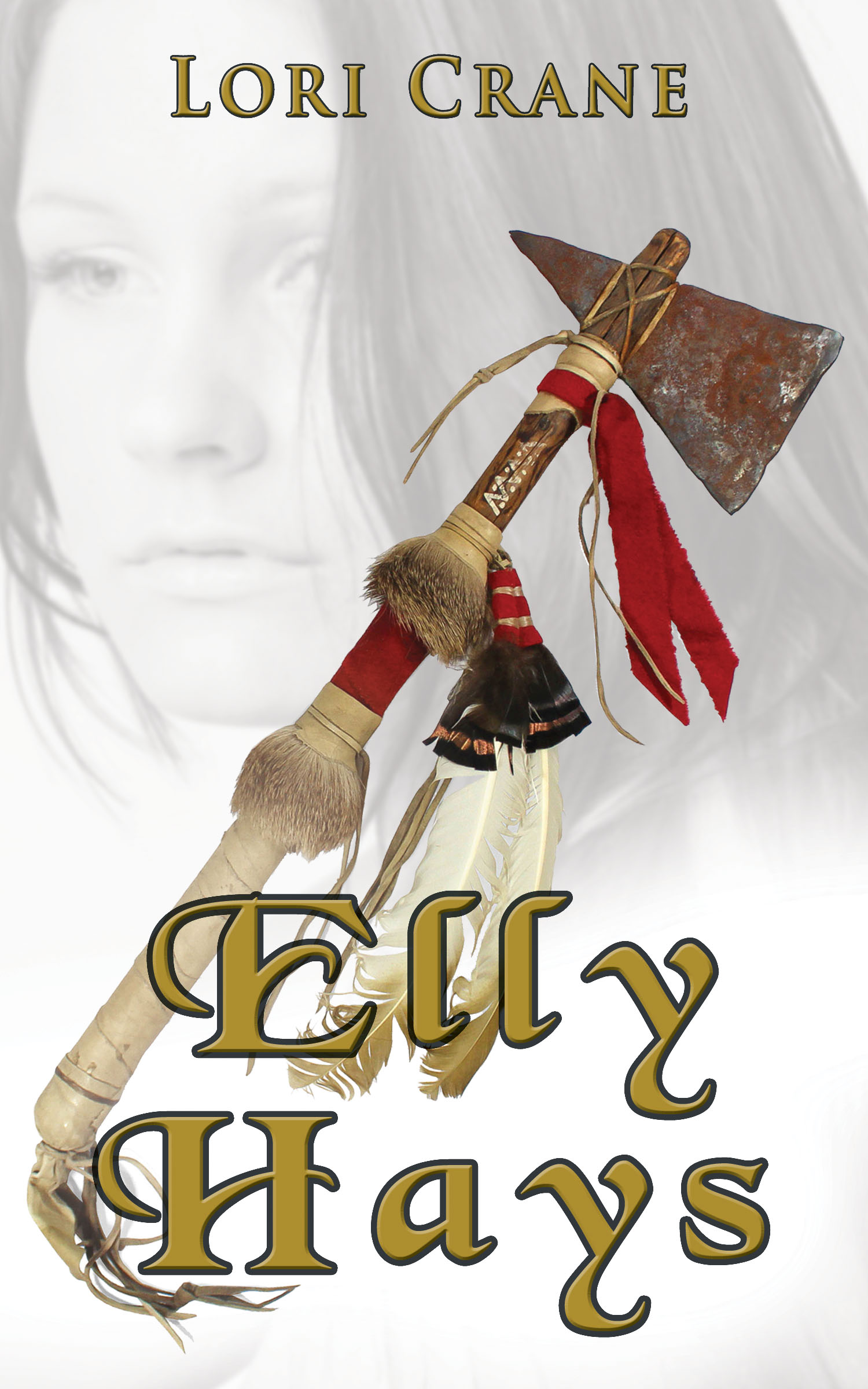
In honor of my coming October book release of “Elly Hays,” today’s Writer’s Corner will be about the book’s heroine, Elizabeth Hays Rodgers, and how she came to be the center of a novel.
She was the only daughter of Samuel Hays and Elizabeth Priscilla Crawford, born in North Carolina in 1774. She spent her young childhood in the unrest of the Revolutionary War. She married when she was sixteen, and after twenty-one years of marriage and eleven children, her husband decided to uproot the family from Tennessee and start a new life in the Mississippi Territory. Considering what they were walking into, I had to write her story. A portion of it is below. It will help you understand that area of the country at that time in history.
The (unedited) Prologue
In 1811, America was on the verge of war. The victory in the Revolutionary War gave Americans their independence, but the newly formed country had many unresolved issues. Americans had a vast frontier to settle and they considered the land now known as Canada to be part of their land. They wanted to expand northward and westward, but the British joined forces with the Native Indians in an attempt to prevent the Americans from expanding in either direction.
The British had also begun restricting America’s trade with France and the mighty Royal Navy ruled the seas. The Royal Navy had more than tripled in size due to their war with France, and they needed sailors. They captured American merchant ships off the coast of America and forced the men with British accents to join the ranks of the Royal Navy, proclaiming they were not American, but indeed British. Kidnappings and power struggles in shipping ports like New Orleans loomed over the newly formed United States.
The British not only invaded the southern coastal cities of the United States, but also the eastern seaboard, attacking Baltimore and New York, and burning Washington D.C. to the ground. The War of 1812 is historically referred to as the second war for independence. It was the battle for boundaries and identity for the Americans.
Sadly, the Native American Indians had the most to lose in the power struggle. Shawnee warrior Tecumseh was but a child when he witnessed his father brutally murdered by a white frontiersman. His family moved from village to village and witnessed each destroyed at the hands of the white men during and after the American Revolution. As a young teen, following the Revolution, he formed a band of warriors who attempted to block the expansion of the white man into their territory, but the effort saw no lasting result. Conflict with the white man was a battle he had fought all his life, and as a warrior now in his early forties, he knew the stakes were high for the Indians in the coming battle. He traveled the southeast, coaxing the numerous Indian nations to unite against the white man, promising help from the British in the form of weapons and ammunition, and offering reinstatement of the Indian’s lost lands upon victory. Tecumseh’s prophet, who traveled with him into Creek territory, forecasted a victory, foreseeing no Creeks being wounded or killed in the battle.
In the Eastern Mississippi Territory, which later became the state of Alabama, the Creek Indians were divided. Many Creek villages had been trading with the white man for years and participated in civilization programs offered by the United States government. These Creeks had been taught the ways of the white man. They spoke English, could read and write, and even incorporated white man’s tools into their daily lives. They traded or were given gifts of plows, looms, and spinning wheels, and had no qualms with the white man. Many had married whites, and they did not want to join in the fight.
In opposition, many villages joined with Tecumseh, for they wanted to maintain their way of life, claiming the white man’s ways would destroy their culture. They had witnessed the white man encroaching on their lands, destroying their forests and villages, and polluting their streams. And probably, some suspected the white man’s intent was not co-existence but domination, for they had seen this come to fruition in the treatment of the black slaves.
In 1811 and 1812, tribal tensions were growing due to these differences in beliefs, and this caused a great war in the Creek nation called The Red Stick War. It was a civil war fought between the Creek people, but by 1813, it expanded to include the American frontiersmen and the U.S. government. At the height of the War of 1812, the Creeks were at war with nearly everyone, including their own people.
It was in this turmoil that a white farming family moved from their home in Tennessee to the fertile farmlands of the eastern Mississippi Territory, a place known today as Clarke County, Alabama. James Rodgers, his wife Elly, and their eleven children unknowingly entered a hornet’s nest.
If you have read the first book in the Okatibbee Creek series, “Okatibbee Creek,” you will be familiar with its heroine, Mary Ann Rodgers. “Elly Hays” is about Mary Ann’s paternal grandmother, Elizabeth Hays Rodgers, better known as Elly. If you have not read any of the Okatibbee Creek series, they are a collection of stories about one family and the strong women of our past. These are the real-life stories of my grandmothers, aunts, and cousins, but if you live in the U. S., they could also be the stories of your female ancestors – the women who fought for us, for our safety, our lives, and our freedom, and who sacrificed everything with the depth of their love and their astounding bravery.
“Elly Hays“ will be release October 2013 in paperback, Kindle, and Nook.
Writing an intense action scene with cowboys, a drunk man, and no offensive language was a challenge, but here it is. This is part of a scene from my book, “An Orphan’s Heart.”
Set up – Alabama 1875. Ellen has hitched a ride across the state with two moonshine-hauling wagons. The four men have been gentlemen for the previous five days, but tonight is a different story. Apparently Floyd has been sampling the product.
Cast of characters:
Ellen Rodgers – twenty-five-year-old girl who hitched a ride
Floyd – old wagon driver
Earl – cook
Buck – sharpshooter
Luke – Buck’s teenage son who drives the second wagon
~~~~~~~~~~~~~~~~~~~~~~~~~~~~~~~~~~~~
“What are you whishpering ovah there? Are you trying to keep that pretty little girl all to yourshelf?” Floyd has risen to his feet, with more than a little difficulty, and is staggering toward us. He stops for a moment in the middle of the campfire clearing, and guzzles from the jug, throwing his head all the way back. I think he may fall backward, and I wonder if he will break open his skull if that happens.
Earl doesn’t move from his spot next to me. He sits in a relaxed pose, leaning forward with his elbows on his knees, with a half-whittled piece of wood in one hand and a knife in the other.
“That’s enough, Floyd! Go sleep it off.” His stern voice doesn’t match his calm body language, but when I see his eyes squinting in Floyd’s direction and his jaw throb with anger, I think Floyd should do as he is told.
“Don’t tell me what to do, Earl. I wanna talk to the pretty girl, too.”
I don’t move. I don’t even think I’m breathing. I have never seen a person in this condition before, and I’m not sure if he’s dangerous or if he’s going to fall down at any moment.
Earl slowly rises to his feet, moves in front of me, and lowers his voice. “You’re not going to do any such thing. The lady doesn’t need to speak with you when you’re drunk.”
Floyd wildly takes a swing at Earl and hits him right in the jaw, causing Earl to hit the ground with a thud. He is out cold. Luke throws his guitar down on the dirt, runs around the outside of the circle, and grabs for my hand, but Floyd beats him to it. Before I realize what is happening, Floyd spins me around and I find myself facing Luke, pinned in Floyd’s arms.
“That’sh better, pretty lady,” Floyd slobbers. The rancid odor of whiskey and rotting teeth invades my nostrils.
Luke freezes and pushes his hands toward the ground in an attempt to calm Floyd down. “Look, Floyd, you don’t want to do this.”
“How do you know what I wanna do?” He spits down my neck as he speaks, wobbling back and forth. The motion and the smell are making me sick to my stomach.
Luke looks past me, over my shoulder. He nods, then there is a sudden noise behind me. When Floyd turns toward the noise, Luke grabs my hand and says, “Come on!”
“Hey!” Floyd hollers at us as we pull away.
“That’s enough, Floyd!” Buck yells, appearing from the woods behind us.
Floyd turns toward Buck, and moves faster than his inebriated body should be able to. Luke yanks me toward the wagon and shoves me in. Buck grabs Floyd by his outstretched arm, spins him around, and puts the knife up to Floyd’s throat. Floyd curses, demanding Buck to let him go. I assume Buck refused, for they’re soon having an all-out brawl. I hear the jug hit the ground, but I don’t know if Floyd threw it or dropped it. I also hear fists making contact with flesh. I can’t imagine Floyd is in any shape to fight off a man like Buck.
I jump when I hear a gunshot. Everything is abruptly silent. The bullfrogs stop croaking, and it seems as if time is standing still. I look wide-eyed at Luke, wondering if Floyd has been shot.
“It’s all right,” he says, shaking his head in answer to my unspoken question.
The property is located in Monroe, Michigan. There have been two homes built on the property. The original house was built by Francois Navarre on land given to him by the Potawatomi Tribe. The house is named after one of its residents, Dr. Alfred Sawyer, who lived there from 1859-1870. The original house was demolished and a new one built in 1873. Dr. Sawyer never lived in the current house, but it remained in his family until his daughter donated it to the city of Monroe in 1973.
Following lunch, my ladies from the United States Daughters of 1812 are having a bench dedication at the River Raisin National Battlefield, commemorating the bicentennial of the War of 1812.
My 1812 soldier is Hays Rodgers.
While I was writing this little blurb, my phone rang and a lady told me my book “Okatibbee Creek” won the bronze medal in Literary Fiction at the 2012 eLit Book Awards. Check the book out on Amazon. The book is about Hays Rodgers’s daughter. “Wow, that’s a weird coincidence,” said the award-winning author. 🙂
 Can you come up with 23 ancestors? Do you have family stories, photos, documents? Are you a history/genealogy/ancestry buff?










 Lori Crane