FREE Kindle just for you!

I, John Culpepper” is FREE on Kindle through 4/19. Grab a copy and relax with a good book this weekend. Click here – “I, John Culpepper” at Amazon.

Below is the blurb and a snippet from the book.
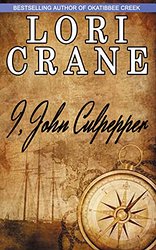
51hHerBrPbL._UY250_I, John Culpepper

John Culpepper was born into a privileged childhood, surrounded by abundant wealth, vast land holdings, and stately English manors. As he grew, he was expected to follow family tradition—attend law school and serve in Parliament, following which he would retire to a quiet life as a country gentleman.

John, however, had different desires. He longed to captain a mighty ship, to hear the snap of the sails, to taste the salty spray on his lips. To follow his dreams, John would have to risk being disinherited by his unyielding father. He would have to defy family convention. He would ultimately be forced to choose between the woman he loved and his mistress—the sea.

I, John Culpepper is a work of historical fiction based on the life of the 17th-century man historians refer to as John Culpepper the Merchant. He is believed to be the progenitor of the modern-day American Culpeppers. He was my 10th great-grandfather.

***********************************************

Here’s a snippet from the day John was born. The photo is the replicas of the ships mentioned in the scene. These replicas were built in the late 1900s and are currently docked on the James River in the Jamestown settlement where the original ships were heading. Road trip! Let’s go!

***********************************************
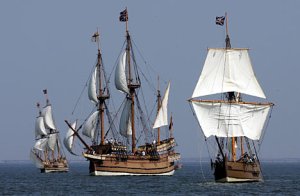
susan constant, discovery, goodspeed replicas on the chesapeake1606, Blackwall, London

“Master Culpepper! Master Culpepper!” the servant boy shouted over the bells clanging from the church steeple. He pulled the scratchy scarf tightly around his neck to ward off the chill as he pushed his way through the masses gathered on the foggy banks of the Thames.

The crowd had been gathering on the wharf for nearly two days to witness the departure of the ships, and they were prepared for a spectacle unlike any they had seen before. When the tide came in, the three ships carrying one hundred forty passengers and sailors would depart England on an exciting adventure. The air smelled of salt and tar and sweat. This was a remarkable place, a magical place, where the preparations were as exciting at the coming voyage. The anticipation in the air was nearly as thick as the fog.

The boy stopped for a moment as a wooden cask was rolled across the cobblestone in front of him. He watched as workers carefully rolled the barrel up the tilted gangplank. He remained frozen in the middle of the bustling crowd, staring at the ship. He had never seen anything so majestic in all his twelve years, and his jaw dropped at her sheer size. She was an enormous castle-like structure, at least eighty feet in length, her belly bulging at the side where the last of the cargo was being loaded in. Crates and boxes were continually being carried up the gangplank, where they disappeared into the ship’s dark interior. The deck above the cargo area was much narrower and the boy imagined that’s where the sailors would remain during the voyage, climbing masts and hoisting sails. Circling the spiderweb of hemp ropes and yardarms, seagulls cawed as if singing along with the rhythmical clanging of a nearby metal object. The boy scanned the scene for the source of the sound and noticed a blind beggar sitting on the cobblestone near the bow of the ship, tapping a stick on a metal bowl.

Behind the ship floated a second ship, nearly as large as the first, and behind that loomed a third. Each hosted its own cast of sailors, supplies, vagrants, and gangplanks. As wavelets gently raised and lowered the vessels, moans of protest arose from the taut ropes, and the weathered wood creaked with each stomp of a sailor’s boot. Nearby, two mangy hounds barked and growled over some fish scraps, bringing the boy’s attention back to his task at hand. Remembering why he had come, he yelled, “Master Culpepper!” He spun around and around looking for the man, weaving between horses, carts, trunks, and sailors shouting commands. He darted in and out of the crowd, making sure he didn’t bump into any wealthy gentlemen, recognizable by their long cloaks adorned with colorful silk threads.

In April, King James had created the Virginia Company, which would finance sailings to Virginia and Plymouth with the aim of settling colonies and profiting from the land’s abundant natural resources. The aristocracy funded the expeditions with the expectation of making an exorbitant profit. The three ships embarking from Blackwall on this day would sail to Virginia and bring back riches. There were rumors of gold, silver, and gems merely washing up on the shore for the taking. If nothing else, there was surely timber to be harvested. The trees in England had long been felled and the rising price of timber would certainly bring the investors a hefty return.

After they finished loading supplies and the morning fog had dissipated, the ships would raise their sails and ride the tide down the Thames. They would enter the English Channel and cross the great ocean and return by summertime.

The boy bobbed in and out of the crowd, searching for his master.

“Who are you searching for, lad?” a man in a ruffled collar asked.

“Master Culpepper,” the boy replied, removing his hat and revealing his dirty blond hair, which was sticking this way and that like a wheat field in a mighty windstorm. He twisted the wool hat in his hands.

“Johannes or Tom?”

“Johannes Culpepper, sir.”

“I saw him down by the front ship—the Discovery—only moments ago. He was standing right on the dock.”

“Thank you.”

The boy nodded, replaced his cap, and shoved through the workers and onlookers toward the front ship. As he passed the first ship, he looked at the name written on her side and sounded out the letters. He couldn’t make any sense of the words Susan Constant, but when he reached the second ship, he could read God…speed. He wondered if the Godspeed was true to her name. If he were to sail, he would rather sail on the Godspeed and get there faster. From what he understood, it was a two-month voyage if the weather was bonny, maybe four months if the ship ran into rough seas.

He had once spent a morning in a small fishing boat and instantly became green with sickness that lasted for days. He didn’t think he would be able to survive the time it would take to sail to Virginia. He gawked at the bow of the Godspeed as he ran past, witnessing a young lad about his age. The sailor dripped with sweat, even in the chill of the damp morning air, as he coiled ropes and folded sails. What a great adventure it would be to sail to Virginia, but alas, the boy would never get to do such amazing things. He was a servant, a gift from His Majesty King James I to Johannes Culpepper. He would always be a servant, but perhaps someday he would be fortunate enough to serve the king. Even though Master Culpepper was good to him, he wished to someday live at court and be somebody. At least he had the slimmest of chances. His sister had been placed in the kitchen of some castle in Wales. She would never be anything more than a scullery maid. Women would never hold a place in society. They were not welcomed on this voyage, either.

He hopped up and down, unsuccessfully trying to look over the crowd. “Master Culpepper!” he called.

A man turned and pointed. “Culpepper is right over there, son.”

“Thank you, sir.”

The boy sprinted in the general direction, and when he pushed through a couple workers conversing on the dock, he saw him.

“Master Culpepper!”

The boy ran up behind Johannes Culpepper and patted the back of his master’s arm, hopping up and down. “Master Culpepper!”

Johannes turned and looked down at the boy, his square jaw set and his blue-gray eyes burrowing into the lad. “What is it, boy? Why are you making such a commotion?”

The boy panted, out of breath from running. “Master Culpepper, m’lady is havin’ the baby, sir!”

Johannes’s face turned red as he glanced around the crowd to see if anyone was eavesdropping. When he saw no one was, he folded his arms across his chest and stroked his beard. “You came all this way to tell me that?”

“Yes, sir.”

“Very good, boy. You run along home now.”

The boy didn’t move. How could his master not be excited about this news? Did he not want to return home and see his wife and child? Was there anything the boy could say to convince the man to accompany him back to the house?

“Go on. Run along.” Johannes waved the boy off with a flip of his ringed fingers and abruptly turned his back.

“Yes, sir.” The lad backed up, keeping his eyes on his master, wondering what he would tell the governess when he returned home without his master in tow. He had ridden nearly four hours to get to Blackwall this morning, most of it in the dark as the sun had not even risen when he left. He would have a four-hour return trip to think of something. He turned and walked back in the direction from which he had come.

*******************************

Get your copy by clicking HERE.

A to Z – Culpeper Garden at Leeds Castle

A2Z-BADGE_[2016]April 2016 A to Z Challenge. I’m participating by writing about history.

C is for Culpeper Garden at Leeds Castle.


,

Leeds-CastleLeeds Castle is located in Maidstone, Kent, England. It was a Norman stronghold in the 11th and 12th centuries, a royal palace in the 13th through 15th, and a Tudor palace in the 16th century. It was also owned by my family at one point. The Culpepers (my mother’s family) owned the castle before the English civil war in the early 1600s. They lost it due to being on the wrong side of the war. If you’re not familiar with the outcome of the war, the king was beheaded and the royalist Culpepers fled to the new colonies to escape the same fate.

In the mid-1600s, the royal family was returned to the throne, and the Culpepers got their house back!!

culpeper_garden_originalWhat is now called the Culpeper garden was originally a kitchen garden and nothing more, but in 1980, a designer transformed it into a cottage garden. It has an informal layout with low box hedges bordering Roses, Lupines, and Poppies. It is said to be named after herbalist Nicholas Culpeper, who is a distant cousin of mine. Nicholas transcribed the pharmacopoeia from Latin to English “so that all men may prescribe for themselves.” He ended up dying in the war mentioned above, but as far as I know, he never lived in the castle. It is still nice that they honored the family hundreds of years later by naming something after them.
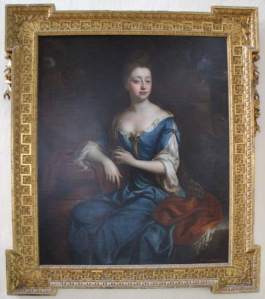
The final Culpeper owner of Leeds was Catherine Culpeper. She married Thomas Fairfax in 1690 and the property then transferred into the Fairfax family. Below are photos of Catherine and Thomas. Since their grandfathers were bitter enemies during the war, I’ve always wondered if the families condoned the marriage, if Catherine was being rebellious by marrying the enemy, or if the Fairfaxes were simply out to take everything from the Culpepers. I’m currently writing a story about it called “The Culpepper-Fairfax Scandal.” I’m not set on the end yet, so we’ll see where the characters take me and which scenario plays out.  At some point in the story, I need to include a stroll through the garden.

LadyCatherine

Thomas_Fairfax 5th baron of cameron, catherine culpeppers husband

A to Z – Beauvoir

A2Z-BADGE_[2016]April 2016 A to Z Challenge. I’m participating in the challenge by writing about history.

B is for Beauvoir.


BeauvoirBeauvoir, meaning beautiful view, is know by many people, especially civil war buffs. It’s an antebellum home that sits on the shores of the Gulf of Mexico in the beautiful town of Biloxi, Mississippi. It was many things but best known as the home of Confederate President Jefferson Davis.


It was built between 1848 and 1852 by a rich plantation owner as a summer home for his family. After the man died, it was sold in 1873 by his widow for back taxes, then sold again three months later to a Sarah Dorsey.

In 1877 (following the civil war), Jefferson Davis was on the coast, looking for a place of solitude to write. He visited his family friend Mrs. Dorsey and they agreed he should stay there. He loved the home so much, he offered to buy it, and she sold it to him for $5,500.00 to be paid in three payments. After making the first payment, Mrs. Dorsey died. President Davis then found in her will that he was her sole heir.

President Davis lived in the home until his death in 1889. His daughter Winnie inherited the house and sold it to the Sons of Confederate Veterans with the stipulation that the home be used to house Confederate veterans and their wives at no charge until it wasn’t needed anymore. The last of the veterans vacated the premises in 1957. The home was severely damaged in Hurricane Katrina but is now again open as a tourist attraction and historical site.

If you find yourself in Biloxi and you’d like to visit, daily tours of the mansion run every hour between 9:30am and 4:30pm. The property is located at 2244 Beach Blvd, Biloxi, MS 39531  (228) 388-4400. You can visit their website HERE.


culpepper Joel B CulpepperMy second great grandfather Joel Bluett Culpepper served in the civil war Co. K 63rd Alabama infantry. He signed up at the age of seventeen. In 1863, he was captured and held at Fort Massachusetts on Ship Island until the end of the war. Under his rights as a Confederate veteran, he spent the last ten months of his life at Beauvoir, dying at the home 11 Jan 1911. He is on the records there as James B Culpepper.


Earthquakes in Tennessee??

Not only earthquakes, but huge 6.8 to 8.8 earthquakes!! They happened back in December of 1811 and January of 1812, but they could happen again.

new madridThe New Madrid Seismic Zone, (shown here compliments of Encyclopedia Brittanica) is six times larger than the San Andreas fault zone in California. It lies centered in New Madrid, Missouri, and the last time it shook it’s ugly head was two hundred years ago. It’s waaaay overdue!! Back in 1811/12, there were over 2000 earthquakes and aftershocks that shook the midwest. They were felt as far away as NY, Boston, and Washington D.C. President James Madison felt them at the White House.

No other quakes have produced so much damage in the history of the world. The Mississippi River ran backwards, crevasses opened up in the land, and missing people were assumed swallowed by the earth. It created two waterfalls in Mississippi.

The prediction for the future?? Some say an earthquake this size will split the United States in two. Some say we haven’t seen any activity from the New Madrid fault for two hundred years, so why worry about it now?

41n6zHpRqRL._UY250_My book Elly Hays opens with Tecumseh’s prediction for the quake, and the quake is the cause for the family moving from Tennessee to the Mississippi Territory. The story isn’t about the 1811/12 quakes, but they are the reason the story happened. Elly Hays is based on a true story and is the tale of my 5th great grandmother Elizabeth Hays Rodgers. It is the epic clash between a fearless warrior with nothing to lose and a young mother on the verge of losing everything.


Elly Hays is on SALE for only $0.99 at Amazon on Kindle April 1-5!


The backstory behind Okatibbee Creek

I wrote Okatibbee Creek in 2012. It has become an award-winning book and a story many people seem to treasure. I’m often asked where the story came from…so here ya go.

Rodgers, Mary Ann Rodgers Carpenter Jolly

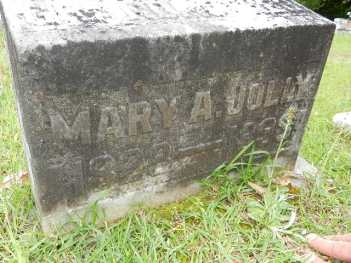
She was just a name in my family tree. Mary Ann Rodgers Carpenter Jolly. My third great grandmother. 1828-1898. I visited her grave at Bethel Cemetery in Mississippi in 2012, and my husband asked, “Now, who is this again?” I sat with him at the foot of her grave and told him her story.

I first discovered she lost her husband, Rice Carpenter, in the Civil War in 1862. How sad to lose the one you love, but hey, it’s war, people die. After he died, she remarried in 1864.

I looked at the 1870 census and found she married William Jolly and was living with his children, her children, and three children they had together. It was a house-full! But at least their three children were proof they must have liked each other, right? That’s good. I was interested in where William came from, so I traced him back and looked at his 1860 census. In 1860, he was living with his wife Harriet, their four children, and a woman named Nancy Carpenter who was 69 years of age.

Nancy Carpenter? The only Nancy Carpenter I know is Rice’s mother. Why was Mary Ann’s mother-in-law living with her future husband in 1860?? Were they neighbors? Was Nancy the cleaning lady? I clicked on Nancy Carpenter and saw her relationship to the “head of house” was listed as “mother-in-law.” She was William’s mother-in-law? What?? She was Harriet’s mother?

So, I went back and looked at Rice’s family, and sure enough, his sister Harriet was married to William. Rice died 31 Dec 1862 and Harriet died a month later of typhoid on 30 Jan 1863. Their spouses, Mary Ann and William, brother-in-law/sister-in-law, married in 1864. Well of course they did. They had known each other for many years, hadn’t they?

The more I looked at the Rodgers and Carpenter families, the more I was amazed by the sheer number of family members they lost to war and typhoid. At the time of my research, I remember counting SEVENTEEN, but I’m sure there were many more I missed. I couldn’t wrap my head around that kind of heartache and quickly became impressed with Mary Ann’s strength. How would you react if you lost two or three family members this year? You would probably need Prozac. How would you respond if you lost a dozen? I wouldn’t even be able to get out of bed. Seventeen in one year? I can’t even fathom that.

okatibbee creek cover front JPEGWe all come from these strong women. We are the living proof of their strength. If the boat sank, the story would be over. But it didn’t, and we know that because we are here. We are the survivors. I dug deep down in my heart and soul and decided to tell her story, a story she would be proud of. I wanted her to know that she didn’t endure all of that heartache in vain. I am here. I am her legacy. Her story has been told to make us see the strength in our own hearts. We are the products of strength, fortitude, and integrity, as well as tears, heartache, and pain. We are the children our grandmothers fought so hard for, and I want Mary Ann to be as proud of me as I am of her.

Okatibbee Creek is available on Kindle at Amazon for only $0.99 March 4-8. You may also want to pick up a box of Kleenex.

Saturday Snippet and Sale

51-lUHhsD7L._UY250_Okatibbee Creek (pronounced oh-kuh-TIB-be) is the story of Mary Ann Rodgers Carpenter Jolly and her trials and tribulations in Mississippi during the Civil War. As her brothers and husband went off to war, a deadly typhoid epidemic swept through the county and decimated what was left of her family. Following the loss of so many loved ones, including both parents, she took in her orphaned nieces and nephews and focused on survival. When the war finally ended, she had to pick up the pieces of her shattered life and begin anew. But how?

Okatibbee Creek is a real place. The characters are real. The events are real. The book will leave you crying and cheering. It is written in first person, present tense, diary-style, allowing you to see inside of Mary Ann’s heart and experience every emotion she felt.

The Kindle version of Okatibbee Creek is on sale at Amazon March 4-8 for only $0.99!

The following is a snippet of the scene when Mary Ann received word that her husband had been killed in the war.

**********

When I reach the bottom of the stairs, I see him. I do not recognize his face, but I recognize his clothing. He is a Confederate soldier. He is standing in the open doorway of the store with the gray, cloudy sky at his back. He is dressed in a wrinkled gray uniform with a dirty yellow cummerbund. His trousers have holes in them, with mud caked around the bottoms of his pant legs. His jacket is missing some buttons, and he looks quite thin and weary. He is wearing shoes that are covered in red Mississippi mud and probably have no soles on the bottom. He is holding his tattered hat and a piece of paper in his dirty hands.

“Hello, sir, what can I do for you?” I ask as I approach.

“Hello, ma’am.” He nods. “Are you Mrs. Carpenter?”

“Yes, I am. And who are you, may I ask?”

“Private Joseph Brown, ma’am. Captain asked me to deliver the latest casualty list to you in person.” He holds the folded piece of paper toward me and looks down at the floor, like a child in trouble for doing something wrong.

“Why are you delivering this? It usually comes by a mail carrier,” I ask as I reach for the paper. I look at the boy’s face. He nervously avoids my eyes and keeps staring at the floor.

“Why are you delivering this to me?” I repeat.

“I promised I would. I’m sorry, ma’am. Goodbye, ma’am,” he murmurs, and backs out the open door.

I look at the piece of paper in my hand for a long time, wondering if I can open it. I don’t know whose names are on this paper, but I suspect the worst, and I don’t want to read it. My eyes sting with tears as I dread a simple piece of paper. I try to unfold it, but my hands are shaking, so I stop and hold it to my chest. I take a deep breath.

Martha Jane stands behind me, not saying a word or making a sound.

“Martha Jane, will you please go upstairs and mind the children for a few minutes?” I ask her.

She nods and quietly heads up the stairs.

I walk outside across the wooden porch and down the two stone steps onto the ground. I walk across the dirt road that is now filled with puddles of red mud from the rain. I keep walking straight ahead. I walk into the overgrown field across the road. I walk with purpose, with determination, like I have somewhere important to go. I want to run. I want to run away and never come back. I keep walking.

In the middle of the field, the thunder sounds above my head. I stop and look up at the ominous clouds that are almost as threatening as the piece of paper I hold in my hand. My hands are shaking as I slowly unfold it and smooth it open. My stomach feels like it has a hole in it. My eyes fill with tears. My hands are now trembling so violently, I almost can’t read it. The name at the top is the only name I see.

“Carpenter, Rice Benjamin: killed in battle 31 December, 41st Mississippi Infantry, Co C.”

Drops of water fall onto the page, but I can’t tell if they are raindrops or teardrops. Even God Himself is crying.

*********

Rodgers, Mary Ann Rodgers Carpenter JollyOkatibbee Creek is available March 4-8 for only $0.99 in Kindle at Amazon. Paperback and audiobook are also available. It is the first of three Okatibbee Creek Series books, but they are stand-alone stories. The second is An Orphan’s Heart. The third is Elly Hays.

Okatibbee Creek was the bronze medal winner of the 2013 eLit Book Awards in literary fiction. It also received honorable mention in the 2013 Great Midwest Book Festival for regional fiction and was a nominee in the 2013 Global eBook Awards for historical fiction. It was also awarded Five-Stars at Readers’ Favorite.

Samuel Dawson Grimes – oldest citizen of the county at 110?

My 4th great grandfather was Samuel Dawson Grimes. The line from me to him is my father Andy Crane, my grandfather Frank Crane, my great Amos Crane, my 2nd great Jack Crane, and my 3rd greats Jeremiah Crane and Sarah Frances Grimes.

I haven’t researched my Crane side very much, and certainly haven’t ventured into the wives on that side of the family, but today I found something pretty interesting.

Grandpa Grimes was born around 1757 in North Carolina. There are a few records indicating he participated in the American Revolution, but I haven’t been able to verify that (yet). He married Darcass Wall in 1788 and the two had seven children. At some point, the family moved to Brundidge, Pike County, Alabama, where he died in 1857.

brundidge_al

Since I don’t know his exact birth date, I find the following interesting. It’s from Find A Grave.

A newspaper article from the Troy Independent American, published on 22 April 1857, as transcribed by Susie K. Senn in her book “Newspaper Abstracts from Pike County, Alabama 1855-1861”:

The Oldest Man in Pike – Samuel D. Grimes, aged 110 years, and the oldest citizen of this county, died a few days since at his residence. Mr. Grimes enjoyed almost uninterrupted health up to a year or so before his death. For a great part of his life he was a member of the Baptist Church, and died as he lived, an honest, upright citizen and Christian. 

110??? Wow! That’s pretty considerable for the times.

I also found his probate records – all thirty hard-to-read handwritten pages. He seemed to be in debt to various local gentlemen, including the local merchant for the purchase of a pair of shoes, a handkerchief, five yards of cotton, and eight yards of calico for $3.45, which was used to “spruce up” his negro woman. His indebtedness was just over $1100.00, and his belongings were auctioned off for $98.00, most being bought by his grown children including his rifle for $1.30. There must have also been a sizable amount of land, as the debtors were paid and there was still plenty to leave to his children and his twenty grandchildren.

The 1840 census shows two adults in his household who couldn’t read or write. It also shows one slave, whom I assume is the “negro woman” mentioned above.

The 1850 census mentions that he is currently 93 years old, living with his daughter, so I think when he died in 1857 he was only 100, but the reporter from the Troy Independent American wasn’t very good at “cipherin’.”

union springsGrandpa Grimes is laid to rest in Union Spring Primitive Baptist Church Cemetery in Brundidge, Pike County, Alabama, where the 2010 census says the population is just over 2000 people, 33% living below the poverty line. I can imagine how small and poor it was in the 1800s when Grandpa Grimes lived there.

Ina Inez Burke’s birthday?

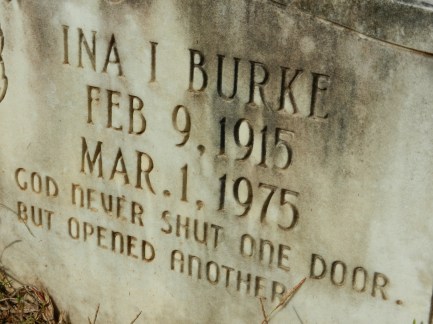
earl culpepper and ina burkeMy grandmother, Ina Inez Burke Culpepper, was a warm and wonderful woman. We always celebrated her birthday on February 9, her death certificate lists her birth as February 9, her tombstone is chiseled February 9. Imagine my surprise when I received her birth certificate stating she was born at 10:00 pm on February 8!
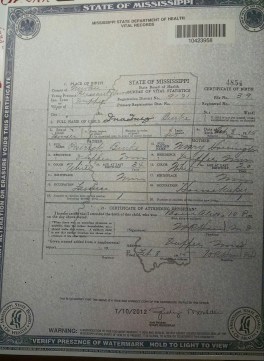
ina burke birth cert

She was born in Mississippi in 1915 to John Patrick “Pat” Burke and Mary Howington Burke. She was the eldest of seven children, one dying as an infant. She grew up with three brothers and two sisters.

marriage license earl culpepper and ina burke

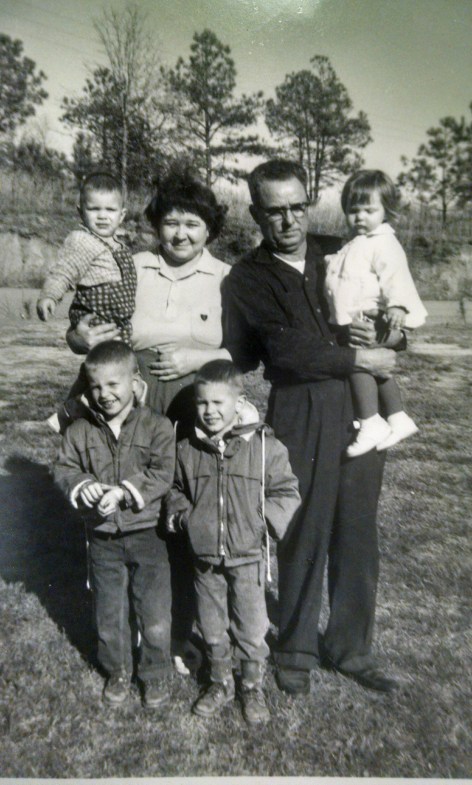
She married Earl Culpepper at the age of 21 on 1 Aug 1936. The union produced two daughters and four grandchildren. (The little girl is me!)

earl, ina, and grandchildren

Ina was a great cook and a professional seamstress, working at Meridian’s Burnley Shirt Factory. She spent many hours teaching me to sew when I was small. I was too young to get under her feet in the kitchen and still regret not being able to make biscuits as good as hers.

She died in 1975 of complications of aortic valve replacement. I always thought she died at the age of 59, but now I wonder if she was only 58.

She is laid to rest at Liberty Baptist Church Cemetery in Newton County, Mississippi, not far from where she was born.

burke Ina Inez Burke headstone


Saturday Snippet – Catherine Culpepper

The following is a rough draft of my current work-in-progress, The Culpepper-Fairfax Scandal. Catherine Culpepper is nineteen years old, and her rich father, Lord Thomas Culpepper the baron of Thoresway, has just died. For two decades, he had been living in London with his mistress and had left everything to the mistress in his will, but Catherine’s mother had the will suppressed. This scene takes place at the probate hearing at Westminster.  Thanks to her mother, Margaretta, and her uncle Alex, Catherine inherited nearly everything.

We’ll make due with a painting of Catherine until I can get a proper book cover made. 🙂

LadyCatherine

************************************

When the proceedings ended in Catherine’s favor, Margaretta and Alex attempted to whisk Catherine from the courtroom, but they were met at the door by a crowd of enthusiastic well-wishers and more than a few gentlemen of questionable intentions. Catherine had just inherited more wealth than she could ever dream of. Not only was she now the sole owner of Leeds Castle, she also held manors and lands in Sussex and Essex, and was one-sixth owner of the proprietorship of the Virginia Colony. The crowd’s din grew as they attempted to get closer to the wealthy heiress. Pushing and shoving toward her, people reached out to touch her, to take her hand, to gain her attention and her favor. When the family emerged from Westminster, Alex hailed their coach, but when he turned back for Margaretta and Catherine, they had been separated from him by a sea of bodies. Margaretta reached for her daughter’s hand to pull her through the crowd, but their fingers were inches away from each other’s as Catherine was pushed back by the crowd, away from the protection of her mother and their waiting carriage.

“Catherine!” Margaretta called.

Catherine heard her mother’s call but couldn’t see her over the heads of the people surrounding her. She attempted to turn, but a growing throng of people blocked her way. Someone was standing on the hem of her gown, stifling her movement, lest she rip her skirts. Her mother called for her a second time. Her heart began pounding as she heard the panic in her mother’s voice and suddenly realized she might be in a dangerous situation. The crowd was growing riotous, pulling at Catherine’s clothing and her hair. Her honey-colored curls fell to her shoulders as her hairpin was snatched from her head, taking with it a handful of hair. She cried out for her mother, for her uncle, for anyone to save her from the melee. It was then that she felt a strong arm around her waist and another under the back of her legs.

“I’ve got you,” he whispered in her ear.

She was scooped into the arms of a savior. She buried her face into his shoulder as he pushed his way through the crowd toward the waiting carriage. When she was gently placed onto the seat in the carriage, she smoothed her hair from her face and lifted her eyes to look at her uncle. But her savior wasn’t Uncle Alex.

Before her stood a striking man whose brown eyes bore into her own, his dark curls falling over his brow, his full lips begging to be touched. Their eyes locked as if time stood still. He then nodded to her and quickly closed the carriage door, disappearing into the crowd.

Uncle Alex yelled for the driver to make haste, and the carriage sped away from the scene, the wheels bouncing on the rough cobblestone street.


Happy 223rd Birthday!

Rodgers Hays Sr

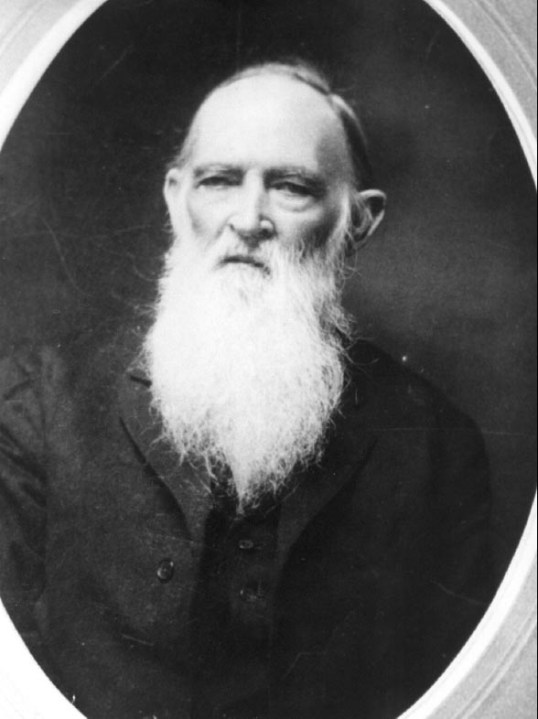
Hays Rodgers Sr was my 4th great grandfather. He was born in Greene Co, Tennessee in February of 1793 to James Rodgers and Elizabeth “Elly” Hays. (Elly was the heroine of my book “Elly Hays.”) Hays was Elly’s eldest son and he had at least ten siblings. Just before the War of 1812 began, the family moved from Tennessee to the Mississippi Territory, today known as Clarke Co, Alabama. Alabama didn’t become as state until 1819.

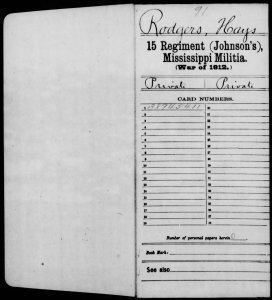
Page 11814 – When Hays was 19, he and his brother, Absolom, signed up for the Mississippi Militia and were assigned to Captain Evan Austill’s company of volunteers in Major Sam Dale’s Battalion to fight against the hostile Creek Indians. Hays remained in the Militia until October 1818, but was only called out once for a two-month tour. Today, I am a member of the United States Daughters of 1812 under his patriotism.

On December 11, 1816, he married Marey Ann Scott, who was from Georgia.

Winter of 1818, following the end of his military service, Hays, Marey, and first-born Lewis, moved to Copiah Co, MS (what later became Simpson, MS). He started buying land and farming. Over the next two decades, the couple had a total of 14 children. Some died young, but the final tally of grandchildren was 71!

In 1834, the US Government began selling off land it had obtained from the Choctaw Indians in the 1830 signing of Dancing Rabbit Creek. Hays went to Pine Springs in Lauderdale County before the land was surveyed and built a small cabin overlooking Rogers Creek bottom so he could claim the land the moment it went up for sale. He was a squatter for all purposes.

September 26, 1836 – A deed was recorded for 80 acres in Pine Springs which he bought from the government.

October 1836 – He bought 160 acres next to his 80 acres from John Calhoun. Mr. Calhoun moved to the Martin Community to open a leather tannery.

1839 – He bought 80 acres from Alex McMullen and 80 acres from Jeremiah Howell. He also began buying slaves and producing cotton.

1856 – He was granted public land adjoining his plantation from the US gov’t in payment for his military service.

MS Cemetery 0761857 – He built the “Ole Stennis House” at the age of 61. I took this photo in 2012 when I visited the house.

In 1860, the U.S. Census states Hays owned 13 slaves, a 640 acre (square mile) plantation, 2 horses, 3 mules, 10 cows, 4 oxen, 16 sheep, 60 swine, and $600 in farming instruments, for a total worth of $8400. A person’s total worth did not include the price of the slaves they owned, and most of his wealth was tied up in slaves that were worth more than $1000 each – that’s probably a million bucks in today’s money.

dec 2012 3881862 – When the Civil War began, Hays sent four of his sons to fight. Three never returned. Also, during the winter of that year, a typhoid epidemic hit his family, killing the only son who didn’t go off to war. Fortunately, Hays was not around to witness the deaths of his sons as he was the first in the family to died of typhoid that winter in December of 1862. He was 66 years old. His wife died shortly after him in March of 1863, also of typhoid.

Upon his death in December 1862, he owned 690 acres of land and stock in the Mobile and Ohio Railroad, which sat unattended until the end of the war, and then for more time as they awaited the boys return at the close of the war in 1865. The boys didn’t return. Finally, the property went to probate in 1869 and was sold at public auction on the steps of the Meridian Courthouse to Major Adam T Stennis, hence the name “Ole Stennis House.” The home remained in the Stennis family for 100 years until 1970 when it was bought by the Hover family.

The story of the time of war and Hays’ death is told through his daughter, Mary Ann’s, eyes in my book “Okatibbee Creek.”

Interesting note: The only son to return home from the war was Hays Jr, albeit with an injured, useless arm and a wilted spirit. Since he no longer had a large family in Mississippi, Hays Jr. sold his farm and moved to Alabama to be near his wife’s family. He sold his farm to a man named Tom Stennis. Tom Stennis was a former slave to Major Adam T Stennis.

This story is brought to you courtesy of “On This Day: A Perpetual Calendar for Family Genealogy.”