“Arise all women who have hearts, whether your baptism be of water or of tears! Say firmly: Our husbands shall not come to us reeking of carnage for caresses and applause. Our sons shall not be taken from us to unlearn all that we have been able to teach them of charity, mercy, and patience…
“We, the women of one country, will be too tender of those of another country to allow our sons to be trained to injure theirs.
From the bosom of a devastated Earth a voice goes up with our own. It says: “Disarm! Disarm! The sword of murder is not the balance of justice.” Blood does not wipe out dishonor, Nor violence indicate possession…”
— Julia Ward Howe, “Mother’s Day for Peace Proclamation,” 1870
Pictured here in 1908.
Howe also wrote “The Battle Hymn of the Republic” in 1861, which seems to me a lot less pro-peace than the above piece. Perhaps the carnage of the Civil War softened her a bit.
“Mine eyes have seen the glory of the coming of the Lord. He is trampling out the vintage where the grapes of wrath are stored. He hath loosed the fateful lightning of His terrible swift sword. His truth is marching on.
Glory, glory, hallelujah, his truth is marching on.”
November 18, 1861, of the writing of the lyrics, Howe remembered:
“I went to bed that night as usual, and slept, according to my wont, quite soundly. I awoke in the gray of the morning twilight; and as I lay waiting for the dawn, the long lines of the desired poem began to twine themselves in my mind. Having thought out all the stanzas, I said to myself, ‘I must get up and write these verses down, lest I fall asleep again and forget them.’ So, with a sudden effort, I sprang out of bed, and found in the dimness an old stump of a pen which I remembered to have used the day before. I scrawled the verses almost without looking at the paper.”
What better way to preserve history and honor those who have come before than to be an active member in societies? I never understood what societies did until I became a member of a few. What they do is preserve and honor tradition. They don’t allow ritual and sacrifice be forgotten. The groups I belong to are service organizations, dedicated to promoting patriotism and history, and they follow strict rules of tradition.
I belong to the United States Daughters of 1812 under my 4th great grandfather Hays Rodgers who fought for the Mississippi Militia. He was assigned to Capt Evan Austill’s company of volunteers in Maj Sam Dale’s Battalion to fight against the hostile Creek Indians.
Here is the U.S.D. of 1812’s purpose copied from their website:
The U.S.D. of 1812, founded in 1892, is a volunteer women’s service organization dedicated to promoting patriotism, preserving and increasing knowledge of the history of the American people by the preservation of documents and relics, marking of historic spots, recording of family histories and traditions, celebration of patriotic anniversaries, teaching and emphasizing the heroic deeds of the civil, military, and naval life of those who molded this Government between the close of the American Revolution and the close of the War of 1812, to urge Congress to compile and publish authentic records of men in civil, military, and naval service from 1784 to 1815 inclusive, and to maintain at National Headquarters in Washington D.C., a museum and library of memorabilia of the 1784-1815 period.
(photo: Hays Rodgers)
I also belong to the Daughters of the American Revolution under my 5th great grandfather Joseph Culpepper who fought for the 3rd South Carolina (Rangers) Regiment.
A little piece of their purpose from their website includes: The DAR, founded in 1890 and headquartered in Washington, D.C., is a non-profit, non-political volunteer women’s service organization dedicated to promoting patriotism, preserving American history, and securing America’s future through better education for children.
If that’s not enough to do, I also belong to the United Daughters of the Confederacy under my 2nd great grandfather Joel B Culpepper who fought for the 63rd Alabama Infantry Co K .
The UDC exists to (from their website):
To collect and preserve the material necessary for a truthful history of the War Between the States and to protect, preserve, and mark the places made historic by Confederate valor
To assist descendants of worthy Confederates in securing a proper education
To fulfill the sacred duty of benevolence toward the survivor of the War and those dependent upon them
To honor the memory of those who served and those who fell in the service of the Confederate States of America
To record the part played during the War by Southern women, including their patient endurance of hardship, their patriotic devotion during the struggle, and their untiring efforts during the post-War reconstruction of the South
To cherish the ties of friendship among the members of the Organization
(photo: Joel B Culpepper)
I am honored and blessed to be a small part of these organizations and to carry on the traditions of the women who served before me.
As with other blogs on my site, this is about my ancestors–the Rice family.
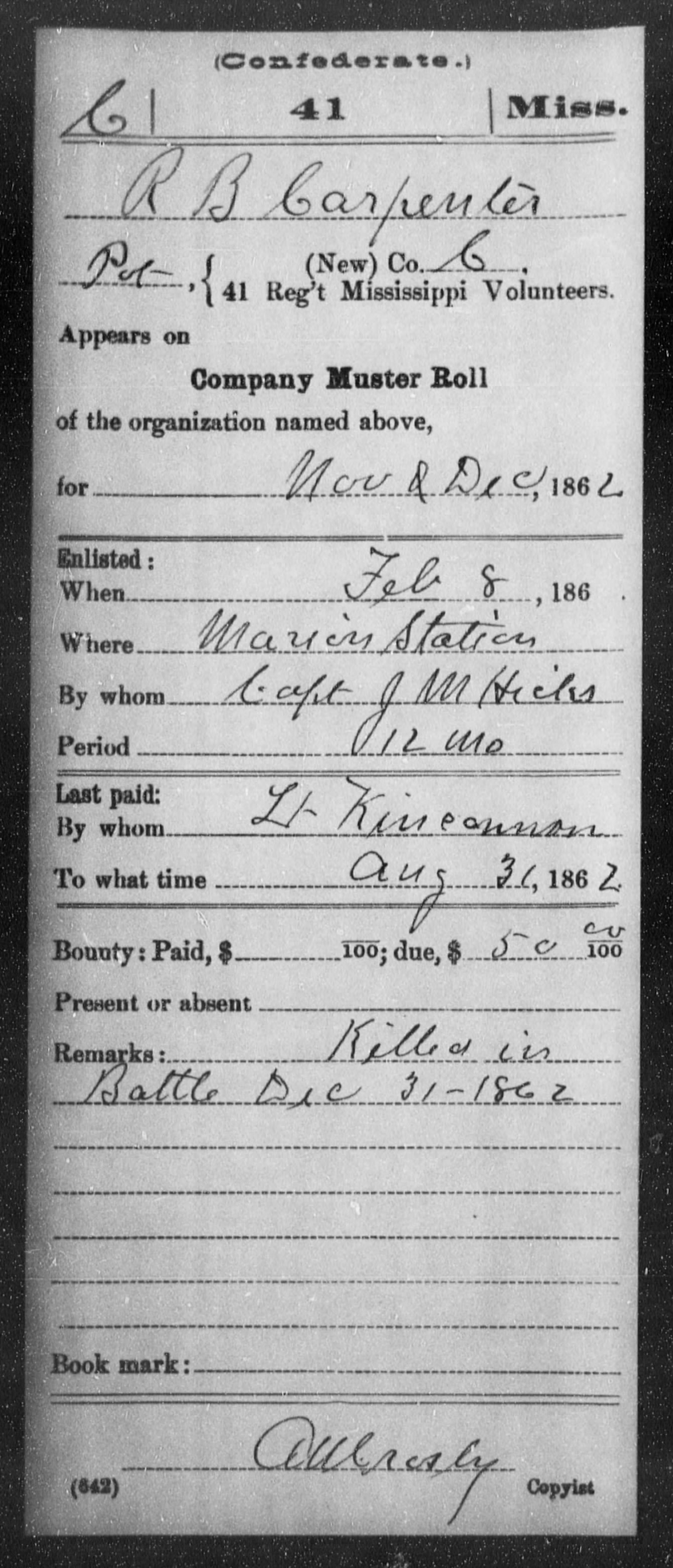
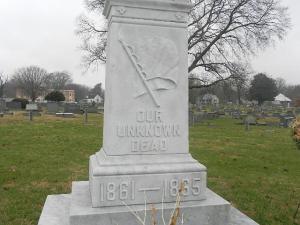
My 3rd great grandfather was Rice Benjamin Carpenter. He was born in 1828 and died during the Civil War serving the Confederacy at the battle of Stones River in Murfreesboro, TN on 31 Dec 1862. He left behind a wife and four young children. He is buried at the Confederate Circle at Evergreen Cemetery in Murfreesboro.
His first name came from his mother’s family—the Rice family. His mother was Nancy Rice, born born 1791 in NC. At some point around 1834ish, she and her husband, Benjamin Carpenter, packed up their home and five children and moved to Lauderdale Co, MS. After arriving there, they had five more children. Nancy and Ben both died in Lauderdale Co in 1870 and 1865, respectively.
Nancy’s father was John B Rice (I bet the B was for Benjamin). John was born in 1755 in NC and died there 29 Apr 1836. He married Elizabeth Hopkins, who was also born and died in NC. They had at least eight children in the late 1700s, including a son named Hopkins Rice. Is this getting confusing yet? John served in the American Revolution (pension no 59062). That makes at least 3 grandfathers of mine who served.
One of my genealogy buddies found the following in a Rice Family archive. It reads to be from a slave’s descendant.
“My family history dates back to Nash County, North Carolina in 1787. A woman by the name of Chaney was born. Little is known about her background, but it is believed that she was the daughter of an African. I have done extensive research on the slaves of Hopkins Rice. It is believed that Chaney and her sister were given to the Hopkins Family of Nash Carolina. Peter Hopkins was the first Hopkins in his family to move to Edgecombe County, North Carolina. He was born in 1730. He married a woman named Wilmoth Fowler. She was born in 1747 in Wake County, North Carolina. She was the daughter of Joseph F. & Anne Fowler. The couple had known children: William Hopkins, John Hopkins, David Hopkins, Elizabeth Hopkins-Rice, and Susannah Hopkins-Russell. The Hopkins oldest daughter, Elizabeth, married a Revolutionary War Hero named John Rice. He was born in 1755 in Bute County, North Carolina. They moved to Nash County, North Carolina and purchased about 800 acres of land on Lee’s Creek. They couple had about eight children.1. John Rice, 2. William Rice, 3. Elizabeth Rice-Richardson, 4. Nancy Rice-Carpenter, 5. Mary Rice-Marriott, 6. James M. Rice, 7. Benjamin Rice, 8. Hopkins Rice. Chaney was brought to this plantation, but it is unsure exactly when. However most of her children were born on the Rice plantation. There is a strong possibility that she had more than five children, but it is uncertain. In the early 1800’s John Rice deeded Chaney and her children to his son Hopkins Rice and his wife Jane. In the early 1820’s Hopkins and his family migrated to Greene County, Alabama by way of Georgia. They purchased land in 1828, where the estate grew in the Clinton and Pleasant Ridge areas. In the later years, some of the Rice’s were sold to various plantations. One of Chaney’s sons, Anderson, was sold to Eldred Pippen. Also three of her great grandsons were sold. Jesse Rice was sold to Gaston Wilder of Pickens County, Alabama. Richard “Dick” Gilmore was sold to William Gilmore of Mantua. The last son was sold to a Harkness, whose name is not known.”
John’s father was Jared or Jerret Rice. He was born around 1730. He married Lettie Potts and they had at least six children. They lived in NC. My second great grandmother (Rice Benjamin Carpenter’s first child) was Martha Lettie Carpenter Blanks. I always wondered where the name Lettie came from. Now we know.
James was my 3rd great grandfather. He was born in Wake County, NC on 15 Jan 1823 to Nimrod Howington and Milbury Bradley. He was the second born of thirteen children. He was 5′ 11″ and had auburn hair and gray/blue eyes.
At some point, he ended up in Sumter Co, AL and married Amelia “Ann” Smith on 24 Sept 1843. His son also married a Smith (my great great grandparents), and I heard through family members that she was a Choctaw Indian. The Indians were all but run out of MS and AL in the 1830s following the signing of the Treaty of Dancing Rabbit Creek. The ones who stayed changed their names to assimilate into the white European culture. They chose names like Smith, so there is a good chance Amelia was an Indian also.
By 1850, they had taken up residence in Newton Co, MS and had ten children before the start of the Civil War. James signed up with the 5th Mississippi Infantry, Co. A, on 7 July 1862. He was captured 15 Jun 1864 and held prisoner at Rock Island, Illinois. When the war ended, he returned home and they had two more children.
His great grandparents (my 6th greats) were Robert and Mary Morris. I’ll let you look them up yourself, but it is proof we have been here in the U.S. for a very long time. Oh, all right, I know you won’t go look. He was one of the signers of the Declaration of Independence. You’ll go look now, won’t you? Yeah, that was my pappy. We seem to have a rebellious streak in our family.
James died around 1880 at the age of 57 and is buried in Pleasant Grove Missionary Baptist Church Cemetery, a few miles from his home.
She was born in Lauderdale County, Mississippi to James Rodgers and Martha Sanderford Rodgers. She had a five-year-old brother and a two-year-old sister, and two more children would follow her. She grew up in a farming community, surrounded by loving grandparents and more than a dozen aunts and uncles, along with their respective spouses and children. Her father and a slave named Bill built the log home she grew up in. Her childhood was ideal.
In 1861, Mississippi seceded from the Union and Civil War broke out. Though she had many uncles go off to fight in the war, her brothers were too young and her father was too old, so they remained safely at home with her.
In the fall of the following year, a typhoid epidemic invaded her community, killing her grandparents, many aunts, uncles, and cousins, and her parents. Her father died October 12, 1862. Her mother died a few short weeks later.
She was nine.
Her given name was Martha Ellen Rodgers, but she was simply known as Ellen.
“An Orphan’s Heart”is her story.
Happy birthday, Ellen! We honor and remember you on this day, 160 years after your birth.
In honor of Ellen Rodgers’s birthday and the May 1st release of “An Orphan’s Heart,” I am hosting a giveaway. One randomly selected person from all the people who LIKE “An Orphan’s Heart” facebook fan page will be chosen on May 1st to receive signed paperback copies of BOTH “An Orphan’s Heart” and “Okatibbee Creek.” Spread the word to your friends. All they have to do is LIKE the page. No purchase necessary. One winner will be chosen. Winner will be notified on or about May 1st. Prizes will be shipped on or about June 1st. Click here to visit “An Orphan’s Heart” facebook fan page.
That is the question historical fiction writers are most often asked. It takes a huge amount of time researching the characters and documents for a historical fiction novel. The obvious items are names, dates, and places, but the not-so-obvious are social questions. What was going on in the world at the time? What about the town? The family? Fashion? Industrial? Politics? Agriculture? Relationships? Economic status? These specifics are very time consuming. There are too many questions to speak of generally, so let’s narrow it down a single person and see if we can make sense out of the documents of one person’s life.
In the historical fiction novel I am currently working on, “An Orphan’s Heart,” we know the following about Ellen Rodgers. She was born in 1853 in Mississippi. In 1860, the census shows her living with her parents and four siblings in Mississippi. Her parents died within a month of each other in 1862. Ellen was nine. The 1870 census shows her living with her aunt Elizabeth Rodgers Graham in Alabama. The 1880 census shows her back in Mississippi, living with her two sisters. There is no 1890 census because it was burned in a fire, but I did find a relative who sent me a copy of Ellen’s 1890 obituary. Ellen died at the age of 37 in Texas.
There are a few social ideas we can deduce about the above facts:
1) Children at that time in history would usually be left in the custody of the eldest male family member. Ellen’s parents died in the middle of the Civil War. Since Ellen ended up with her aunt, we can assume any male who would have taken custody, if there was one, was probably off fighting in the war.
2) Travel to Alabama and back to Mississippi would have probably been by wagon. Her locations were 110 miles apart. Ox-pulled wagons traveled 10-15 miles per day, making the trip 7-10 days. Horses moved faster, perhaps 6-8 days. Indians were not too apt to steal horses in the area like they were out West, and there was a river to travel along to have a fresh water supply, so it they had them, they probably used horses.
3) The most logical way to get to Texas in the 1880s would have been by train. Travelling the route from Meridian, MS to Mobile, AL, to New Orleans, LA, to Houston, TX, and then up to Runnels County would have been probable through a combination of three lines; The Mobile and Ohio RR, the Louisiana Western RR, and the Houston and Texas Central RR, and would have taken about five days. It would have involved changing trains, staying over in towns, layovers for supper, and sleeper cars.
There are more than a few personal questions:
How did Ellen end up in Alabama in 1870? Why did she go back to Mississippi? Why and when did she go to Texas? Why did she die so young?
Those answers lie in other members of the family.
Probate documents show Ellen was indeed in the custody of her uncle Hays Rodgers. He returned home at the end of the war in 1865. About 1866/67, he moved his family to Alabama. His sister, Elizabeth, was already living there. That’s how Ellen ended up in Alabama. She arrived at about age 13 or 14 and was 17 in the 1870 census. But why did she go back to Mississippi?
That answer lies in Aunt Elizabeth’s records. Elizabeth died in 1875. There is it. Ellen has now lost another adult she probably considered a mother. Sometime before 1880, she went back to Mississippi. Perhaps her uncle escorted her, perhaps she traveled alone.
Also, back in 1866/67, her two brothers went on a wagon train to Runnels County, TX with their maternal uncles. That is Ellen’s connection to Texas. But, when did she go and why? And, how did she die there at the young age of 37?
The answer to that lies in Mr. Sam Meek and Pleasant Hill Cemetery in Bell County, TX.
Ellen’s brother was married to Sam’s sister. When Ellen went out there, either to visit or to live, she naturally met Sam. They were married in 1885 (making her arrival there about 1884ish). Ellen and Sam had twin boys who were stillborn in 1887. They had a daughter in 1888. And they had a second daughter on August 5, 1890. Ellen died eight days later on August 13, 1890. Since there were no medicines to fight off infection in those days, she more than likely died of complications or infection following childbirth. Sadly, the baby died a couple months later in October. They are all buried at Pleasant Hill Cemetery.
Now, we can weave together the life of this young woman. Here’s where the “fiction” part comes in. What kind of personality would you give Ellen? Would she be strong? Shy? Bold? Reserved? As the author, it would be your choice. How about her aunt Elizabeth? What kind of house did they live in? How about her relationship with Sam? You can examine his family and come to your own conclusion about what kind of man he was. You can look at the historical time, locations, house styles, economy, but the final call is yours. Who stood vigil at Ellen’s death bed? What happened to the surviving daughter? That question requires more research. Would you research further or would you end the story with Ellen’s death? Is there a moral to the story, something to be learned, a reason for her short life?
So, there you have it. How much is true? All of it…and none of it. Was she strong? Shy? Bold? No one will ever know. Does she have an interesting story? Yes. Is it worth giving her a personality to tell her story? Yes.
Someone asked me how I came to write a historical fiction book, what sparked my interest in the main character? I had been working on my book for eight months, so I kind of lost track of how it all started. At the same time, I was also asked to do a talk/reading/book-signing in February, and I spoke with my husband about the important points of my impending talk.
He said, “You should let them know how it all started. Why did you write it?”
So, I put my thinking cap on and tried to remember…
She was just a name in my family tree. Mary Ann Rodgers. My third great grandmother. I discovered that she lost her husband, Rice Carpenter, in the Civil War in 1862. How sad to lose the one you love, but hey, it’s war, people die. After he died, she remarried in 1864. I looked at the 1870 census and found she was married to William Jolly and was living with his children, her children, and three children they had together. It was a house-full! But at least their three children were proof they must have liked each other, right? That’s good. I was interested where William came from, so I traced him back and looked at his 1860 census. In 1860, he was living with his wife Harriet, their four children, and a woman named Nancy Carpenter who was 69 years of age.
Nancy Carpenter? The only Nancy Carpenter I know is Rice’s mother, whose maiden name was Nancy Rice. Why was Mary Ann’s mother-in-law living with her future husband?? Were they neighbors? Was she their cleaning lady? I clicked on Nancy Carpenter and saw her relationship to the “head of house” was listed as “mother-in-law.” She was William’s mother-in-law? What?? She was Harriet’s mother?
So, I went back and looked at Rice’s family, and sure enough, his sister Harriet was married to William. Rice died 31 Dec 1862 and Harriet died a month later on 30 Jan 1863. Their spouses, Mary Ann and William, brother-in-law/sister-in-law, married in 1864. Well of course they did. They had known each other for many years, hadn’t they?
The more I looked at the Rodgers and Carpenter families, the more I was amazed by the sheer number of family members they lost to war and typhoid. At the time of my research, I remember counting SEVENTEEN, but I’m sure there were many more I missed. I couldn’t wrap my head around that kind of heartache and quickly became impressed with Mary Ann’s strength. How would you react if you lost two or three family members this year? You would probably need Prozac. How would you respond if you lost a dozen? I wouldn’t even be able to get out of bed. Seventeen in one year? I can’t even fathom that.
Years, numbers, and names from census records are just that – years, numbers, and names – unless you put yourself in their shoes. Then they become tears, children, and heartaches. We all come from those strong women. We are the living proof of their strength. If the boat sank, the story would be over. But it didn’t, and we know that because we are here. We are the survivors. I dug deep down in my heart and soul and decided to tell her story, a story she would be proud of. I wanted her to know that she didn’t go through all of that in vain. I am here. I am her legacy. Her story has been told to make us all stronger. We are the products of strength, fortitude, and integrity, as well as tears, heartache, and pain. We are the children our grandmothers fought so hard for, and I want Mary Ann to be as proud of me as I am of her.
Hi Y’all! I’m back from vacation. Happy New Year to you all!!
A few interesting things happened while I was on vacation.
First, in case you missed it, my book “Okatibbee Creek” came out in paperback. Check it out on Amazon here. If you’re a Kindle fan, the Kindle version will be out in a week or so.
The interesting thing about the book release is watching the progress, which is like watching a horse race. The Amazon ratings, which are generated by some incomprehensible algorithmic computer program, shows my book jumping up and down between 60k and 380k on the best selling list. I swear it changes by 10k in the two seconds I’m looking at it. The ratings of “books released in the last 30 days” are a little more stable. I’ve been bouncing between 25 and 35 in the historical fiction category for the last week. Out of over 1000 historical fiction titles released in the last month, that’s not too bad.
Next interesting thing. I went to Biloxi, MS for a few days and found that 50% of the beachfront is still vacant since Katrina went through seven years ago, and it’s all for $ale. I didn’t know it was possible to purchase beachfront property any more, but apparently it is! And while it’s not cheap cheap, it’s still relatively affordable – about $1 million per acre. Not a bad price for beachfront. Yes, I’m thinking about it.
Next, I didn’t know New Orleans was so close to Biloxi – only an hour and a half away. So, we sauntered down to the French Quarter for an afternoon. Gumbo and Beignets!
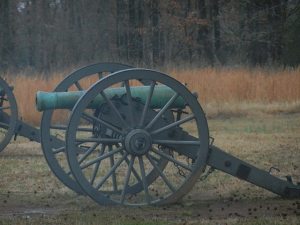
Following our Bourbon Street party, we went up to Murfreesboro, TN to see the 150th anniversary reenactment of the battle of Stones River. It was a cold, rainy day – just like the day of the real battle 150 years ago. I walked the land where my third great grandfather died on December 31, 1862 – which happens to be a large part of my above mentioned book. The only word to describe the experience is “humbling.”
RIP Private Rice Benjamin Carpenter, 41st Mississippi Infantry, Co C.
 Pictured here in 1908.









 Lori Crane