Rice Benjamin Carpenter was born August 15, 1828 in Greene County, Alabama to Benjamin Carpenter and Nancy Rice Carpenter. He was the eighth of ten children.
In 1834, his family moved to Pine Springs, Lauderdale County, Mississippi for the low-cost land and fertile soil. Rice was six years old.
He married Mary Ann Rodgers in 1846. They were both seventeen.
They had five children – Martha Lettie, Benjamin Hays, William Travis, Charles Clinton, and MF – one girl and four boys.
After living with his friends Ebenezer and Sarah Miles in Pine Springs for a few years, in 1853 they bought 80 acres of land from Mary Ann’s father and began farming, but within a few short years, Rice realized he was a better merchant than a farmer, and by 1860 they had opened a general store in Marion Station, Mississippi.
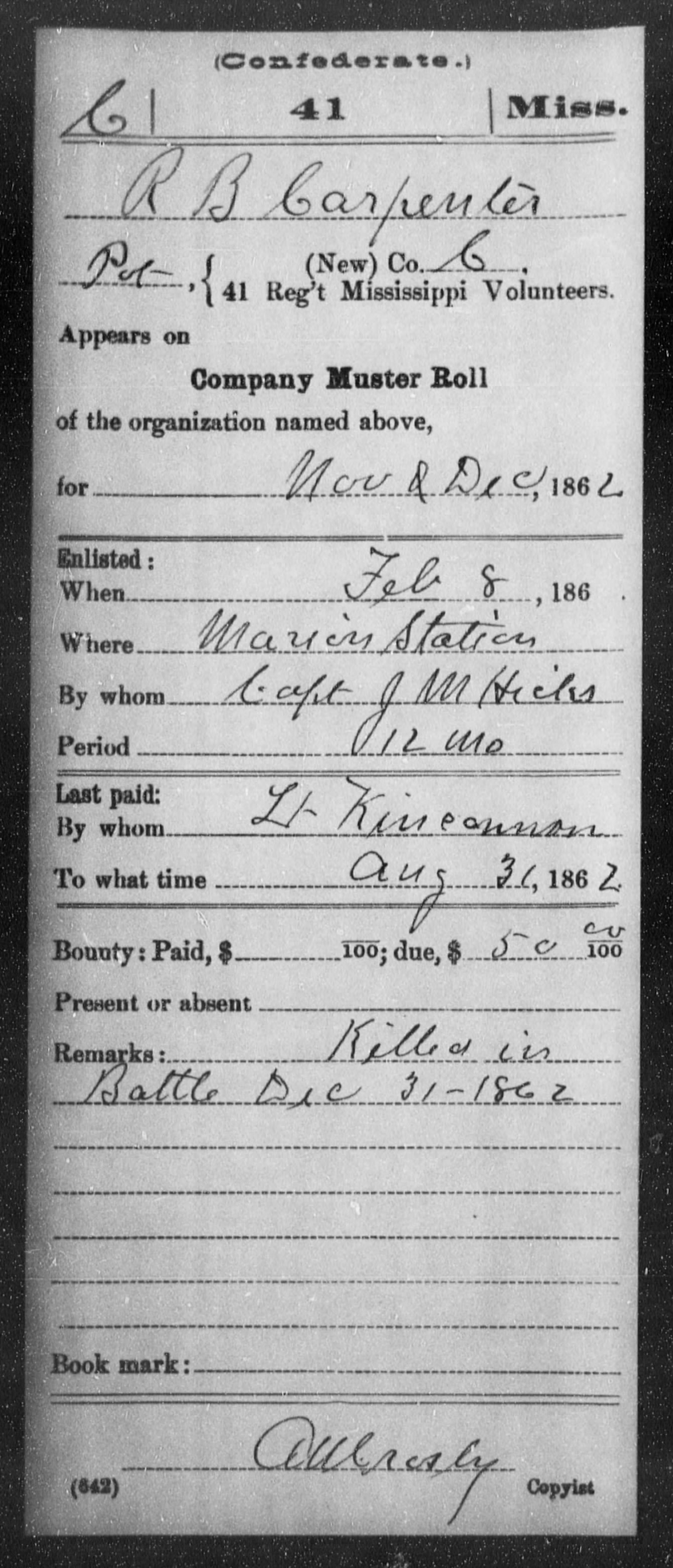
When the Civil War began, Rice signed up for the 41st Mississippi Infantry, Company C on February 8, 1862. This must have been a frightening time for the family, as Mary Ann was eight months pregnant with their last child who was born March 12th, 1862.
At dawn on December 31, 1862, amid limestone boulders and cedar forest, his infantry attacked the Union soldiers at the Battle of Stones River in Murfreesboro, Tennessee.
Private Rice Benjamin Carpenter died on that day on the battlefield at the age of 34, leaving behind his wife and children.
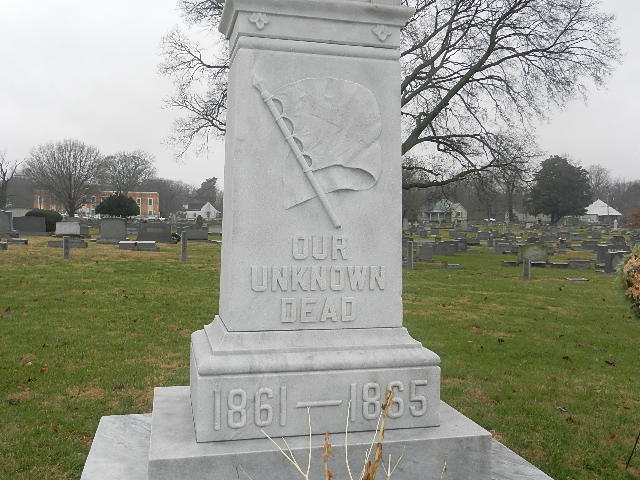
He is laid to rest at Confederate Circle, Evergreen Cemetery, Murfreesboro, Tennessee. RIP 3rd great grandpa. Rest well soldier, your job is done.
Even if you’re published, publishers don’t support book tours anymore. So, a writer is left with two options: 1) schedule events and signings yourself or 2) do a virtual tour. Either way is a lot of work, but the virtual tour is far less expensive. I’m putting together a November tour for my coming release “Elly Hays,” so I’ve been doing tons of research and organizing it myself. I decided to do a fall tour because I notice a huge spike in sales following holidays. I assume it’s because of word-of-mouth at family gatherings, so I want to get the book in a lot of reader’s hands before Thanksgiving. That’s my theory anyway.
So, here’s what I’ve learned about Virtual Book Tours:
Preparedness, Organization, and Communication are the most important points.
Prepare all of your blogs, interviews, excerpts, links, media kits, photos, etc., far in advance.
Organize your items in folders on your computer, along with host information, schedule, etc. You need this all in one place. Excel spread sheet, anyone?
Communication with your hosts is key. Make a folder to keep all correspondence. Invitation, Follow up, Confirmation, Reminder, and Final Thank You.
I guess the next step is to be WAY ahead of yourself. Give yourself at least two months to plan.
Set up an account to do a giveaway. Rafflecopter is awesome.
Consider offering an end-of-tour Twitter Chat on one day for one hour with a specific hashtag. Announce it throughout the tour.
Have some crafty photo-shop-type person make you a banner.
Promote Promote Promote before during and after!!!!!
As I mentioned before, I’m setting up a tour for November 4-16. If you have room for me on your blog, please let me know, and I’ll put together whatever type of post you’d like to feature. Email me at loricraneauthor@gmail.com and we’ll choose a date and content. If you’d like to do a review, I can supply you with a free paperback, Kindle, or Nook.
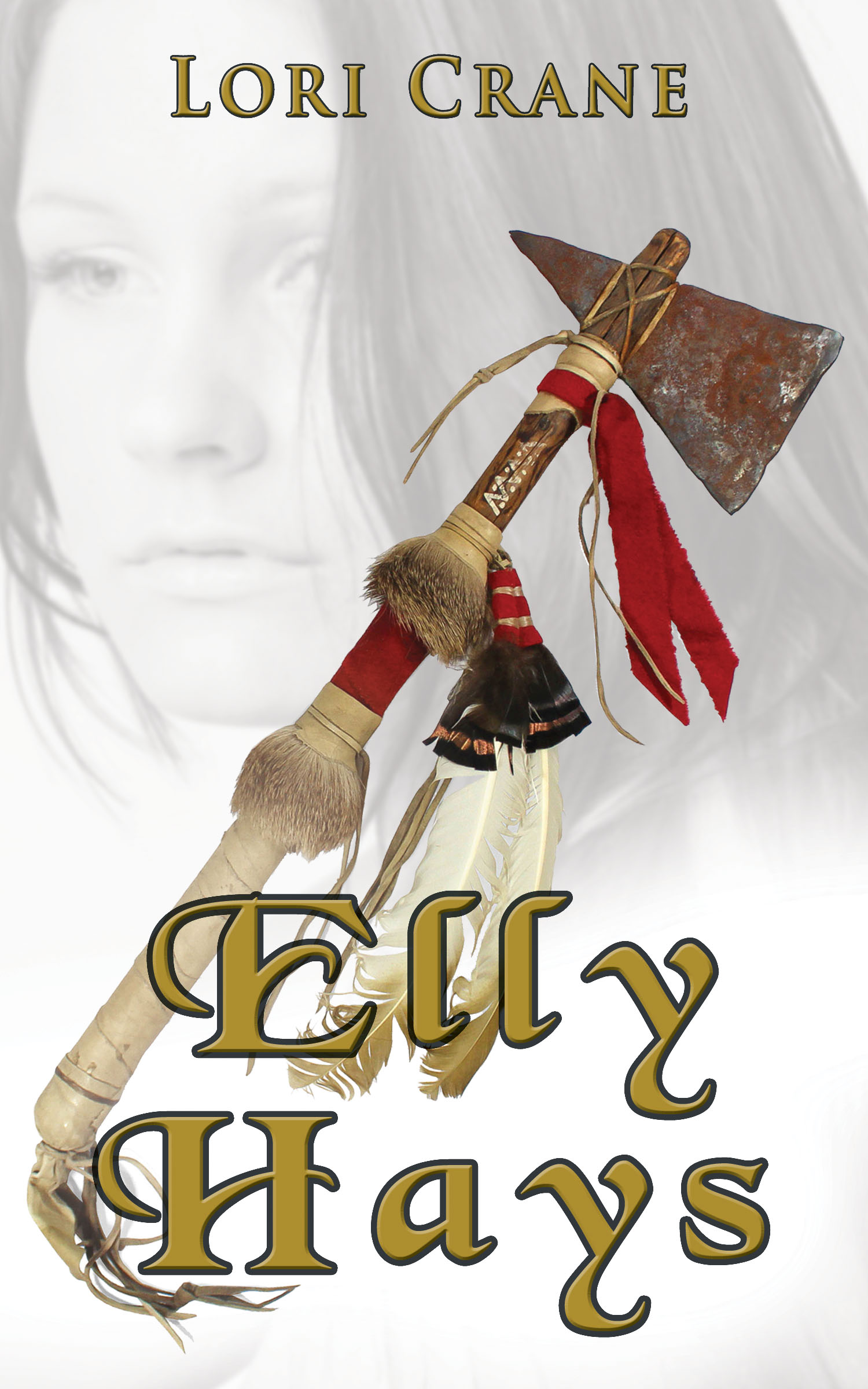
In honor of my coming October book release of “Elly Hays,” today’s Writer’s Corner will be about the book’s heroine, Elizabeth Hays Rodgers, and how she came to be the center of a novel.
She was the only daughter of Samuel Hays and Elizabeth Priscilla Crawford, born in North Carolina in 1774. She spent her young childhood in the unrest of the Revolutionary War. She married when she was sixteen, and after twenty-one years of marriage and eleven children, her husband decided to uproot the family from Tennessee and start a new life in the Mississippi Territory. Considering what they were walking into, I had to write her story. A portion of it is below. It will help you understand that area of the country at that time in history.
The (unedited) Prologue
In 1811, America was on the verge of war. The victory in the Revolutionary War gave Americans their independence, but the newly formed country had many unresolved issues. Americans had a vast frontier to settle and they considered the land now known as Canada to be part of their land. They wanted to expand northward and westward, but the British joined forces with the Native Indians in an attempt to prevent the Americans from expanding in either direction.
The British had also begun restricting America’s trade with France and the mighty Royal Navy ruled the seas. The Royal Navy had more than tripled in size due to their war with France, and they needed sailors. They captured American merchant ships off the coast of America and forced the men with British accents to join the ranks of the Royal Navy, proclaiming they were not American, but indeed British. Kidnappings and power struggles in shipping ports like New Orleans loomed over the newly formed United States.
The British not only invaded the southern coastal cities of the United States, but also the eastern seaboard, attacking Baltimore and New York, and burning Washington D.C. to the ground. The War of 1812 is historically referred to as the second war for independence. It was the battle for boundaries and identity for the Americans.
Sadly, the Native American Indians had the most to lose in the power struggle. Shawnee warrior Tecumseh was but a child when he witnessed his father brutally murdered by a white frontiersman. His family moved from village to village and witnessed each destroyed at the hands of the white men during and after the American Revolution. As a young teen, following the Revolution, he formed a band of warriors who attempted to block the expansion of the white man into their territory, but the effort saw no lasting result. Conflict with the white man was a battle he had fought all his life, and as a warrior now in his early forties, he knew the stakes were high for the Indians in the coming battle. He traveled the southeast, coaxing the numerous Indian nations to unite against the white man, promising help from the British in the form of weapons and ammunition, and offering reinstatement of the Indian’s lost lands upon victory. Tecumseh’s prophet, who traveled with him into Creek territory, forecasted a victory, foreseeing no Creeks being wounded or killed in the battle.
In the Eastern Mississippi Territory, which later became the state of Alabama, the Creek Indians were divided. Many Creek villages had been trading with the white man for years and participated in civilization programs offered by the United States government. These Creeks had been taught the ways of the white man. They spoke English, could read and write, and even incorporated white man’s tools into their daily lives. They traded or were given gifts of plows, looms, and spinning wheels, and had no qualms with the white man. Many had married whites, and they did not want to join in the fight.
In opposition, many villages joined with Tecumseh, for they wanted to maintain their way of life, claiming the white man’s ways would destroy their culture. They had witnessed the white man encroaching on their lands, destroying their forests and villages, and polluting their streams. And probably, some suspected the white man’s intent was not co-existence but domination, for they had seen this come to fruition in the treatment of the black slaves.
In 1811 and 1812, tribal tensions were growing due to these differences in beliefs, and this caused a great war in the Creek nation called The Red Stick War. It was a civil war fought between the Creek people, but by 1813, it expanded to include the American frontiersmen and the U.S. government. At the height of the War of 1812, the Creeks were at war with nearly everyone, including their own people.
It was in this turmoil that a white farming family moved from their home in Tennessee to the fertile farmlands of the eastern Mississippi Territory, a place known today as Clarke County, Alabama. James Rodgers, his wife Elly, and their eleven children unknowingly entered a hornet’s nest.
If you have read the first book in the Okatibbee Creek series, “Okatibbee Creek,” you will be familiar with its heroine, Mary Ann Rodgers. “Elly Hays” is about Mary Ann’s paternal grandmother, Elizabeth Hays Rodgers, better known as Elly. If you have not read any of the Okatibbee Creek series, they are a collection of stories about one family and the strong women of our past. These are the real-life stories of my grandmothers, aunts, and cousins, but if you live in the U. S., they could also be the stories of your female ancestors – the women who fought for us, for our safety, our lives, and our freedom, and who sacrificed everything with the depth of their love and their astounding bravery.
“Elly Hays“ will be release October 2013 in paperback, Kindle, and Nook.
Here’s a snippet from my AWARD-WINNING book “Okatibbee Creek.” Haha. Yes, award winning! It was recently named the bronze medal winner in the 2013 eLit Book Awards in Literary Fiction. That’s funny, because I’m sure it was entered as Historical Fiction, but whatev. An award is an award. We take ’em any way we can get ’em! 😛
~~~~~~~~~~~~~~~~~~~~~~~~~~~~~~~~~~~~~~~~~~~~~~~~
Set up – January 1863 Mississippi. The Civil War is in full swing. Mary Ann Carpenter owns an old general store in town where the war’s casualty lists are periodically posted. Four of her brothers and her husband, Rice, are off fighting in the war, and she has not heard from any of them in a while and is understandably worried.
~~~~~~~~~~~~~~~~~~~~~~~~~~~~~~~~~~~~~~~~~~~~~~~~
Martha Jane yells up the stairs, “Mary, there’s a gentleman here. He says he has to see you.”
I return to my room to get my day cap. I smooth down my wrinkled dress and head downstairs.
When I reach the bottom of the stairs, I see him. I do not recognize his face, but I recognize his clothing. He is a Confederate soldier. He is standing in the open doorway of the store with the gray, cloudy sky at his back. He is dressed in a wrinkled gray uniform with a dirty yellow cummerbund. His trousers have holes in them, with mud caked around the bottoms of his pant legs. His jacket is missing some buttons, and he looks quite thin and weary. He is wearing shoes that are covered in red Mississippi mud and probably have no soles on the bottom. He is holding his tattered hat and a piece of paper in his dirty hands.
“Hello, sir, what can I do for you?” I ask as I approach.
“Hello, ma’am.” He nods. “Are you Mrs. Carpenter?”
“Yes, I am. And who are you, may I ask?”
“Private Joseph Brown, ma’am. Captain asked me to deliver the latest casualty list to you in person.” He holds the folded piece of paper toward me and looks down at the floor, like a child in trouble for doing something wrong.
“Why are you delivering this? It usually comes by a mail carrier,” I ask as I reach for the paper. I look at the boy’s face. He nervously avoids my eyes and keeps staring at the floor.
“Why are you delivering this to me?” I repeat.
“I promised I would. I’m sorry, ma’am. Goodbye, ma’am,” he murmurs, and backs out the open door.
I look at the piece of paper in my hand for a long time, wondering if I can open it. I don’t know whose names are on this paper, but I suspect the worst, and I don’t want to read it. My eyes sting with tears as I dread a simple piece of paper. I try to unfold it, but my hands are shaking, so I stop and hold it to my chest. I take a deep breath.
Martha Jane stands behind me, not saying a word or making a sound.
“Martha Jane, will you please go upstairs and mind the children for a few minutes?” I ask her.
She nods and quietly heads up the stairs.
I walk outside across the wooden porch and down the two stone steps onto the ground. I walk across the dirt road that is now filled with puddles of red mud from the rain. I keep walking straight ahead. I walk into the overgrown field across the road. I walk with purpose, with determination, like I have somewhere important to go. I want to run. I want to run away and never come back. I keep walking.
In the middle of the field, the thunder sounds above my head. I stop and look up at the ominous clouds that are almost as threatening as the piece of paper I hold in my hand. My hands are shaking as I slowly unfold it and smooth it open. My stomach feels like it has a hole in it. My eyes fill with tears. My hands are now trembling so violently, I almost can’t read it. The name at the top is the only name I see.
“Carpenter, Rice Benjamin: killed in battle 31 December, 41st Mississippi Infantry, Co C.”
Drops of water fall onto the page, but I can’t tell if they are raindrops or teardrops. Even God Himself is crying.
All I’ve wanted the last seven months is for my husband to come home and hold me and tell me everything will be all right. All I’ve done for the last seven months is managed the store and the family, and I’ve waited—waited for Rice to come home. I’ve waited and I’ve prayed and I’ve done everything possible in preparation for him to come home to me.
I’ve dreamed of his homecoming. I’ve dreamed of taking up our lives where we left off. I’ve imagined us having more children. I’ve wished for his arms around me. I’ve seen his blue eyes in my dreams so often and heard his laughter ringing in my head over and over. I’ve pictured his beautiful Carpenter smile as he runs up the road and takes me in his arms. My heart always feels like bursting at the thought of seeing him again. I’ve imagined our happy reunion hundreds of times.
Now what?
There will be no homecoming. There will be no funeral. There will be no body. There will be no goodbye. It’s just over. My heart is ripping out of my chest in a pain I can’t even try to describe. My future is gone. My past is gone. My present is gone. Everything is gone. It all died with Rice.
I stand in the middle of the field in a blinding thunderstorm, holding a wet piece of paper that is all that is left of my husband, and I scream at the top of my lungs.
~~~~~~~~~~~~~~~~~~~~~~~~~~~~~~~~~~~~~~~~~~~~~~~
“Okatibbee Creek” is available in Kindle and paperback at Amazon, and Nook and paperback at Barnes & Noble. Also in ebook at Sony and Kobo.
The property is located in Monroe, Michigan. There have been two homes built on the property. The original house was built by Francois Navarre on land given to him by the Potawatomi Tribe. The house is named after one of its residents, Dr. Alfred Sawyer, who lived there from 1859-1870. The original house was demolished and a new one built in 1873. Dr. Sawyer never lived in the current house, but it remained in his family until his daughter donated it to the city of Monroe in 1973.
Following lunch, my ladies from the United States Daughters of 1812 are having a bench dedication at the River Raisin National Battlefield, commemorating the bicentennial of the War of 1812.
My 1812 soldier is Hays Rodgers.
While I was writing this little blurb, my phone rang and a lady told me my book “Okatibbee Creek” won the bronze medal in Literary Fiction at the 2012 eLit Book Awards. Check the book out on Amazon. The book is about Hays Rodgers’s daughter. “Wow, that’s a weird coincidence,” said the award-winning author. 🙂
In the publishing world – formatting is the Devil.
The following is a story of aggravation, so my indie author friends can point and laugh.
When I self-published “Okatibbee Creek,” I knew I would need someone to format it for me. There were two reasons. A) It had a lot of photographs and documents that needed to be included. B) I didn’t know squat about formatting. So, I paid a reputable (insert shitty) company to do the grunt work. I was told it was a six-week process, beginning with a mock-up, followed by a full format, followed by a paperback proof, followed by the finished product. The six weeks included the week-long time to incorporate any changes I would make at each stage of the process.
I requested a few specific things upfront: 1) I wanted the chapter titles to be the same font as the cover, 2) I wanted drop caps at the beginning of each chapter, 3) I wanted fleurons (the little fancy squiggles separating times or at the end of a chapter), and 4) there were letters included in the story, so I wanted those indented and a different font, perhaps something in the neighborhood of handwriting.
The first week became twelve days, and the mock up contained ZERO items on my above wish list.
Back to the drawing board.
The revisions (insert starting over from scratch) were supposed to take a week, and ended up taking another ten days, but the mock up came back perfect, except I didn’t get a sample of the indented, handwriting font for the letters, nor did I see one fleuron. Oh, well, take what you get at this point. We’re now well into November and I’d like to get this book out before the holidays.
The completed full format, supposedly a 10-day process, took another couple weeks, and it looked good…until the last 50 pages. Photos were in the wrong places with the wrong captions, single lines were left lonely at the bottom of a page when they obviously should have been at the top of the next page. One page actually had a paragraph in a totally unrelated font in a strange size just looming there for no reason at all. Apparently the formatter grew tired after lunch, or got into a fight with her boyfriend, or needed a Pepsi, or was anxious to get out the door and go on her Thanksgiving break.
I emailed the corrections – which would take another week (but probably more because of Thanksgiving).
After two weeks, I called them because I hadn’t heard back. Apparently, someone over there didn’t click the right button, and my file was hanging in limbo with no one working on it. They were sorry. How nice.
After another week, I received a paperback copy in the mail. It only needed two or three minor changes. Would they let me request those over the phone or by email and call it good? No. They needed me to download the full format, make the changes on the document, email it back to them, and they would incorporate the changes, and send me yet another paperback copy. Another ten days of waiting.
Finally, after ten weeks, it was finished. Of course it would take another week or so for it to appear on any of the online retailer’s sites. Being too late for holiday sales, I guess it didn’t really matter at this point. Sigh.
I received an email from them a month later asking me to fill out a survey about their services. Well, you can imagine what I wrote. Actually, I was very nice (insert a little bitchy) and told them specifically where things had fallen apart.
Here’s the rub. I got an email back, telling me I was WRONG. It explained that they were well within the six-week time frame they initially told me. They said I uploaded my manuscript on Oct 12, 2012, and they published the finished product on Dec 21, 2012. I don’t know how they figure that was six weeks. They must be using that Mayan calendar.
The moral of the story: I’ve spent the last three months learning how to format for paperback, Kindle, and Smashwords. I finished the formatting for my next book for all mediums in five days. 🙂
She was born in Lauderdale County, Mississippi to James Rodgers and Martha Sanderford Rodgers. She had a five-year-old brother and a two-year-old sister, and two more children would follow her. She grew up in a farming community, surrounded by loving grandparents and more than a dozen aunts and uncles, along with their respective spouses and children. Her father and a slave named Bill built the log home she grew up in. Her childhood was ideal.
In 1861, Mississippi seceded from the Union and Civil War broke out. Though she had many uncles go off to fight in the war, her brothers were too young and her father was too old, so they remained safely at home with her.
In the fall of the following year, a typhoid epidemic invaded her community, killing her grandparents, many aunts, uncles, and cousins, and her parents. Her father died October 12, 1862. Her mother died a few short weeks later.
She was nine.
Her given name was Martha Ellen Rodgers, but she was simply known as Ellen.
“An Orphan’s Heart”is her story.
Happy birthday, Ellen! We honor and remember you on this day, 160 years after your birth.
In honor of Ellen Rodgers’s birthday and the May 1st release of “An Orphan’s Heart,” I am hosting a giveaway. One randomly selected person from all the people who LIKE “An Orphan’s Heart” facebook fan page will be chosen on May 1st to receive signed paperback copies of BOTH “An Orphan’s Heart” and “Okatibbee Creek.” Spread the word to your friends. All they have to do is LIKE the page. No purchase necessary. One winner will be chosen. Winner will be notified on or about May 1st. Prizes will be shipped on or about June 1st. Click here to visit “An Orphan’s Heart” facebook fan page.
Someone asked me how I came to write a historical fiction book, what sparked my interest in the main character? I had been working on my book for eight months, so I kind of lost track of how it all started. At the same time, I was also asked to do a talk/reading/book-signing in February, and I spoke with my husband about the important points of my impending talk.
He said, “You should let them know how it all started. Why did you write it?”
So, I put my thinking cap on and tried to remember…
She was just a name in my family tree. Mary Ann Rodgers. My third great grandmother. I discovered that she lost her husband, Rice Carpenter, in the Civil War in 1862. How sad to lose the one you love, but hey, it’s war, people die. After he died, she remarried in 1864. I looked at the 1870 census and found she was married to William Jolly and was living with his children, her children, and three children they had together. It was a house-full! But at least their three children were proof they must have liked each other, right? That’s good. I was interested where William came from, so I traced him back and looked at his 1860 census. In 1860, he was living with his wife Harriet, their four children, and a woman named Nancy Carpenter who was 69 years of age.
Nancy Carpenter? The only Nancy Carpenter I know is Rice’s mother, whose maiden name was Nancy Rice. Why was Mary Ann’s mother-in-law living with her future husband?? Were they neighbors? Was she their cleaning lady? I clicked on Nancy Carpenter and saw her relationship to the “head of house” was listed as “mother-in-law.” She was William’s mother-in-law? What?? She was Harriet’s mother?
So, I went back and looked at Rice’s family, and sure enough, his sister Harriet was married to William. Rice died 31 Dec 1862 and Harriet died a month later on 30 Jan 1863. Their spouses, Mary Ann and William, brother-in-law/sister-in-law, married in 1864. Well of course they did. They had known each other for many years, hadn’t they?
The more I looked at the Rodgers and Carpenter families, the more I was amazed by the sheer number of family members they lost to war and typhoid. At the time of my research, I remember counting SEVENTEEN, but I’m sure there were many more I missed. I couldn’t wrap my head around that kind of heartache and quickly became impressed with Mary Ann’s strength. How would you react if you lost two or three family members this year? You would probably need Prozac. How would you respond if you lost a dozen? I wouldn’t even be able to get out of bed. Seventeen in one year? I can’t even fathom that.
Years, numbers, and names from census records are just that – years, numbers, and names – unless you put yourself in their shoes. Then they become tears, children, and heartaches. We all come from those strong women. We are the living proof of their strength. If the boat sank, the story would be over. But it didn’t, and we know that because we are here. We are the survivors. I dug deep down in my heart and soul and decided to tell her story, a story she would be proud of. I wanted her to know that she didn’t go through all of that in vain. I am here. I am her legacy. Her story has been told to make us all stronger. We are the products of strength, fortitude, and integrity, as well as tears, heartache, and pain. We are the children our grandmothers fought so hard for, and I want Mary Ann to be as proud of me as I am of her.
2012 has been a most interesting year. Since my children were little, my years have been measured by childhood accomplishments: that’s the year he started high school, that’s the year she started piano. There have been family measurements too: that’s the year we went to the Grand Canyon, that’s the year we sold the house, or that’s the year Grandma died.
This year has been different. There have been no measurements. We didn’t move, no one died, there were no graduations, no great happenings, no exciting journeys around the globe.
This year has, however, been filled with humbling personal victories for me.
If you have ever read my blog, you know I’m into genealogy. I’ve been tracing my family for 30 years. I try to be as accurate as I can, but I realize memories are fuzzy, documents are mis-dated, names are misspelled. This is a fact in genealogy research, so I don’t worry myself too much with perfection of details. Example: I have known since childhood that my grandmother was 59 when she died. When I ordered her birth certificate this year, I found that her birth date was not the year we all thought. She was actually 60 when she died and her tombstone is wrong. See? You just can worry yourself with details. It takes nothing away from my love for my grandmother either way.
So, in 2012, I submitted my genealogy paperwork to three different organizations for membership. I didn’t feel one way or the other about the memberships, but when I was accepted into all three, I realized that my research has indeed been correct and now has been validated by others. More than becoming a member of these organizations, I have been patted on the back for my years of research. I am pleased to say that 2012 will be marked as the year I became a member of the United States Daughters of 1812, the United Daughters of the Confederacy, and the Daughters of the American Revolution. Even better than that, the three memberships are under three different lines in my family tree.
I’ve also held a lifelong desire to write my memoirs for my descendants. I always craved more detail about my great grandparent’s lives, and wished they would have left me something. So, since I was very young, I thought I would someday write my memoirs in case my great grandchild felt the same. Sadly, I don’t really have a fabulous and interesting life, so I have very little to write in a memoir. I’ve spent many hours over the decades with pencil and paper in hand and never could find a way to start.
2012 became the year of writing a memoir! Not mine. My third great grandmother’s. I spent most of the year writing her life story and turned it into a book. I am currently holding the very first printed copy of the paperback and look forward to the official release of “Okatibbee Creek” in a week or so. I’ve written stories and music my whole life, but I have never completed a novel before, so I am speechless to be holding this book. The fact that it is a family history, a memoir, the family book I’ve always wanted to write, the family history I’ve always wanted to read, gives me great pleasure and validation – validation of my family history, validation of my dreams, validation that 2012 was a year well spent.
It is bittersweet to say goodbye to 2012. It will be remembered as: that’s the year I was validated.









 Lori Crane