OKATIBBEE CREEK on Amazon

CLICK HERE TO GET YOUR COPY OF OKATIBBEE CREEK …and don’t forget the tissue.

okatibbee creek cover front JPEGIn the bloodiest years of our nation’s history, a young mother was left alone to endure the ravages of the Civil War and a typhoid epidemic that threatened the lives of everyone left behind.

Okatibbee Creek is based on the true story of Mary Ann Rodgers, who survived the collapse of the Confederate dollar, food shortages, and the deaths of countless family members to war and disease. As she searched for a way to feed her children and her orphaned nieces and nephews, Sherman’s Union army marched through Mississippi on their way to destroy Meridian, and Mary Ann found the distant war literally on her doorstep. Help arrived just in the nick of time in the form of an unexpected champion, and Mary Ann emerged on the other side a heroic woman with an amazing story.

Okatibbee Creek is a novel of historical fiction that brings the Deep South vividly to life and will have you cheering and crying through a real-life story of loss, love and survival.

CLICK HERE TO GET YOUR COPY OF OKATIBBEE CREEK

On This Day in 1862

My 3rd great grandfather, Rice Benjamin Carpenter, was born August 15, 1828 in Greene County, Alabama to Benjamin Carpenter and Nancy Rice Carpenter. He was the eighth of ten children.

In 1834, following the signing of the Treaty of Dancing Rabbit Creek, his family moved to Pine Springs, Lauderdale County, Mississippi for the low-cost land and fertile soil. Rice was six years old.

He married Mary Ann Rodgers in 1846. They were both seventeen.

They had five children – Martha Lettie, Benjamin Hays, William Travis, Charles Clinton, and MF – one girl and four boys.

frs4544After living with some friends in Pine Springs for a few years, in 1853 they bought 80 acres of land from Mary Ann’s father and began farming, but within a few short years, Rice realized he was a better merchant than a farmer, and by 1860 they had opened a general store in Marion Station, Mississippi.


dec 2012 388When the Civil War began, Rice signed up for the 41st Mississippi Infantry, Company C on February 8, 1862. This must have been a frightening time for the family, as Mary Ann was eight months pregnant with their last child who was born March 12th, 1862.


dec 2012 394On This Day at dawn on December 31, 1862, amid limestone boulders and cedar forest, his infantry attacked the Union soldiers at the Battle of Stones River in Murfreesboro, Tennessee. (only 20 miles from my house)


Page 6Private Rice Benjamin Carpenter died on that day on the battlefield at the age of 34, leaving behind his wife and children.


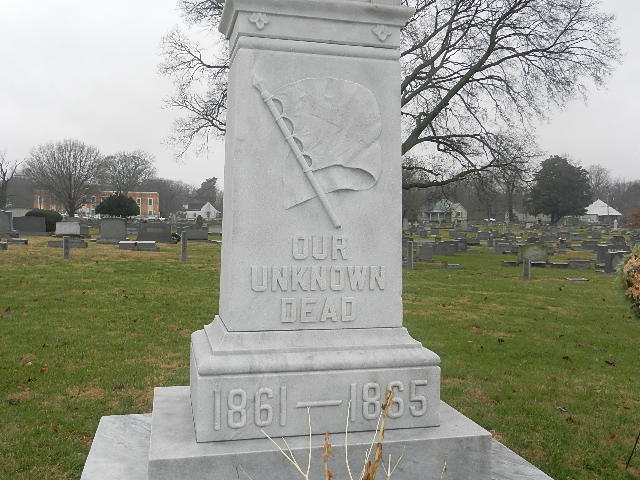
dec 2012 407He is laid to rest at Confederate Circle, Evergreen Cemetery, Murfreesboro, Tennessee.

RIP 3rd great grandpa. Rest well soldier, your job is done.

A portion of his story is told in my book, “Okatibbee Creek.” Available at Amazon.

This post brought to you by On This Day. 

On This Day in 1864

carrie mcgavock portrait

Yesterday, November 29, 1864, Carrie McGavock sat on the front porch of her Tennessee home, the Carnton Plantation, enjoying a warm afternoon of Indian summer. Suddenly, she witnessed thousands of Confederate troops marching across her 1400 acres, heading directly toward her home. The troops told her a battle was coming and asked if they could use her house as a hospital, and by nightfall, surgeons and medics had arrived and started moving her furniture against the walls to make way for the injured. They took the doors off her outbuildings to be used as cots and operating tables. I can only imagine how nervous she felt, dreading the unknown that was to come.


carnton house


On This Day, November 30, 1864

back of Carnton HouseAt 3:30 p.m. the five-hour battle began. Cannon fire shook the house. Bullets drilled holes into the walls of the outbuildings. By the time night fell and the battle was over, hundreds of wounded, bleeding, and dying men had been carried into her home and placed throughout the rooms, in the hallways, on the staircase. Four dead generals lay covered on this back porch. 150 soldiers died in her home that night. The wooden floors are still stained with their blood. The outbuildings still show the bullet holes.


The next morning, December 1, 1864

cemetery 1At the first light of dawn, the 750 residents of Franklin, TN began tending the nearly 10,000 Union and Confederate soldiers lying all over McGavock’s property, some dead, some wounded, moaning and crying out for help. Forty-four private homes in Franklin were converted into temporary hospitals.

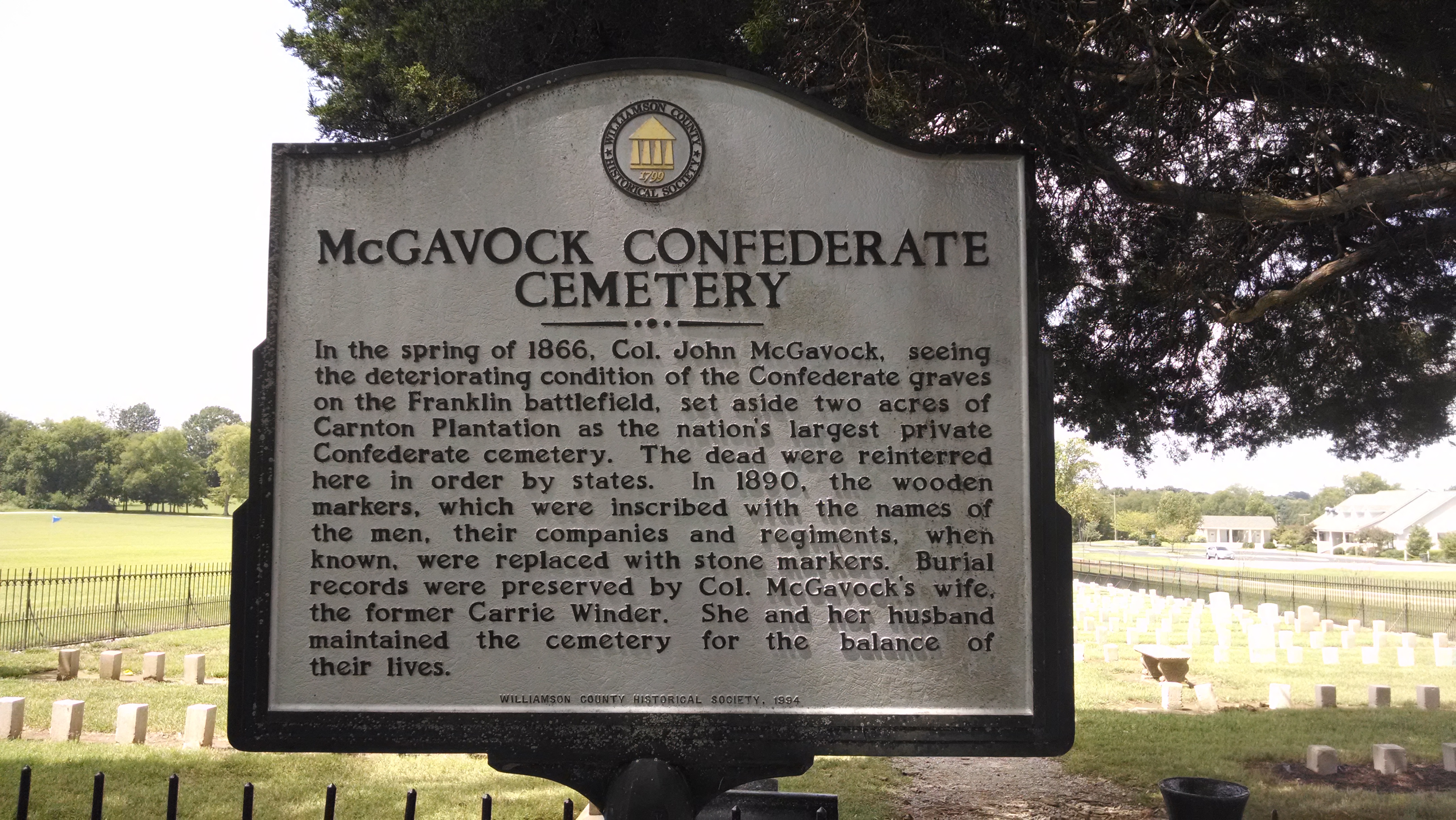
By 1866, the McGavock’s had seen numerous bodies that had been buried in shallow graves all over the battlefield become unearthed by the elements and the woodland animals. The McGavocks donated two acres of their land to be used as a Confederate Cemetery and properly re-interred the soldiers. Carrie’s husband, John McGavock, and the townspeople cataloged and buried 1500 Confederate soldiers, 500 of whom they could not identify. The Union soldiers were moved to the National Cemetery in Murfreesboro, TN.


mcgavock confererate cemeteryCarrie McGavock cared for the Confederate cemetery until her death in 1905, at which time it was turned over to the United Daughters of the Confederacy.

Saturday Snippet – OKATIBBEE CREEK

okatibbee creek cover front JPEGOkatibbee Creek takes place in Mississippi during the Civil War and is based on a true story. Our heroine, Mary Ann, has been left alone with the children while the men in her family are off fighting. I don’t think she’s as fragile as the Yankees assume.

*****************************************************************

I can hear Charlie screaming for me as he runs up the road. He flies in the front door of the store, shouting that the Union Army is coming down the street. Oh, no, here we go. Apparently I am now in the middle of this war. Unfortunately, on this day, I have all of the children with me: my three, William’s four, and James’s five.

I order the boys to run to the field in back and chase the hog and the horse into the woods. I order the girls to take every jug, every crock, and every jar of food from the store and the cellar, put them in the attic, barricade the door, and stay there. Then I load my rifle. I’ll be damned if I’m going to let these disgraceful, plundering Yankees ruin my life any more than they already have. And I will kill every last one of them before I let them harm the children. When the Yankees arrive, I will be more than ready for them.

I watch for them out the front window of the store. My palms are sweating. My heart is pounding out of my chest. My breathing is heavy. I can also feel my anger rising like flames from the very depths of Hell. My hands are shaking, though I don’t know if it is from fear or rage. I can hear them coming before I can see them. Their horses are clomping on the dry road and there is a jingling sound from their spurs and saddles. Sure enough, they stop right in front of my store. There are three of them on horseback dressed in their blue uniforms. They are filthy and unshaven and a bit thin and weary. I slowly emerge through the doorway onto the wooden front porch with my loaded rifle in my hands.

“What do you want?” I yell to the Yankees.

“Do you have any food here?” one of them asks, though it sounds more like a demand than a question.

“No, I don’t have any food,” I say, surprised at the sound of the strength in my own voice even though my statement is a bold lie.

“Is your husband home?” the second one asks.

“No. You already killed him,” I reply, with venom in my tone that would scare off any other man, but they don’t move.

“Is there a man of the house here?” the third one asks.

“No, there are no men here, just me.” I raise my gun slightly.

“You need to put that gun away, ma’am. We just want some food. We’re not here to hurt anyone. You have to have some kind of food in that store,” the first one says with a cocky smile on his unshaven face, as he climbs down from his horse. He removes his dusty hat and takes a couple steps toward me.

“I already told you, I don’t have any food,” I say slowly without raising my voice. I do, however, raise my gun to my shoulder and point it squarely at the man’s face. The two Yankees still on horseback put their hands on their pistols.

The man on the ground stops moving and holds up his free hand to the other two to keep them from drawing their weapons. Again, he starts to move toward me.

I cock the hammer. Again, he stops.

We seem to be at a stalemate. But what he doesn’t know is that the rage inside me will have no trouble blowing his damn head off. We stare each other directly in the eye and neither of us moves.

*************************************************

Lori Crane Books at Amazon and audiobook at Audible.

Video Trailer

It’s Monday! What are you reading? A Difference of Purpose

2a2


I’m currently reading…

A Difference of Purpose: A Novel of the American Civil War

by Terry Soileau


816r0GNpUaL._SL1500_Anything to do with the Civil War pulls at my heartstrings, and I got this book for free from the author’s Kindle giveaway. I’m about halfway through and find it a quick read. The book opens with a list of the cast of characters, which puts me off just a bit, because I know at that point the character development will be lacking. As I read, I began to see the story is not told in a novel style or an historical fiction style, but more as an historian delivering just the facts. The tale is interesting, but I wish the book was told as a true drama. There is a bit of dialog, but the writer seldom indicates who said the line, leaving the reader to figure it out on his own. That being said, it is a very good story, and would have been a lot better with a substantive edit.

Blurb from Amazon

A DIFFERENCE OF PURPOSE is a civil war novel that tells the story of 12 year old Jonathan Berkeley, a Confederate drummer boy serving with the famous Orphan Brigade, and his uncle and Godfather, Alexander Wythe, an abolitionist lawyer and captain serving in the Union army. They wrestle with God and their own inner demons as they confront devastating personal tragedies and search desperately for faith, love, and meaning in a torn and tragic world of civil war. Captain Wythe is forced to question his faith when confronted with the loss of loved ones, including his wife, Amanda Wythe, and with the human suffering, inhumanity, cruelty and chaos of the American Civil War. This story of loss, sorrow, faith and redeeming love takes the reader on a fast paced journey to the bloody battlefields of Fredericksburg, Stones River, and Chickamauga, and through a tragic world of division and heartbreak. Also, featured in this novel of love and war are Abraham Lincoln, Clara Barton, the abolition of slavery, the mistreatment of American Indians, and the largest mass execution in American history

On This Day in 1828

On This Day 1828

August 15, 1828 was the birthday of my 3rd great grandfather, Rice Benjamin Carpenter.

Rice was born to Benjamin Carpenter and Nancy Rice. He was the eighth of ten children, the first five born in North Carolina, and the last five born in Mississippi. When he was 17 years old in 1846, he married my 3rd great grandmother, Mary Ann Rodgers. The Carpenter and Rogers families lived near each other and Rice and Mary Ann had grown up together.

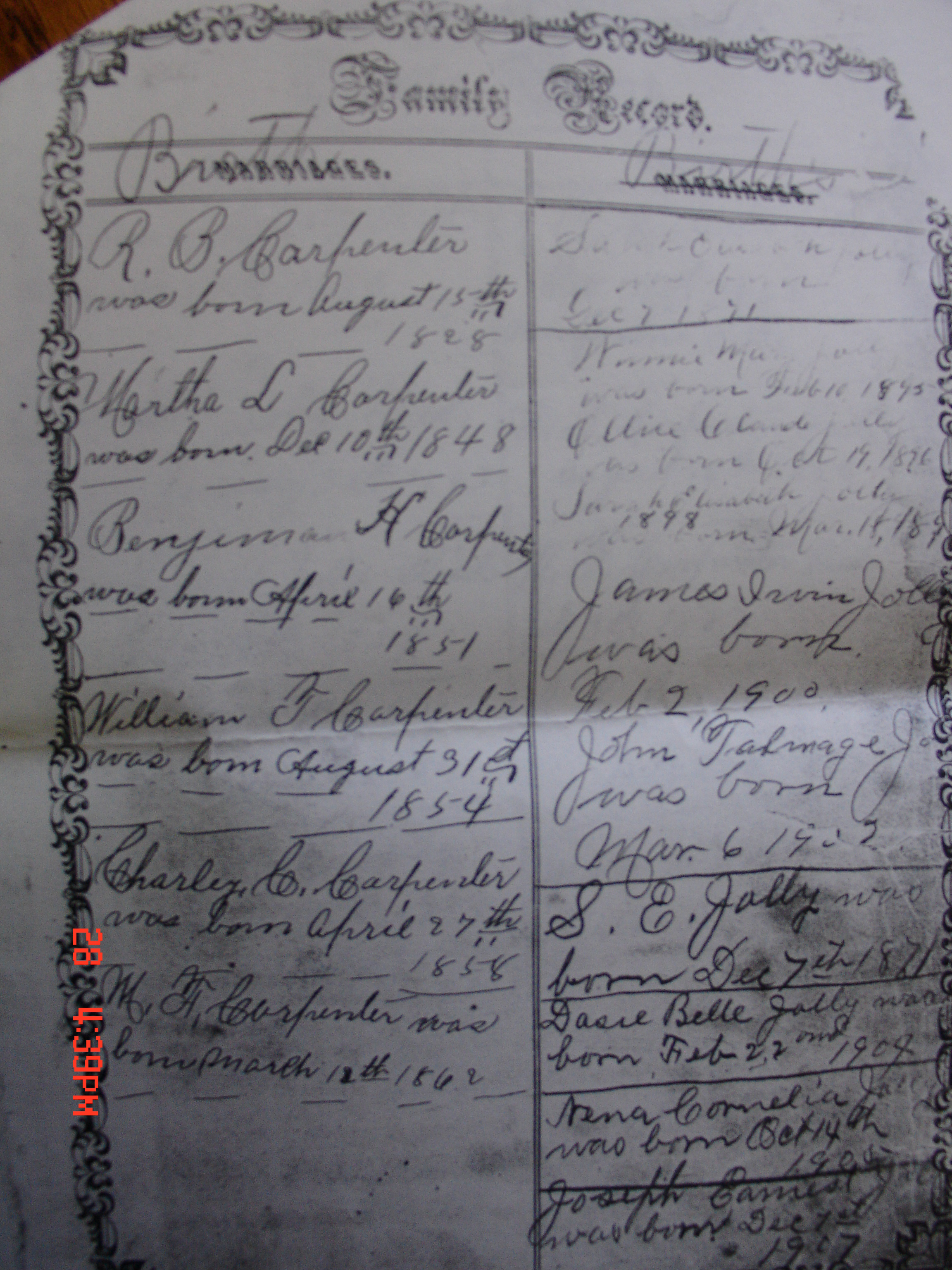
Jolly family bible pg2Rice and Mary Ann had five children: Martha Lettie (my 2nd great grandmother 1848-1933), Benjamin Hays (1850-1929), William Travis (1854-1856), Charles Clinton (1858-1890), and a son with the initials MF (1862-1863). As you can see by the dates, William Travis died at the age of two, and MF died as an infant. His full name is not known, but his initials are written in the family Bible, as you can see on the bottom of the first column in the photo.

Rice and Mary Ann set up house on land they got from Mary Ann’s father, but sometime around 1860, they sold the land and moved to the town of Marion Station in Lauderdale County, Mississippi, to open a general store. Abandoning the farm so Rice could become a merchant was probably their way of starting over after losing their first son. The excitement of a new life was not long-lived, however. In February of 1862, with Mary Ann eight months pregnant, Rice signed up for the 41st Infantry Regiment, the Cole Guards, and prepared to fight in the Civil War.

port-hudsonOn 31 December 1862, his company found themselves in Murfreesboro, Tennessee (only 25 miles from my house) where they met the Union troops head-on at the Battle of Stones River. As you can see in the Port Hudson News, the newspapers were reporting a successful campaign for the Rebels, but Rice was not so lucky. He was killed in the very first charge. Rice’s son MF had been born March 12, 1862. In February of that year, Rice had signed up to fight, but is shown as absent until May. Perhaps he did get to spend time with his youngest son.

On the 150th anniversary of the battle, 31 December 2012, I visited the Stones River National Battlefield in Murfreesboro. The man there told me the battle that took place on 31 December actually happened about two miles up the road in what is now a golf course.

dec 2012 407The Confederate Circle was established at Evergreen Cemetery in Murfreesboro in 1890, and in 1891 all of the remains of soldiers from local areas were re-interred in a mass grave there. Of the 2000 soldiers buried in the Circle, about 90% are unknown or not recorded in the records – one being Rice Benjamin Carpenter. He left behind a grieving widow and three children ages 14, 12, and 4.

Rest in Peace, Grandpa Rice.

Shameless plugs:

Mary Ann’s story is told in my book Okatibbee Creek.

This post is brought to you by On This Day available at Amazon.

On This Day in 1861

On This Day, April 12, 1861, Fort Sumter, South Carolina was shelled by the Confederacy. This marked the start of the Civil War.

SumterPreviously, on February 4th, a convention of seceded states met in Montgomery, Alabama and formed the Confederate States of America.

On March 3rd, Confederate General Beauregard took command of the troops around Charleston Harbor, surrounding Fort Sumter.

By April, the fort was running low on rations. President Lincoln (only president for a month at this point) told them he would re-supply and instructed them to hold the fort.

On April 11th, General Beauregard demanded Union Major Robert Anderson evacuate the fort, but he refused. He was warned if he did not evacuate, the fort would be fired upon at 4:30 a.m. on April 12th.

When the evacuation did not happen, as promised, General Beauregard commanded the men to open fire on Fort Sumter. Fortunately, there were no casualties on either side, but the fort had no option but to surrender.

At 2:30 p.m. on April 13th, Major Robert Anderson surrendered the fort.

flying confederate flag on april 14The Confederate flag was raise over Fort Sumter and a 100-gun salute to the flag was planned, but a gun discharged prematurely, killing Union Private Daniel Hough. He was the first casualty of the war.

The war produced over one million casualties with between 650,000 and 850,000 Americans giving their lives. They died fighting their own countrymen and left behind as many grieving parents, widows, and children. These Americans gave their lives to save the United States they knew, whether it be Union or Confederate. As Americans, we have a duty to honor their memories and to get it right. God forbid, we ever divide and do it again.


(shameless plug: I wrote this post in honor of my new book On This Day. It’s a perpetual calendar/journal/record book. If you’re a genealogy buff, you HAVE to get this book to keep track of your ancestor’s special dates. Check it out here.)


#Civil War Journal on Special #Sale

A RARE PIECE OF AMERICAN HISTORY. Check out this amazing book by author PC Zick! It’s a journal of a real Civil War soldier, and fortunately for us, he was also a great writer. It’s on sale right now for $0.99, so forward this info to your Civil War buff friends. They’ll love it! Where else can you get a real piece of history for that price?

P. C. Zick's avatarLiving Lightly

Civil War Journal of a Union Soldier , the memoir of my great grandfather, is on a Kindle Countdown deal this week. March 22 and 23, the Kindle version is only .99 cents. On March 24, it goes up to $1.99 for four days, before reverting back to its original price. If you haven’t downloaded the journal yet, here’s your change to take advantage of this special offer. The book is also available in paperback for $6.93.

Here’s an excerpt from 152 years ago this week. Harmon Camburn brings the sights, sounds, and sensibilities of the regular infantry soldier to light with his riveting prose.

Click on cover for Amazon page Click on cover for Amazon page

March 21, 1862 – The bugle sounded “Strike Tents.” Taking the road up Hampton Creek a mile or so, we crossed the bridge and passed through the ruins of Hampton. This was the oldest town and had the oldest…

View original post 467 more words

Saturday Snippet – Okatibbee Creek

okatibbee_cover frontIt’s been a while since I posted a snippet. The following is from my book Okatibbee Creek. The heroine of the story is my 3rd great grandmother. She barely survived the Civil War and typhoid running rampant through her family. In this scene, the war is over and disease has passed, she is older and having a discussion with the slave who raised her.

*************************************************************

I look up and see Bertie slowly walking up the road toward daddy’s house. She’s wearing a dark blue dress and a floppy straw hat covering her eyes.

“Hi, Miss Bertie,” I yell to her as I wipe away my tears and put a smile on my face.

“Hi, baby girl.” She waves back.

“What brings you out on this lovely morning?” I ask when she finally reaches the porch and plops down on the step. She takes off her hat and reveals her gray hair tied in a bun. She sets her hat next to her and wipes beads of sweat off her forehead with her handkerchief.

“I was just on my way to your house to see the babies and to see how you are doing,” she says as she tucks her handkerchief back into her sleeve.

I can tell by her demeanor that there is something more on her mind, but I figure she will tell me when she is ready.

“Well, it’s nice to see you. We are all doing fine at home,” I reply.

“That’s good to hear, baby girl.”

“Bertie, I’m forty-one years old. How long are you going to call me baby girl?” I tease her.

She laughs. “You have been my baby girl since I came to your daddy’s house when you were six years old. You will always be my baby girl.”

“Aw, you know I love you, Miss Bertie.” I reach over and pat her bony hand.

“And I love you, too, baby girl. You know, you have always been the smartest and most beautiful of your momma’s children. And with everything you have been through, you have become the strongest and most courageous woman I have ever known.”

She pauses and looks out across the yard as her mind wanders to another time and place. After a moment she adds, “Your momma and daddy would be very proud of you, but it was a blessing they were not around to witness all the pain and loss we went through.” She pauses again and looks out across the yard. “You’re also a wonderful mother.”

I can tell she’s leading up to something.

“I don’t know what I would have done without you, Bertie. You helped me through so much.”

“I know what you went through, baby girl. I witnessed it all. I have seen you stand strong in the face of disaster and death and sickness and hunger. You have faced every adversity with courage and every defeat with dignity and grace. I’m very proud of you, more than you’ll ever know.”

My eyes well up with tears as I feel a mixture of being touched by her kind words, and trepidation that she is going somewhere awful with this talk.

“Bertie, your love has been one of the reasons I have been able to be strong and steadfast. Together, we have laughed and cried through so much,” I say as I stare straight ahead at the field.

Memories come flooding back, along with the sadness and the happiness. Rice, Daddy, Momma, Monroe Franklin. I shake the memories off and look back at Bertie.

“I have the feeling you weren’t headed all the way to my house just to tell me you’re proud of me.” I stop and wait for her to speak.

“Well, baby girl, like I said, you have always been the smartest of your momma’s children.” She takes a deep breath and exhales. I wait patiently as I watch her build up her courage. “Well, I have not been feeling very well lately and I saw the doctor. He said he can’t do much for me and I may not be around much longer. You know I have raised Tony as my own since his parents died of the fever. He’s only thirteen and not quite ready to face the world on his own just yet.” She looks away. I can tell she is trying to get through this speech without crying. Finally, she turns to me and looks me straight in the eye. “I want to ask you to take care of Tony when my time comes. I can rest easy if I know you will do that for me.”

“What? Bertie, of course I will take care of Tony. But I don’t want to hear anything about you being gone. We’ve been through too much together and everything finally seems to be turning around for the better.” I pause, wondering if that is really true. Is everything going to be all right?

I continue, “We’ve walked straight through the midst of hell and we are just now starting to find our way back.”

“I hope you’re right, baby girl, but we can’t control what the good Lord wants to do. We just have to handle it the best we can when it comes.”

I nod and quietly say, “Bertie, I will do whatever you need me to do.”

“I know you will, baby girl. I just thought it would be nice to ask.” She winks at me.

Using both arms to lift herself, Bertie slowly rises from the step. I stand up, too, and she gives me a long hug. She puts her hat on and carefully steps away from the porch, heading toward the dirt road. I yell “goodbye” to her and she waves her hand behind her head without turning around. She walks very, very slowly, favoring one leg more than the other, and I watch her until she shuffles out of sight.

**********************************************

Lori Crane Books at Amazon and on audiobook at Audible.

FREE FREE FREE AUDIOBOOK

Hi everyone!

Last month, I released my book Okatibbee Creek on audiobook at Audible, Amazon, and iTunes. It was narrated by the talented and fabulous Margaret Lepera. Audible has granted me a few FREE copies and I would like to give them away to you!

Please read the blurb below and and check out the sample at Audible – click HERE. If you find the story fits your taste, shoot me an email at LoriCraneAuthor@gmail.com and I’ll send you a FREE download code. I have ten to give away, so hurry up and be the one of the first ten to send me an email. I only ask that you rate it on Audible when you’re done listening. I only have one rating over there so far, and it looks pretty lonely. 😦

51QeOBe26zL._SL500_AA300_PIaudible,BottomRight,13,73_AA300_Blurb:

In the bloodiest years of our nation’s history, a young mother was left alone to endure the ravages of the Civil War and a typhoid epidemic that threatened the lives of everyone left behind.

Okatibbee Creek is based on the true story of Mary Ann Rodgers, who survived the collapse of the Confederate dollar, food shortages, and the deaths of countless family members to war and disease. As she searched for a way to feed her children and her orphaned nieces and nephews, Sherman’s Union army marched through Mississippi on their way to destroy Meridian, and Mary Ann found the distant war literally on her doorstep.

Help arrived just in the nick of time in the form of an unexpected champion, and Mary Ann emerged on the other side a heroic woman with an amazing story.

Okatibbee Creek is a tale of historical fiction that brings the Deep South vividly to life and will have you cheering and crying through a real-life story of loss, love, and survival.

UPDATE FEBRUARY 11: I still have one more copy if you’re interested. LoriCraneAuthor@gmail.com