 The Travel Channel has a show called Most Terrifying Places in America. They’ve been on for a couple seasons now, and they’ve finally gotten around to the most terrifying place I know of – Stuckey’s Bridge.
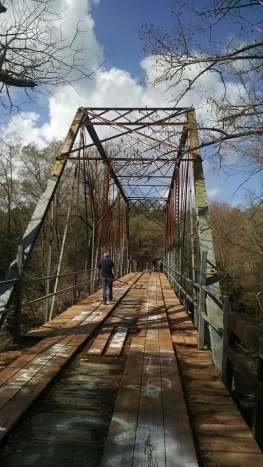
I was born in Meridian, Mississippi, near the bridge, and heard the creepy legend of the man locals refer to as Ole Man Stuckey my whole life.
Legend has it he was a member of the notorious Dalton Gang, but he was so evil, he was kicked out. He found his way to Lauderdale County, Mississippi where he opened an inn on the Chunky River.
At that time, the river was used to transport goods and produce down to the gulf. Ole Man Stuckey was known to pace the old bridge every evening at dusk, waving his lantern, and offering travelers a warm meal and a soft bed.
In 1901, the Virginia Bridge and Iron Company began rebuilding the 50-year-old wooden bridge. During the project, they discovered bodies buried on the banks.
The townsfolk were suspicious about the creepy man who ran the inn and rounded up a posse to go find him. The mob took him down to the bridge, tied a noose around his neck, and hung him from the new iron rails of the bridge.
His body dangled over the river for five days. When the sheriff cut him down, he splashed into the river below.
Strangely enough, the ghosts around Stuckey’s Bridge today don’t seem to be the victims. The ghost seems to be Ole Man Stuckey, himself. Unexplained lights are witnessed. Footsteps on the bridge and loud splashes into the water below are heard. An apparition of a man walking across the bridge, waving a lantern, is occasionally seen.
 We taped the episode for the show last week, and in typical Stuckey-style, there were a few strange occurrences while we were there. A couple phones when crazy for a few minutes. A drone used to take footage of the river and the bridge crashed. We all heard it splash into the water, but when we ran onto the bridge to look over the railing for it, we saw it up in a tree. I wonder what the splash was…
I’ve written three books about the legend (available at Amazon, click here). That’s why they asked me to participate in the show. It was fun to go back home for the day, and I loved being out there again. It’s a cool place and it was a beautiful spring day! I’m very grateful my part of the show was wrapped up before nightfall.
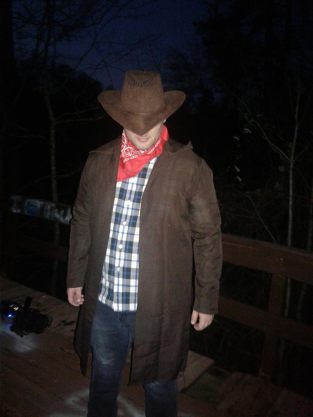
Here’s my cousin dressed up to play the part of Ole Man Stuckey! This picture was taken long after I skedaddled out of there by Stuckey Bridge Canoe and Kayak
Sweet Dreams…
 This above story is the bridge featured in my book, “


 Annette Kellerman (6 Jul 1887 – 6 Nov 1975) was a professional swimmer, a vaudeville star, a writer, an actress, and a multiple-business owner. She had her own line of one-piece bathing suits for women and helped popularize the sport of synchronized swimming. She performed in many aquatic-themed movies, most depicting her as a mermaid. Her mermaid costume designs are still mimicked today in mermaid shows around the world. Ms. Kellerman performed all her own stunts including a ninety-two-foot dive into the sea and a sixty-foot dive into a pool of crocodiles. She was a life-long vegetarian and in her later years, she owned a health-food store in Long Beach, California.
 If you haven’t read
 ![A2Z-BADGE_[2016]](https://loricrane.com/wp-content/uploads/2016/04/a2z-badge_2016.jpg?w=146&h=146) April 2016 A to Z Challenge – I’m writing about history.
April 2016 A to Z Challenge – I’m writing about history. Thomas was born the son of a butcher in England in March 1473. In his twenties, he studied theology, eventually becoming a priest and a chaplain to the Archbishop of Canterbury. In 1509, he went to work for King Henry VIII. That’s where the fun begins. Keep in mind, young Henry was only 18 years old at the time, and I’m sure the 36-year-old Wolsey figured he’d lead the king in righteousness with his mature and prudent ways.
![A2Z-BADGE_[2016]](https://loricrane.com/wp-content/uploads/2016/04/a2z-badge_2016.jpg?w=170&h=170) April 2016 A to Z Challenge – I’m blogging about history.
April 2016 A to Z Challenge – I’m blogging about history. In the 11th and 12th centuries, the center of the action in London was Westminster Palace. Since 1049, the king had lived there, and subsequently, government held their operations there. As you can imagine, the surrounding neighborhood became too expensive for any normal person to afford. So, in 1240, the Archbishop of York bought a more affordable piece of land a little further away and called it York Place. He built a pretty nice house on the 23-acre property. So much so, that King Edward I stayed there while Westminster was being rebuilt to accommodate his large entourage. It must have been a large and splendid house. The photo is a depiction of the property from the show Tutors.
 Henry expanded the house even larger than York and Wolsey had done, adding a bowling green, indoor tennis courts, and a full tiltyard for jousting. After
 ![A2Z-BADGE_[2016]](https://loricrane.com/wp-content/uploads/2016/04/a2z-badge_2016.jpg?w=169&h=169) April 2016 A to Z Challenge – I’m writing about history.
April 2016 A to Z Challenge – I’m writing about history. As with most holidays, Valentine’s Day is nested in pagan roots. February 15 was the pagan festival of Lupercalia. To begin the festival, members of the Luperci (an order of Roman priests) would gather at a sacred cave and sacrifice a goat which represented fertility. They would then cut the goat’s hide into strips and dip the strips in blood. (Romantic so far, no?) They would then march through the town, gently slapping women with the goat hide. Instead of beating the priests to death with rocks, women actually welcomed the slap of the hide, believing it would make them more fertile in the coming year.
![A2Z-BADGE_[2016]](https://loricrane.com/wp-content/uploads/2016/04/a2z-badge_2016.jpg?w=196&h=196) April 2016 A to Z Challenge – I’m blogging about history.
April 2016 A to Z Challenge – I’m blogging about history.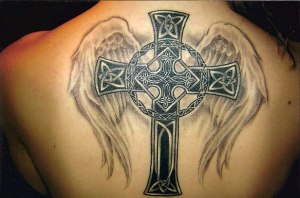 Tattooing is widely practiced today, and some folks say it’s desecrating God’s work, but this blog is not an argument about their merit or lack of. It is about the history of tattoos. When and where did they start…and why?
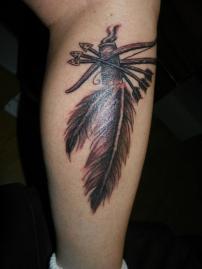
 No matter what people say about tattoos, I find them fascinating. I have two tattoos (below) and hope to get a third someday. Mine are in commemoration of my ancestors, the first being the Culpepper family crest on my back honoring my mother’s family, and the second being the Choctaw Indian crest on my leg honoring my great, great grandmother and my Indian ancestors whose way of life was destroyed when the Culpepper part of the family moved to America. I also have Irish ancestors and hope someday to get a claddagh to honor them.
 Lori Crane