Wednesday Writer’s Corner – Sept 4, 2013

1860614957_1375101769Are you a writer? How often do you write? How many words do you write when you sit down? Do you think you should write more than you do?

Do you know that the more you write, the faster and more prolific you become? Yeah, me too. I heard you. Your answer was, “Yes, but I don’t do it.”  So, try this… “750 Words”

http://750words.com/

This is a fun and awesome site for you to write 750 words per day in private. It is not a blog. No one else can see your blabbering. You can write a story or you can just brain-dump. It’s all up to you. Just write!

The cool thing is you get badges and awards for consecutive days, writing quickly and not being distracted, entering monthly challenges, points, points, points, badges, badges, badges. I am addicted to anything that even slightly resembles a game. And I think sometimes I get overwhelmed by my schedule and find it cleansing and therapeutic to dump all that crap out of my brain.

When you’re done for the day, it even gives you stats, graphs, and pie charts to let you know what your thinking about and what’s weighing most heavy on your mind. Today, my stats came up as PG13, containing either swearing, sexual content, or violence. I swear I didn’t say anything that was even close to any of those, but whatev…it’s fun to look at.

I’m hooked!


When worlds collide…you can hear me scream!

The funniest thing happened yesterday.

I met (online) a cousin on my dad’s side. We share a great grandfather, who I haven’t written about in my blog yet, but I guess I’ll have to get on that now. She showed me a picture of a plaque located in the Lauderdale County Courthouse in Meridian, Mississippi. Our mutual grandfather, Thomas G Lafayette Keene, was apparently the treasurer of Lauderdale County from 1904-1907.

plaque in Lauderdale Co Court House in Meridian


That was awesome! But that wasn’t the funny part.

The book I released in June is called “The Legend of Stuckey’s Bridge.” It takes place in Lauderdale County and you can click on “my books” at the top of the page to read all about it. The man chasing the evil Old Man Stuckey throughout the book was Sheriff J.R. Temple. Go back to the picture and look at the top name.

You probably heard me scream from my office last night when I saw that! My books are historical fiction, based on real people and real events, but it is still strange to see his name etched out in marble and to be reminded that he was indeed a real person and not just a character in my head. And that he knew my great grandfather.  🙂

Stuckey's cover_web

Interview by Elizabeth Caulfield Felt

I had so much fun doing this interview. Elizabeth is a warm and gracious hostess, and also a busy teacher, librarian, historical fiction author, and reader. I don’t know where she finds the time to do things like chat with me, but the pleasure was all mine.

Check out the interview here !!!


Ancestry Scrapbook

Like I don’t have enough to do, I’ve decided to make Ancestry Scrapbooks for my grown children. Our family is traced so far back, there are almost 9000 people in our family tree, and when I speak about it to my children, they get that glassy-eyed glaze-thing happening. And it doesn’t help matters that since the early 1500s, most of our family have lived in the southeast part of the United States. You know what they say about the south being all intermarried? It’s true! So, when I try to explain that someone on mom’s side is the sister of someone on dad’s side, I lose the kids. Don’t even try to tell them grandpa’s little sister married grandma’s uncle, making my grandma’s uncle also my momma’s uncle. Forget it. They don’t care.

Well, I want them to care!

So, I’ve decided to put together a fun and colorful book they can look through and connect their own dots. There’s a company called My Canvas, that will make a real printed book. You upload all your stuff, arrange it anyway you want, and for a fairly decent price, they will print a real book. They are beautiful books, but the largest is only big enough for 4 or 5 generations. I think I want a little more.

How about a digital scrapbook from DSP?? You make as many pages as you want, print them, and put them in any book you want.

Check out this cover with all the family names! I’m in love with this!!

Ancestors

Apparently you need a photo program like Photoshop (which I suck at) and a layout program like “My Memories Suite” or “Nova Scrapbook Factory Deluxe.” Then you can purchase page kits online or a whole CD of designs. I don’t know that I want to put time into learning a new program. I think I may stick with the old fashion scrap-booking process. Cutting, gluing, adding embellishments.

…but I do LOVE that cover! I might try it.

************************

Update Sept 1st – I did it. I buckled under the pressure and bought “My Memories Suite” and tons of ancestry/genealogy/heritage paper and embellishments to play with. I’ll let you know how it turns out! 🙂

Wednesday Writer’s Corner – August 21, 2013

Swimming in a Turquoise Sea of Jumbled Lyrics    

  *or*

Why Don’t You Just Hire an Editor?

“The sky was the color of a bruised palette…”

Road-Cloudy-Sky


I was reading an intense, frightening chase scene when the above sentence appeared. It stopped me dead in my tracks and has stuck in my mind for a long, long time. I assume the writer meant the sky was filled with blue and gray clouds, but he could have meant someone’s mouth was bruised from getting punched in the face. Obviously, I don’t know the difference in spelling between the roof of your mouth and the board used to mix paints. Either way, it took me out of the story. I began thinking about painter’s palettes and how they can’t get bruised, because they’re made of wood.

I’m not only going to pick on that writer. I’ve done it myself. While running from a murderer through the foggy forest, my character “looked up into the black arms of the haunted trees.”

4166377665_76d5666d50


Fortunately, I have a fabulous editor who crossed it out in bold, bright red. I thought it was pretty clever, but I could almost hear her yelling “WTF?” all the way from her office in California.

An editor will kick your artistic butt, but they will make you look good. They will correct your grammar, your punctuation, your point of view, tighten up your wonky dialog (as above), and if you give them enough latitude, they will do heavy copy editing and replace your poor choice of words, repair your jumbled scenes, and restructure your paragraphs. They will also check your facts and your timeline. In one book, I mentioned Sir Arthur Conan Doyle in a story that took place two years before he was knighted. My editor caught it and deleted the ‘Sir’ from his name. Deep in my heart, I know she’s worth far more than I pay her.

There’s only one bad thing about a good editor. When you get your manuscript back with more corrections than your ninth-grade English term paper, you will feel like you should never write again. But you have to shake that off. Editors do what they are paid to do, and it has nothing to do with your talent or your feelings.

Stephen King has an editor. You should too.

(The above photos are from thewallpapers.org and flickriver.com.)

Born August 15, 1828

Rice Benjamin Carpenter was born August 15, 1828 in Greene County, Alabama to Benjamin Carpenter and Nancy Rice Carpenter. He was the eighth of ten children.

In 1834, his family moved to Pine Springs, Lauderdale County, Mississippi for the low-cost land and fertile soil. Rice was six years old.

He married Mary Ann Rodgers in 1846. They were both seventeen.

They had five children – Martha Lettie, Benjamin Hays, William Travis, Charles Clinton, and MF – one girl and four boys.

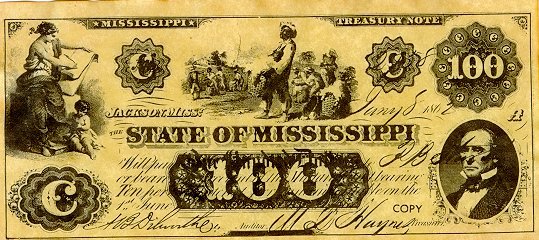
After living with his friends Ebenezer and Sarah Miles in Pine Springs for a few years, in 1853 they bought 80 acres of land from Mary Ann’s father and began farming, but within a few short years, Rice realized he was a better merchant than a farmer, and by 1860 they had opened a general store in Marion Station, Mississippi.

conf_money

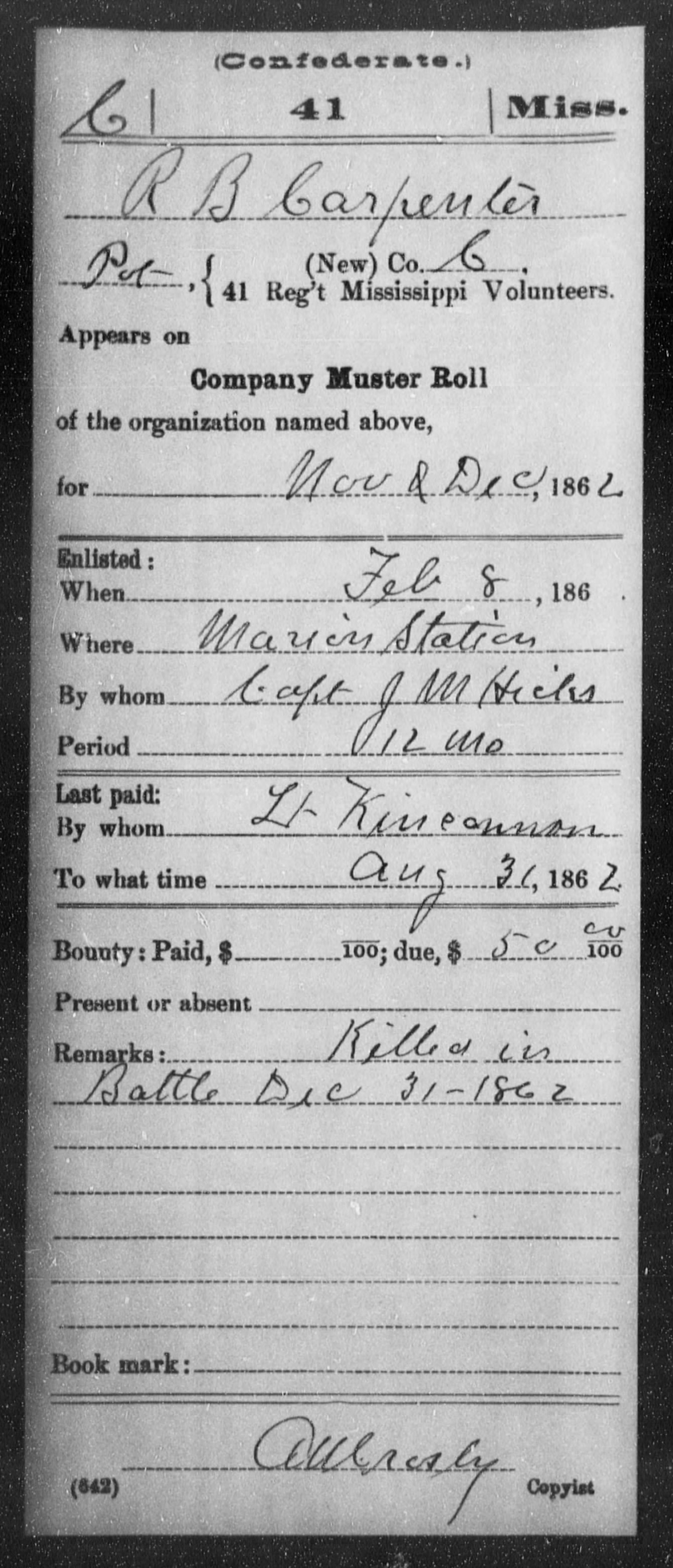
When the Civil War began, Rice signed up for the 41st Mississippi Infantry, Company C on February 8, 1862. This must have been a frightening time for the family, as Mary Ann was eight months pregnant with their last child who was born March 12th, 1862.

dec 2012 388

At dawn on December 31, 1862, amid limestone boulders and cedar forest, his infantry attacked the Union soldiers at the Battle of Stones River in Murfreesboro, Tennessee.

port-hudson

Private Rice Benjamin Carpenter died on that day on the battlefield at the age of 34, leaving behind his wife and children.

Page 5

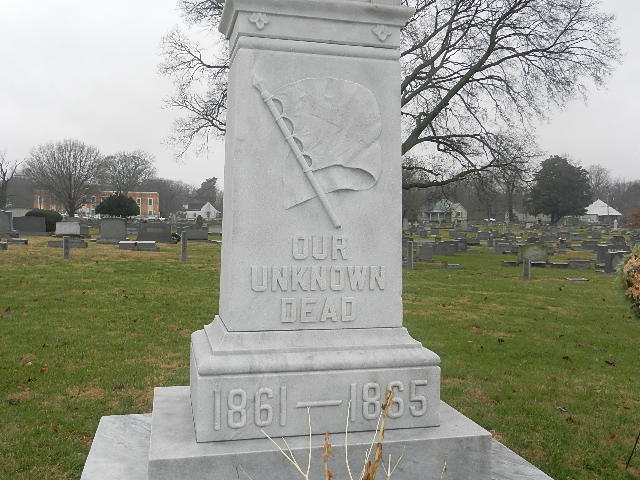
He is laid to rest at Confederate Circle, Evergreen Cemetery, Murfreesboro, Tennessee. RIP 3rd great grandpa. Rest well soldier, your job is done.

dec 2012 407

A portion of his story is told in my book, “Okatibbee Creek.” Available at Amazon.

okatibbee_cover front

Wednesday Writer’s Corner – August 14, 2013

Virtual Book Tours! YAY!!

Virtual-Book-Tour-copy1

(Photo from workingwritersclub.com)

Even if you’re published, publishers don’t support book tours anymore. So, a writer is left with two options: 1) schedule events and signings yourself or 2) do a virtual tour. Either way is a lot of work, but the virtual tour is far less expensive. I’m putting together a November tour for my coming release “Elly Hays,” so I’ve been doing tons of research and organizing it myself. I decided to do a fall tour because I notice a huge spike in sales following holidays. I assume it’s because of word-of-mouth at family gatherings, so I want to get the book in a lot of reader’s hands before Thanksgiving. That’s my theory anyway.

So, here’s what I’ve learned about Virtual Book Tours:

Preparedness, Organization, and Communication are the most important points.

Prepare all of your blogs, interviews, excerpts, links, media kits, photos, etc., far in advance.

Organize your items in folders on your computer, along with host information, schedule, etc. You need this all in one place. Excel spread sheet, anyone?

Communication with your hosts is key. Make a folder to keep all correspondence. Invitation, Follow up, Confirmation, Reminder, and Final Thank You.

I guess the next step is to be WAY ahead of yourself. Give yourself at least two months to plan.

Set up an account to do a giveaway. Rafflecopter is awesome.

Consider offering an end-of-tour Twitter Chat on one day for one hour with a specific hashtag. Announce it throughout the tour.

Have some crafty photo-shop-type person make you a banner.

Promote Promote Promote before during and after!!!!!

As I mentioned before, I’m setting up a tour for November 4-16. If you have room for me on your blog, please let me know, and I’ll put together whatever type of post you’d like to feature. Email me at loricraneauthor@gmail.com and we’ll choose a date and content. If you’d like to do a review, I can supply you with a free paperback, Kindle, or Nook.

Ancestry – or Why I’m So Jacked Up – Great Grandparents continued (dad’s side)

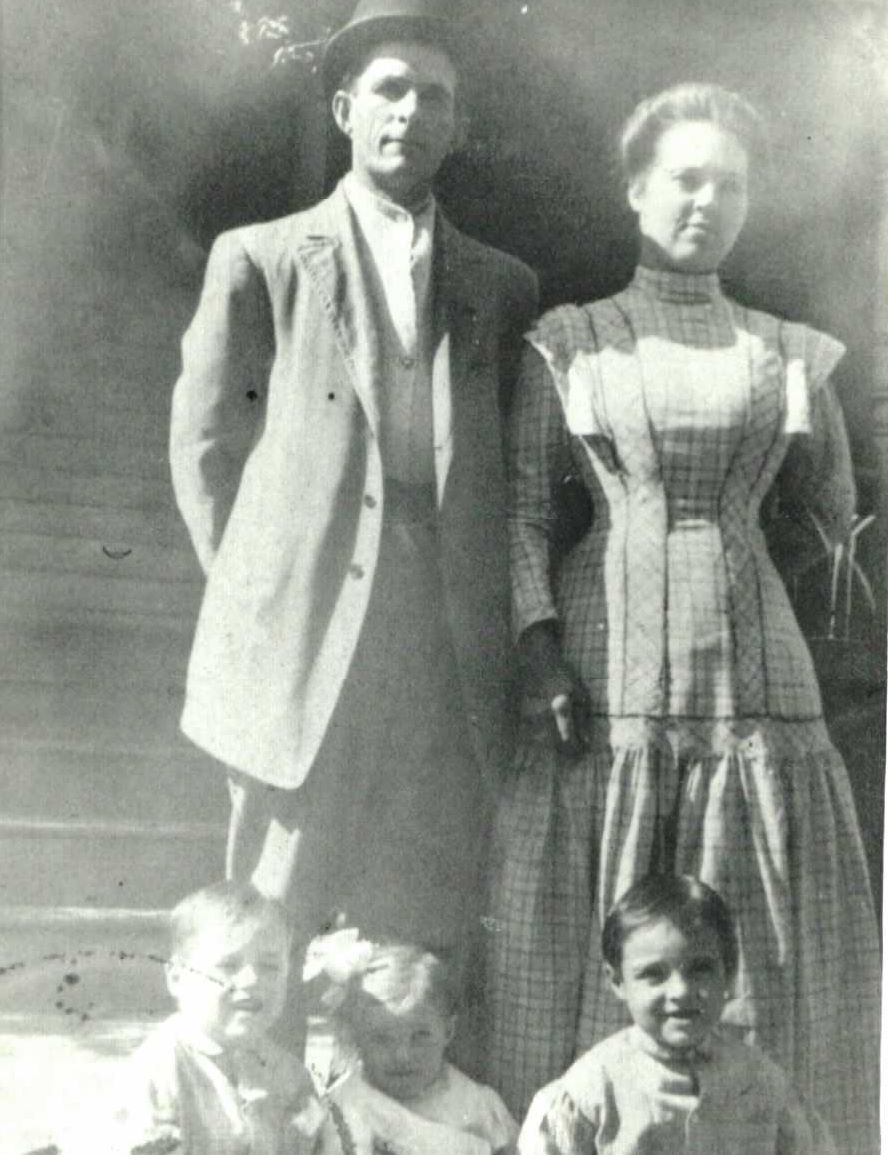
The first part of this blog was written on February 20, 2013. You can see it HERE if you wish. However, the most amazing thing happened this week. I just received a photo in the mail from my cousin. It is my paternal great grandparents!!! I have a picture of her, but I have NEVER seen him before. He was quite dapper, no? 🙂 This is Amos and Minnie Crane and three of their six children, from left to right: Horace, Evelyn, and my grandfather Frank. The photo must be around 1912. Evelyn was born Oct 1910.

Amos Crane and Minnie White with Horace, Minnie Ellen, and Frank

Amos Bolivar Crane and Mary Elizabeth “Minnie” White married in Mississippi on August 10, 1902. He was twenty and she was seventeen. In 1903, they had their first child, Andrew Frank Crane (my grandfather), followed by Horace, Evelyn, Amos Jr, Thomas Jackson (Tommy), and finally, Minnie Ellen in 1918. They lived in Lauderdale County, Mississippi throughout most of their marriage except for a brief stint in Gulfport, Mississippi in the 1950s. He died in 1959 and she followed in 1964. Since I was born in 1962, I probably met her, but I don’t remember, and there is no one left to ask.

They are buried at McGowan Chapel Cemetery in Harmony, Mississippi. I took these photos in September 2012, and a cousin told me I drove right by their house on the way to the cemetery. There were only a couple houses there, but I don’t know which one was theirs. RIP great grandma and grandpa.

crane amos bolivar

white mary elizabeth minnie white crane

I put the PRO in Procrastinate


 procrastination6

I’m not going to bore you with the mountains of work in front of me, but I AM going to complain that there are just not enough hours in the day to complete it all. And it seems the more work there is to do, the more I’d rather blow it off and play video games.

I bought a new planner today. I figure if I write “WRITE 10am” on August 13th, I’ll actually write at 10am on August 13th instead of checking Facebook or my email. Do you think that will work? Probably not, but I’m going to try it anyway. Of course, I haven’t written anything in there yet. It’s on my to-do list.

I think I’m just overwhelmed by my own self-imposed deadlines. Among other things, I was going to have my new manuscript rewrites completed in August. Well, it’s August 12th…no, wait…August 13th, and I have the first two chapters finished. It’s a 30-chapter book. Ugh.

You may think I’m procrastinating by writing this blog, but posting a blog is actually on my to-do list for today. So there! According to my time-zone, I still have 43 minutes to complete this blog.

the-dangers-of-procrastination

Give me some help here. How do you un-procrastinate yourself??


Wednesday Writer’s Corner – Aug 7, 2013

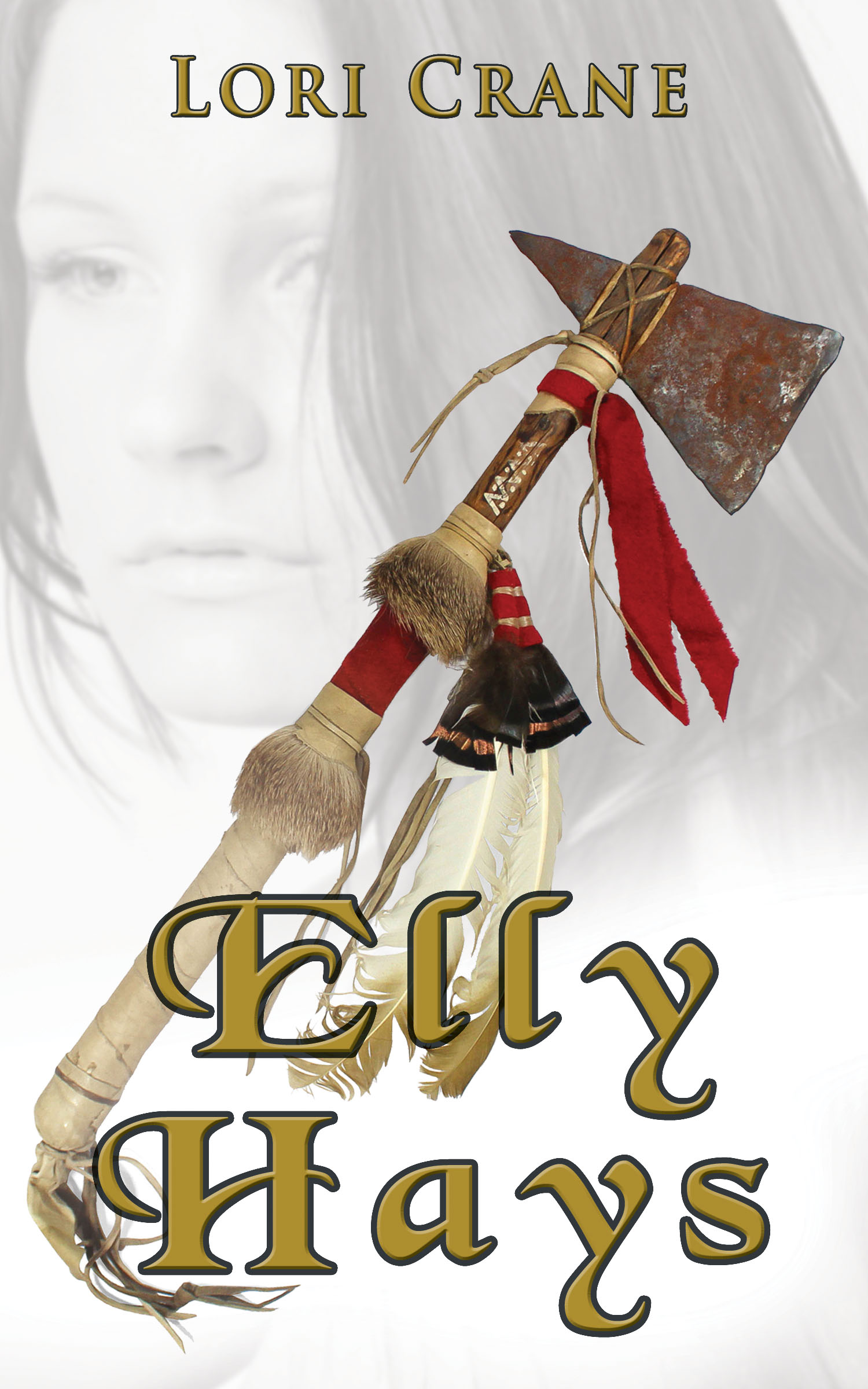
In honor of my coming October book release of “Elly Hays,” today’s Writer’s Corner will be about the book’s heroine, Elizabeth Hays Rodgers, and how she came to be the center of a novel.

She was the only daughter of Samuel Hays and Elizabeth Priscilla Crawford, born in North Carolina in 1774. She spent her young childhood in the unrest of the Revolutionary War. She married when she was sixteen, and after twenty-one years of marriage and eleven children, her husband decided to uproot the family from Tennessee and start a new life in the Mississippi Territory. Considering what they were walking into, I had to write her story. A portion of it is below. It will help you understand that area of the country at that time in history.

The (unedited) Prologue

In 1811, America was on the verge of war. The victory in the Revolutionary War gave Americans their independence, but the newly formed country had many unresolved issues. Americans had a vast frontier to settle and they considered the land now known as Canada to be part of their land. They wanted to expand northward and westward, but the British joined forces with the Native Indians in an attempt to prevent the Americans from expanding in either direction.

The British had also begun restricting America’s trade with France and the mighty Royal Navy ruled the seas. The Royal Navy had more than tripled in size due to their war with France, and they needed sailors. They captured American merchant ships off the coast of America and forced the men with British accents to join the ranks of the Royal Navy, proclaiming they were not American, but indeed British. Kidnappings and power struggles in shipping ports like New Orleans loomed over the newly formed United States.

The British not only invaded the southern coastal cities of the United States, but also the eastern seaboard, attacking Baltimore and New York, and burning Washington D.C. to the ground. The War of 1812 is historically referred to as the second war for independence. It was the battle for boundaries and identity for the Americans.

Sadly, the Native American Indians had the most to lose in the power struggle. Shawnee warrior Tecumseh was but a child when he witnessed his father brutally murdered by a white frontiersman. His family moved from village to village and witnessed each destroyed at the hands of the white men during and after the American Revolution. As a young teen, following the Revolution, he formed a band of warriors who attempted to block the expansion of the white man into their territory, but the effort saw no lasting result. Conflict with the white man was a battle he had fought all his life, and as a warrior now in his early forties, he knew the stakes were high for the Indians in the coming battle. He traveled the southeast, coaxing the numerous Indian nations to unite against the white man, promising help from the British in the form of weapons and ammunition, and offering reinstatement of the Indian’s lost lands upon victory. Tecumseh’s prophet, who traveled with him into Creek territory, forecasted a victory, foreseeing no Creeks being wounded or killed in the battle.

In the Eastern Mississippi Territory, which later became the state of Alabama, the Creek Indians were divided. Many Creek villages had been trading with the white man for years and participated in civilization programs offered by the United States government. These Creeks had been taught the ways of the white man. They spoke English, could read and write, and even incorporated white man’s tools into their daily lives. They traded or were given gifts of plows, looms, and spinning wheels, and had no qualms with the white man. Many had married whites, and they did not want to join in the fight.

In opposition, many villages joined with Tecumseh, for they wanted to maintain their way of life, claiming the white man’s ways would destroy their culture. They had witnessed the white man encroaching on their lands, destroying their forests and villages, and polluting their streams. And probably, some suspected the white man’s intent was not co-existence but domination, for they had seen this come to fruition in the treatment of the black slaves.

In 1811 and 1812, tribal tensions were growing due to these differences in beliefs, and this caused a great war in the Creek nation called The Red Stick War. It was a civil war fought between the Creek people, but by 1813, it expanded to include the American frontiersmen and the U.S. government. At the height of the War of 1812, the Creeks were at war with nearly everyone, including their own people.

It was in this turmoil that a white farming family moved from their home in Tennessee to the fertile farmlands of the eastern Mississippi Territory, a place known today as Clarke County, Alabama. James Rodgers, his wife Elly, and their eleven children unknowingly entered a hornet’s nest.

If you have read the first book in the Okatibbee Creek series, “Okatibbee Creek,” you will be familiar with its heroine, Mary Ann Rodgers. “Elly Hays” is about Mary Ann’s paternal grandmother, Elizabeth Hays Rodgers, better known as Elly. If you have not read any of the Okatibbee Creek series, they are a collection of stories about one family and the strong women of our past. These are the real-life stories of my grandmothers, aunts, and cousins, but if you live in the U. S., they could also be the stories of your female ancestors – the women who fought for us, for our safety, our lives, and our freedom, and who sacrificed everything with the depth of their love and their astounding bravery.

Elly Hays will be release October 2013 in paperback, Kindle, and Nook.
elly cover_web