On This Day in 1836 my 3rd great grandmother Sarah Ann Elvira Dollar was born.
Don’t you find the name “Dollar” to be a little strange? Well, her father was Ambrose Dollar, her grandfather was Reuben Dollar who came to America from Wales and fought in the Revolution, and her great grandfather was Edward Dolier – probably French Doh-lee-AY or Irish D’Olier. Either one of those makes more sense than Dollar.
Sarah Ann’s mother was Jemima Clearman, whose father was Jacob Van Clearman, whose father was John William Clearman from Germany.
Well, that’s just a crazy European mix, isn’t it?
Let’s go back to her dad’s side for just a moment. This is the transcription of the sworn statement of Dr. J.M. Dollar, the great grandson of Reuben Dollar.
 Gause Texas, August 4th 1913
This is to certify that my great grandfather Reuben Dollar told me of fighting in the Revolutionary War when I was a boy. He came from Wales and fought in the war. He returned to Wales and was disinherited by his father for having fought against the British Crown. After which he returned to America and settled in Edgefield S.C. He died in Miss. in 1858 at the age of 113 years.
Signed J.M Dollar
State of Texas:
County Of Milam:
subscribed and sworn to before me this August 4th. 1913
J.R. Fraim, Notary Public, Milam co. Texas
I find these old records fascinating!!
Anyway, back to Sarah Ann…
 She was the 6th born of 8 children, half boys, half girls. She was born March 11, 1836 in Pickens County, Alabama. Pickens County is right on the Mississippi border, and at some point between 1840 and 1850, the family moved west to Mississippi. At the age of 17, on October 6, 1853, she married William Lafayette Brown, Jr. in Lauderdale County, Mississippi. Keep in mind, the above Patriot grandfather was still alive until 1858 and died in Lauderdale County, Mississippi, so he might have been living with them. If not living with Sarah Ann and her husband, at least with a nearby family member.
Sarah Ann gave birth to her first child at the age of 18, James Floyd Brown in 1854. He was followed by John Ambus Brown in 1857, Angeline Brown in 1859, William Harrison Brown in 1860, Sarah Elizabeth “Bettie” Brown in 1862, Warren Brown in 1865, Franklin Carlton Brown in 1867, Charles Berry Brown in 1871, Pinkney Earlie Brown in 1874, and Martha Catherine Brown in 1877.
Do you notice anything strange about those birth dates?
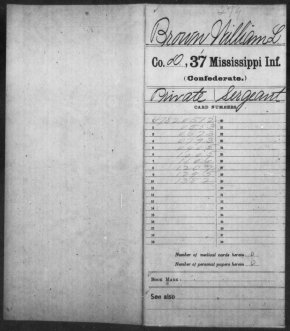 When the Civil War broke out in 1861, her husband was about 25 years old. Yes, he went to fight for the Confederacy. As a matter of fact, he was a sniper who guarded Mississippi bridges in the area. At one point, he was captured by the Union. He escaped. He went back and allowed himself to be captured again to help others escape, which he/they did. After that, he had a bounty on his head for the rest of the war.
It doesn’t look like the war or the captures between 1861 and 1865 stopped him from visiting home at least a few times. Obviously he stopped by the house long enough for some hanky panky. The girl born in 1862 was my second great grandmother. Her birthday is the same day as mine, November 19.
One thing for sure, these people didn’t back down from a challenge! I look forward to doing more research on the Dollars and Clearmans very soon.
Sarah Ann died in Mississippi July 18, 1915 at the age of 79.
Happy birthday, Grandma Sarah Ann!!

This post brought to you by “On This Day,” a perpetual calendar for family genealogy.
 The tree is about a foot wide at the bottom, so I started with a big, fat paint brush and some really scary black paint. I aimed for the middle of the wall, fighting with the corner of my desk that was too heavy for me to move. Next, I grabbed the next size smaller brush and started painting random branches. This is the point where my trophy husband came home from work, walked into the office, stared at the wall for a minute, shook his head, and walked out. Yeah, I know it doesn’t look that great, but just wait! I’m an artist. You have to trust me. Then again, he’s been here before. Poor guy.
 Step two. I used a smaller paint brush to extend the branches and then another smaller one. Starting to look like a tree, no? A little skimpy, but still, a tree! It’s going to need to be a lot bigger than this for all my pictures. I’m thinking of taking it all the way to the ceiling and as wide as it’ll go.
 Step three. I used even smaller brushes. The tree’s getting bigger. Of course I’m climbing across my desk and standing on a chair to reach this high, so I have to keep getting down and backing up to make sure it’s symmetrical. I don’t want it perfect, but I do want it to at least look like a healthy tree. My knees may be getting a little tired. Trophy husband’s also asking about dinner. Umm, I’m in the middle, you’ll have to order a pizza. Poor guy. But in my defense, he already knew we were having pizza when he came home and saw the beginning of the tree.
 Step four is a smaller brush and a smaller brush. Need. More. Branches. My arm is getting tired now.
 Step five is the smallest brush I could find, like one of those out of a paint-by-number box. I’m not sure the branches go as small as I want, but my next step would be to use a Sharpie. I don’t think trophy husband would approve, and I’m not sure you can re-paint over a Sharpie. Sounds like that might be a problem if this thing doesn’t turn out.
 Step six. The next day, I randomly taped pictures to the wall to figure out how I wanted to display the photos I have. It’s kind of looking cool just doing it randomly.
 Step seven. After living with it for a couple days, I decided to stay random. I also decided to not frame anything. I like the freedom to add and move the pictures as needed. I used two rolls of cellophane tape.
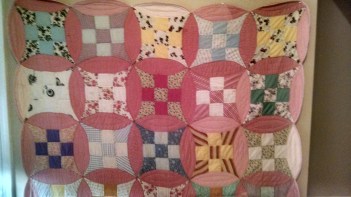 When I was a young girl, my paternal great grandmother made me this quilt. When I was at her house, I noticed her sewing in the evening while watching television. It was done completely by hand. It never occurred to me that she was sewing it for me.
 It started with cutting out 680 pieces. Sigh. That took a couple weeks. Then, fortunately, I had house guests, so I put it all in a box and ignored it for a couple weeks.
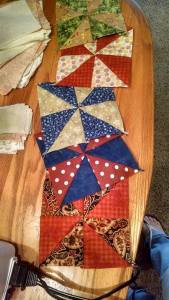 When I pulled it back out, I began making pinwheels for the center of the blocks. Twenty pinwheels seemed daunting, but using a sewing machine, (not sewing by hand, you silly rabbit!) the pieces came together fairly quickly, but still….there was twenty of them.
 Now, I had to cut these square pinwheels and turn them into octagons. Not owning a special ruler or being able to find one at JoAnn Fabrics, I spent hours figuring out how to do this. After I had a total meltdown, my husband quietly worked on the computer constructing a template for me. In the meantime, I found a
 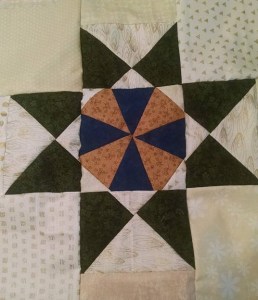 Next, I started working on the star points. They were time consuming, but they came together easily. The octagon/square was placed in the middle of the star points. Notice in this photo, the octagon still looks like a cross, and the completed square has two star points pointing up. Well, that’s also an illusion and won’t look like that for long.
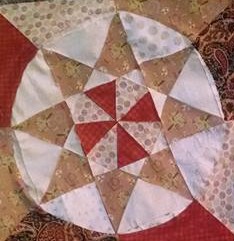 Since the octagon and the star points shifted with adding the frame, you can see in the finished square that the cross is gone and the star only has one point sticking up. This whole quilt is one big illusion.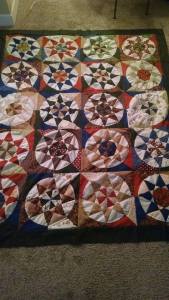
 Second, there are also maturity issues here because Mother’s Day is not about buying gifts or getting gifts. It’s about giving. It’s also not about being a biological mother and feeling bad if you’re not one. It’s about thanking the person who nurtured you, who pointed you in the right direction, who loved you unconditionally. Hopefully, we all have someone who did that for us.
 Back to the woman’s blog. If you haven’t done that painful job, why would you feel bad when other women who have done the job get special treatment and you don’t? Doesn’t make sense. The holiday is not about getting, remember? Get off your immature, egocentric horse, and go find someone to be nice to. Buy them a flower. Give them a hug. Call them late in the day and claim you forgot it was Mother’s Day but you just wanted to say, “I love you.”
 Egocentric: regarding the self as the center of all things.
 Photo: In my mind, these are not and have never been little kids. —>>>
![A2Z-BADGE_[2016]](https://loricrane.com/wp-content/uploads/2016/04/a2z-badge_2016.jpg?w=196&h=196) April 2016 A to Z Challenge – I’m blogging about history.
April 2016 A to Z Challenge – I’m blogging about history. Tattooing is widely practiced today, and some folks say it’s desecrating God’s work, but this blog is not an argument about their merit or lack of. It is about the history of tattoos. When and where did they start…and why?
 No matter what people say about tattoos, I find them fascinating. I have two tattoos (below) and hope to get a third someday. Mine are in commemoration of my ancestors, the first being the Culpepper family crest on my back honoring my mother’s family, and the second being the Choctaw Indian crest on my leg honoring my great, great grandmother and my Indian ancestors whose way of life was destroyed when the Culpepper part of the family moved to America. I also have Irish ancestors and hope someday to get a claddagh to honor them.

![A2Z-BADGE_[2016]](https://loricrane.com/wp-content/uploads/2016/04/a2z-badge_2016.jpg?w=170&h=170)

 What is now called the Culpeper garden was originally a kitchen garden and nothing more, but in 1980, a designer transformed it into a cottage garden. It has an informal layout with low box hedges bordering Roses, Lupines, and Poppies. It is said to be named after herbalist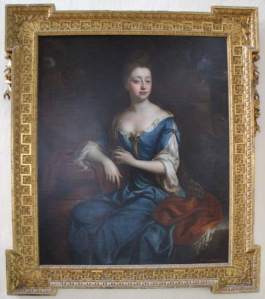

![A2Z-BADGE_[2016]](https://loricrane.com/wp-content/uploads/2016/04/a2z-badge_2016.jpg?w=198&h=198)
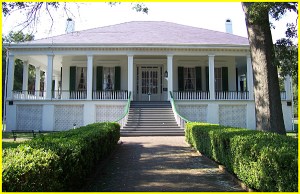 Beauvoir, meaning beautiful view, is know by many people, especially civil war buffs. It’s an antebellum home that sits on the shores of the Gulf of Mexico in the beautiful town of Biloxi, Mississippi. It was many things but best known as the home of Confederate President Jefferson Davis.
 My second great grandfather Joel Bluett Culpepper served in the civil war Co. K 63rd Alabama infantry. He signed up at the age of seventeen. In 1863, he was captured and held at Fort Massachusetts on Ship Island until the end of the war. Under his rights as a Confederate veteran, he spent the last ten months of his life at Beauvoir, dying at the home 11 Jan 1911. He is on the records there as James B Culpepper.
 This week’s snippet is from

 Lori Crane