On This Day in 1921

Burying children used to be a more common occurrence than it is today.

On This Day in 1921, Fleta Marie “Clarice” Pickett was born in Lauderdale County, Mississippi to Benjamin Berry Pickett and Eula Ouida Keene Pickett (my great grandparents). She had two older siblings: Howard who was four and Margaret Azalea (my grandmother) who was two. She was named after her mother’s older sister, Fleta. Months before, Fleta had given birth to a daughter and named her Eula. The two sisters, though fourteen years apart, were obviously very close.

Clarice was born into a large family as her father had five siblings and her mother had seven who all lived nearby. Her father’s mother was from the Fisher family, and the Picketts, Keenes, and Fishers were numerous in the area, and still are today. So much so, that they have their own family cemetery on Zero Road called Fisher Cemetery. Even though family cemeteries fell out of vogue in the early 1900s in favor of community cemeteries, Fisher Cemetery is still used today.

At one year and five months, Clarice succumbed to pneumonia. Note in her obituary that the family held the funeral in their living room as was custom in those days. Before the mid-1900s, the family of the deceased prepared, dressed, and displayed their loved ones, and following the funeral, the body was carried out of the house head first. Clarice’s obituary reads as follows:

pickett fleta clarise pickett death certFleta Marie “Clarice” Pickett Born: December 1, 1921 in Lauderdale County, MS
Died: May 8, 1923 in Lauderdale County, MS 

Fleta Marie “Clarice” Pickett, 17-month-old daughter of Ben Berry and Eula Keene Pickett, who reside near Zero, MS, passed away this morning at 4 o’clock. Funeral services will be held from the residence Wednesday morning at 10 o’clock. Interment is to follow in Fisher Cemetery.


pickett fleta clarise headstoneRest in peace, little one.

You have not been forgotten.

This post brought to you by On This Day.


Saturday Snippet – OKATIBBEE CREEK

okatibbee creek cover front JPEGOkatibbee Creek takes place in Mississippi during the Civil War and is based on a true story. Our heroine, Mary Ann, has been left alone with the children while the men in her family are off fighting. I don’t think she’s as fragile as the Yankees assume.

*****************************************************************

I can hear Charlie screaming for me as he runs up the road. He flies in the front door of the store, shouting that the Union Army is coming down the street. Oh, no, here we go. Apparently I am now in the middle of this war. Unfortunately, on this day, I have all of the children with me: my three, William’s four, and James’s five.

I order the boys to run to the field in back and chase the hog and the horse into the woods. I order the girls to take every jug, every crock, and every jar of food from the store and the cellar, put them in the attic, barricade the door, and stay there. Then I load my rifle. I’ll be damned if I’m going to let these disgraceful, plundering Yankees ruin my life any more than they already have. And I will kill every last one of them before I let them harm the children. When the Yankees arrive, I will be more than ready for them.

I watch for them out the front window of the store. My palms are sweating. My heart is pounding out of my chest. My breathing is heavy. I can also feel my anger rising like flames from the very depths of Hell. My hands are shaking, though I don’t know if it is from fear or rage. I can hear them coming before I can see them. Their horses are clomping on the dry road and there is a jingling sound from their spurs and saddles. Sure enough, they stop right in front of my store. There are three of them on horseback dressed in their blue uniforms. They are filthy and unshaven and a bit thin and weary. I slowly emerge through the doorway onto the wooden front porch with my loaded rifle in my hands.

“What do you want?” I yell to the Yankees.

“Do you have any food here?” one of them asks, though it sounds more like a demand than a question.

“No, I don’t have any food,” I say, surprised at the sound of the strength in my own voice even though my statement is a bold lie.

“Is your husband home?” the second one asks.

“No. You already killed him,” I reply, with venom in my tone that would scare off any other man, but they don’t move.

“Is there a man of the house here?” the third one asks.

“No, there are no men here, just me.” I raise my gun slightly.

“You need to put that gun away, ma’am. We just want some food. We’re not here to hurt anyone. You have to have some kind of food in that store,” the first one says with a cocky smile on his unshaven face, as he climbs down from his horse. He removes his dusty hat and takes a couple steps toward me.

“I already told you, I don’t have any food,” I say slowly without raising my voice. I do, however, raise my gun to my shoulder and point it squarely at the man’s face. The two Yankees still on horseback put their hands on their pistols.

The man on the ground stops moving and holds up his free hand to the other two to keep them from drawing their weapons. Again, he starts to move toward me.

I cock the hammer. Again, he stops.

We seem to be at a stalemate. But what he doesn’t know is that the rage inside me will have no trouble blowing his damn head off. We stare each other directly in the eye and neither of us moves.

*************************************************

Lori Crane Books at Amazon and audiobook at Audible.

Video Trailer

“Elly Hays” named semi-finalist!

book-contest-semi-finalistMy book “Elly Hays” was named semi-finalist in the 2014 Authorsdb Book Cover Contest! I love this cover best of all my books. It was designed by Elite Book Design and is awesome!!!

The distinction wasn’t for the book itself, only the cover, but check it out anyway. It’s a really, really good story if I do say so myself. It’s the story of my 5th great grandmother during the War of 1812. It has received 14 reviews on Amazon totaling 4.5 stars, and it generally sits in the Top 100 of Native American stories over there, and has for the last year since its release in October 2013.


elly cover_webBlurb

As the War of 1812 approached, the Creek Indian Nation was in the middle of a civil war. They fought brutally between themselves, as well as with the white settlers who were encroaching upon tribal land.  

It was during this time Elly’s family moved to the eastern Mississippi Territory for the promise of low-cost land and fertile soil. She had no idea they were moving into Creek territory – into the middle of a hornet’s nest. Tafv’s band of warriors taunted them, stealing their property, killing their animals, and destroying their livelihood. Just when the family thought things couldn’t get any worse, during one of the Indian raids as Elly’s husband chased the Indians away from the farm, Tafv’s young son was killed in the pursuit. Tafv vowed revenge against Elly’s family, and a final showdown was imminent.
.
“Elly Hays” is based on the real-life story of Elizabeth Hays Rodgers and is the epic clash between a fearless warrior with nothing to lose and a young mother on the verge of losing everything.
.

Lori Crane Books at Amazon

On This Day in 1877

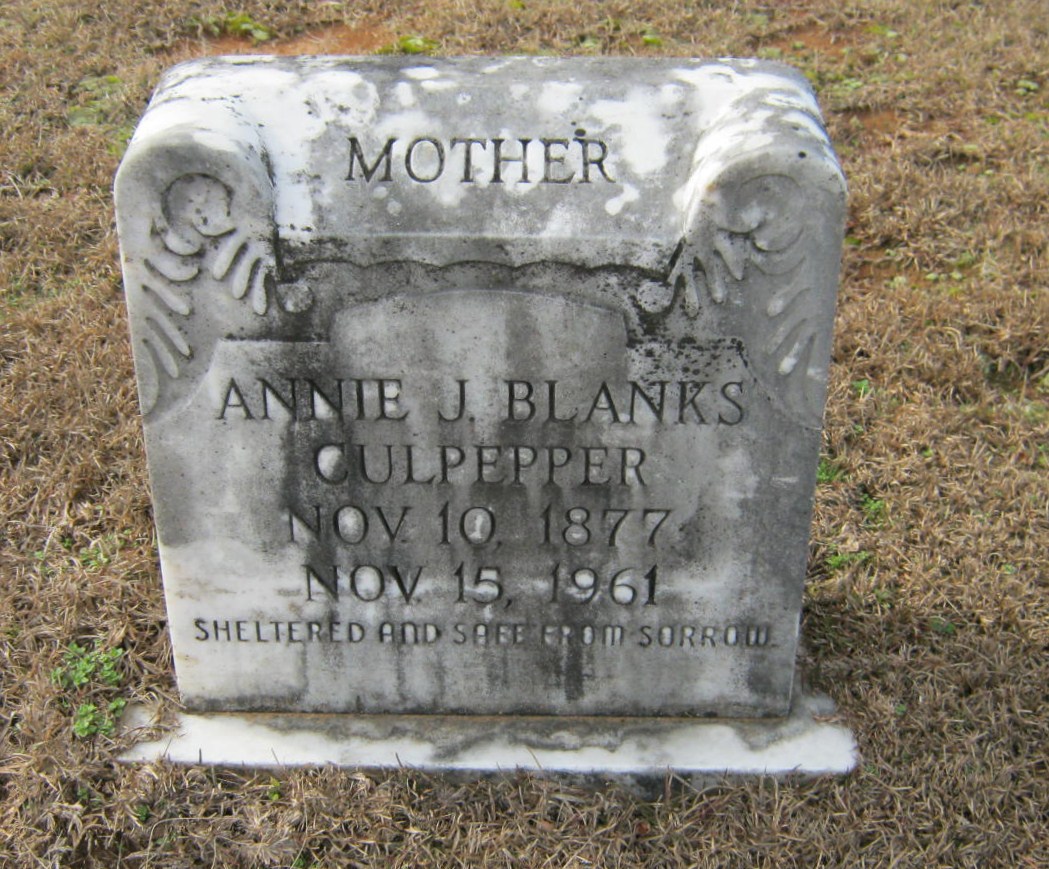
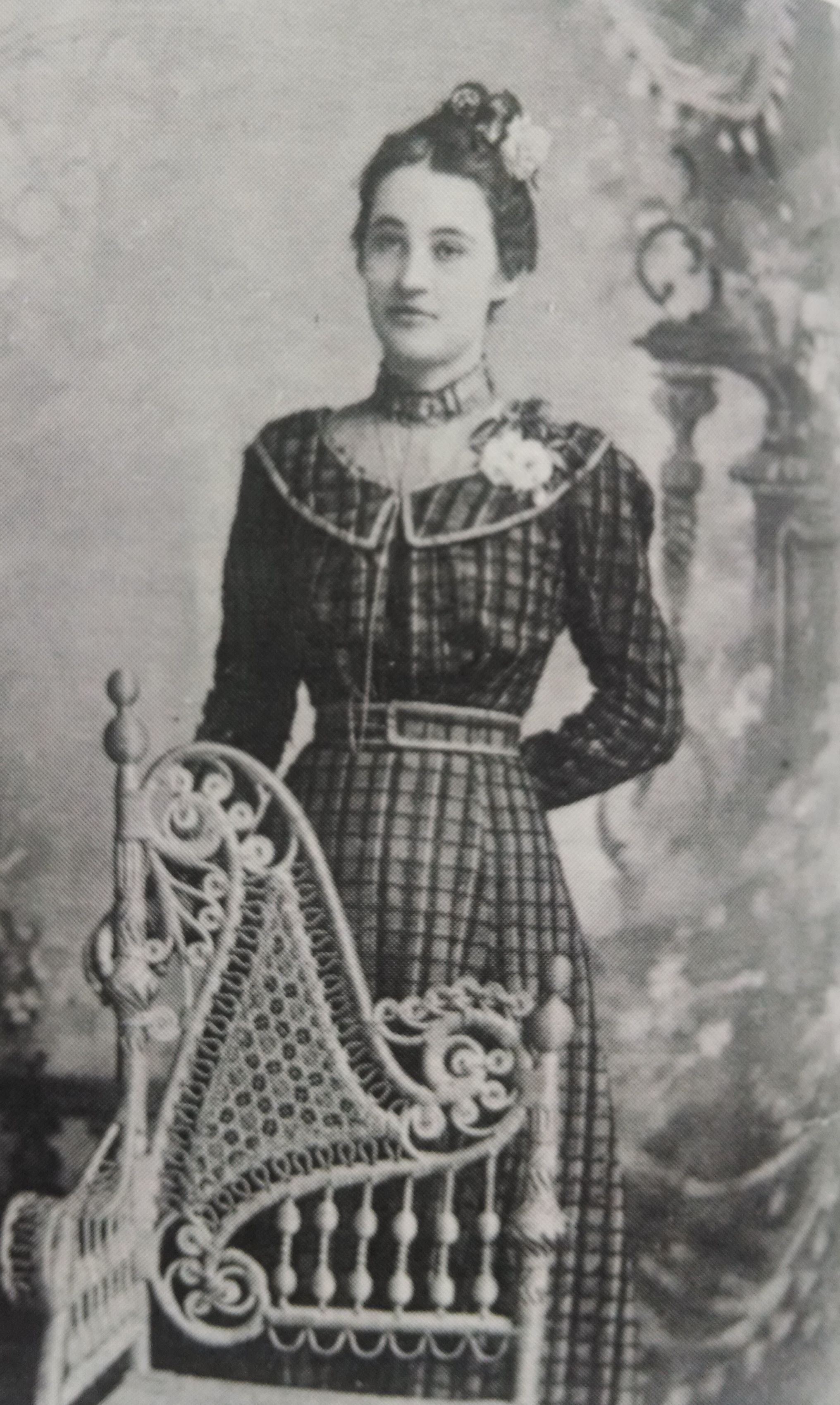
Annie Blanks CulpepperOn This Day in 1877, a beautiful woman was born. On November 10, 1877, my great grandmother, Josephine Annie Blanks Culpepper, was born in Kemper County, Mississippi to William Henry Blanks III and Martha Lettie “Mattie” Carpenter. She was in the middle of seven children, six of them being girls. Her father was a teenager when the Civil War took place and fought as a private in the 2nd Mississippi Infantry Company H. Her mother was a young lady of fourteen when she lost her own father at the Battle of Stones River on December 31, 1862. I can imagine as parents, they did their best to keep the peace in the household, but there is a distinct possibility they both had emotional scars from the trauma each had seen and faced during the war.

Annie grew up on a farm in Daleville, Mississippi, and with eleven aunts and uncles in the area, one must assume she had plenty of cousins to play with. She witnessed amazing technological changes as home comforts such as indoor plumbing and electricity moved from the nearby city of Meridian to the country, and paved roads reached homes throughout the area at the turn of the century before the Model T made its first appearance in 1908.

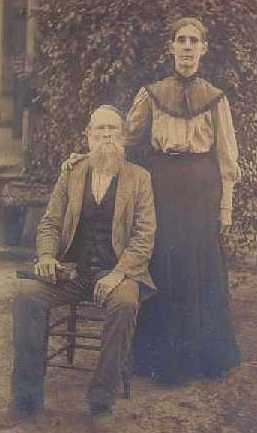
culpepper Sam CulpepperIn 1899, she met handsome William Samuel “Sam” Culpepper, and they married when she was 21. She said about him, “Sam was really a handsome man with rosy cheeks, dark curly hair, and teeth as white as pearls.” Sam was described as a kind fellow who always had a twinkle in his eye and a smile on his face. He loved fishing, squirrel hunting, and playing the family’s old pump organ. He was a sawyer by trade and followed the sawmill business, often being gone for weeks at a time. Fortunately Annie and Sam had five boys and four girls between 1900 and 1921, and the boys were taught to run the farm in their father’s absence. He was said to have been a strict but loving father.

culpepper Sam and Annie CulpepperAfter their youngest child married and moved out in 1938, one would have expected they lived out their retirement in comfort, but sadly, Sam suffered from high blood pressure, and his life was cut short by a stroke at the age of 66, on December 10, 1939. Annie never remarried. In her later years, she moved to Mobile, Alabama and lived with their sons who had relocated there.

She passed away at the age of 84 on November 15, 1961. She is laid to rest next to her husband at Mt. Nebo Cemetery in Kemper County, Mississippi.


culpepper annie j blanks headstoneHer obituary is as follows:

Funeral arrangements were being completed today for Mrs. Anne Blanks Culpepper, 84 of Mobile, a former resident of the Martin community who died yesterday at Mobile.

Mrs. Culpepper was a member of the Duffee Baptist Church and had been active in its various organizations until she suffered a broken hip three years ago. Her two daughters are Mrs. Mae Howington of Meridian and Mrs. Aaron Spears of Enterprise. She is also survived by five sons, Joe Culpepper of Susqualena; Earl and Clinton Culpepper, Meridian; Fred and Frank Culpepper, Mobile; and two sisters, Mrs. Woodie Logan and Miss Velma Blanks of Laurel.

The body was to arrive in Meridian this afternoon and will be at Stephen’s. The service will be held at 2 o’clock tomorrow at the Mt. Nebo Baptist Church with Rev. Herman Pilgrim in charge, assisted by the Rev. Vernon Blackburn. Interment will be in the Mt. Nebo Cemetery.

This post is brought to you by On This Day available at Amazon.


On This Day in 1800

On This Day in 1800, my 3rd great grandfather, William Henry Blanks II, was born in Greene County, Georgia.

downloadIt’s pretty easy to trace your great grandfathers when your 2nd is WHB III, your 3rd is WHB II, and your 4th is WHB I. Sadly, I don’t usually give the middle grandfather much thought. I have photos of the Civil War soldier 2nd great, and the 4th great was a Revolutionary War soldier, so I have lots of info on him. Somewhere in the middle, my poor 3rd great doesn’t get much attention, Well, today on his birthday, let’s show him some love.

William Henry Blanks II was born October 12, 1800 (Same day as my daughter’s birthday!) in Greene County, Georgia. In 1800, Greene County was in the middle of the northern part of the state and was right on the border of the Creek Indian Territory to the west. Keep in mind, the War of 1812 in the north was fought between the Americans and the British, but the war in the south, particularly Alabama and Georgia, was fought between the Americans and the Creek Indians who had been armed by the British. This was the edge of the frontier in 1800.

William Henry’s father had been previously married to Mariah Robertson and had two girls and a boy – Mary Polly, Littleberry, and Nancy – in Virginia. Sometime between 1795 (last child’s birth in VA) and 1799 (wife’s death in GA), the family had moved south to Georgia. Following Mariah’s death, WHB I immediately married Jane Hill. They had five children – two boys and three girls  – William Henry, Matilda, William Ezekiel, Martha, and Seleba. William Henry’s mother died in 1817 and his father in 1823.

At the age of 19 in 1819, William Henry married Nancy Narcissus Young, and over the next twenty-five years, they had five boys and three girls  – James Lafayette, Thomas Young, Jefferson Franklin, female who died, Richard Lane, Martha Ellen, Nancy Ann, and William Henry III. The female who died at birth was the twin of Richard Lane. The last child was born in 1846 in Georgia, and the 1850 census shows the family living in Lauderdale County, Mississippi. I don’t know why they moved. His wife died in 1857. William Henry died September 9, 1859. I do not know where they are buried.

Will of William Henry Blanks II – Note: His wife is already dead, so he leaves everything to his two youngest children – Nancy 16 and William 13.

last-will-and-testamentThe Last Will and Testament of William H Blanks… State of Mississippi Lauderdale County August 18,1859.

Know all persons by these present that I do this day bequeath to my daughter Nancey & son William the sum total of my Estate being in consideration of my parental affection and love for them. My sons James, Thomas, Jefferson, and Richard I do give unto one dollar a peice also my daughter Martha English I give the same one dollar to be by each and all of them held in peas for life. My daughter Nancey and son William are by the Law of the Land old enough to choose their own guardians. Let them choose who they please their money is to be for their education and rasing to be laid out on them at the will of their Guardian he to give Securtiy for his management of the same, all of the above do request as the Last Will on Earth hoping the same may be satisfactory to all people on Earth in Testimony on which setting my hand and Seal Witness by undersigned. W H Blanks

W J Brown, P H Higgins

Jas F Ginnen                                                                  

   P. S. It is my wish for Nancey & William to have their brother Thomas to hold their business in charge.

Will Book 1, Page 17 Lauderdale County Courthouse, Meridian, Mississippi.


This post is brought to you by On This Day.

On This Day in 1882

culpepper ora wedgeworth wife of Joseph FloydOn This Day in 1882, my great great aunt, Ora Wedgeworth Culpepper was born to Howell Joel “Hobby” Wedgeworth and Martha Morrow in Lauderdale County, Mississippi. She was the youngest of eight children with only one other girl, the eldest.


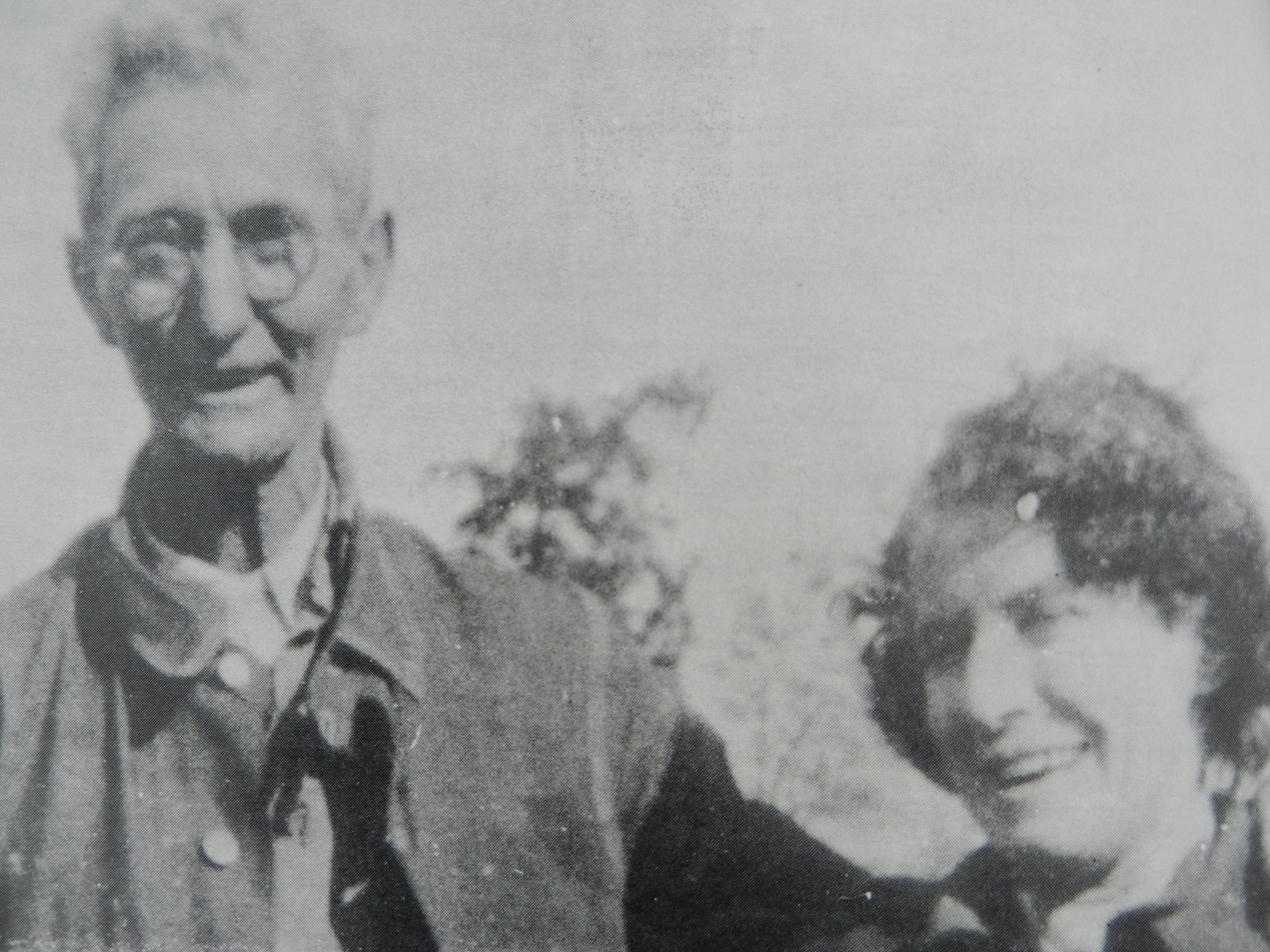
wedgeworth howell joel hobby and martha morrow, par of ora wedgeworth culpepperPrior to Hobby marrying Martha, he had been previously married to Elvira Hughens. They had one daughter in 1858, and Elvira died in 1860. I don’t know who raised the girl after that, as Hobby went off to fight with the 5th Mississippi Infantry Company K and was captured by Union soldiers at the Battle of Franklin, Tennessee (where I currently live) on November 30, 1864. He spent the last six months of the war at Camp Douglas, Illinois as a prisoner of war. His father, Rev. Joel Walker Wedgeworth, went to pick him up after the war ended, and it was said his father didn’t even recognize him because he was so thin. One can tell just by looking at this photo of Hobby and Martha, they were very strict parents.

culpepper joseph floyd

On November 2, 1904, Ora married Joseph Floyd Culpepper, my great grandpa Sam Culpepper’s brother, and between 1905 and 1926, they had eight children, five girls and three boys.


culpepper joseph floyd and ora wedgeworthOra lost her husband to pneumonia on August 1, 1951. She never remarried. She died May 15, 1966 at the age of 83. They are buried at Memorial Park Cemetery, Winston County, Mississippi.


This post brought to you by On This Day.


Saturday Snippet – Culpepper Saga Preview

I usually post blogs about books that are already finished, but I’m having such a good time with my work in progress, I’d like to share a piece of it with you. The Culpepper Saga will be four books about one of my ancestors named John Culpepper.
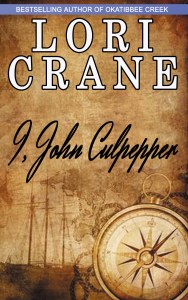
Culpepper_1John was born in England in 1606. As a young lad he was trained as a lawyer, but he decided to be a merchant instead. He bought a ship and sailed back and forth between the colony of Virginia and England, delivering immigrants to the colonies and bringing back cotton and tobacco. His life wasn’t spectacular, but the cast of characters surrounding him were pretty intriguing, the political and religious climate of his homeland was so volatile, one could lose a head if one wasn’t careful, and the vast expansion of the new world set the stage for quite an amazing adventure. The first installment will be about his childhood, the second about the English Civil War where King Charles I was executed and the royalist Culpepper family scattered like rats, the third about his adventures in Virginia and rise to family patriarch, and the final story will be in his later years during Bacon’s Rebellion and his son causing the Culpepper Rebellion in North Carolina and being charged with treason (good thing daddy was a lawyer!).

culpepper book 2 cover ideaI’ve decided on the title “I, John Culpepper” for the first book.

All that being said, here’s a bit of the scene from the day John was born….

**************************************************************

1606, Blackwall, London

“Master Culpepper! Master Culpepper!” the servant boy shouted over the bells clanging from the church steeple. He pulled the scratchy scarf tightly around his neck to ward off the chill as he pushed his way through the masses gathered on the foggy banks of the Thames.

The crowd had been gathering on the wharf for nearly two days to witness the departure of the ships, and they were prepared for a spectacle unlike any they had seen before. When the tide came in, the three ships carrying one hundred forty passengers and sailors would depart England on an exciting adventure. The air smelled of salt and tar and sweat. This was a remarkable place, a magical place, where the preparations were as exciting at the coming voyage. The anticipation in the air was nearly as thick as the fog.

The boy stopped for a moment as a wooden cask was rolled across the cobblestone in front of him. He watched as workers carefully rolled the barrel up the tilted gangplank. He remained frozen in the middle of the bustling crowd, staring at the ship. He had never seen anything so majestic in all his twelve years, and his jaw dropped at her sheer size. She was an enormous castle-like structure, at least eighty feet in length, her belly bulging at the side where the last of the cargo was being loaded in. Crates and boxes were continually being carried up the gangplank, where they disappeared into the ship’s dark interior. The deck above the cargo area was much narrower and the boy imagined that’s where the sailors would remain during the voyage, climbing masts and hoisting sails. Circling the spiderweb of hemp ropes and yardarms, seagulls cawed as if singing along with the rhythmical clanging of a nearby metal object. The boy scanned the scene for the source of the sound and noticed a blind beggar sitting on the cobblestone near the bow of the ship, tapping a stick on a metal bowl.

Behind the ship floated a second ship, nearly as large as the first, and behind that loomed a third. Each hosted its own cast of sailors, supplies, vagrants, and gangplanks. As wavelets gently raised and lowered the vessels, moans of protest arose from the taut ropes, and the weathered wood creaked with each stomp of a sailor’s boot. Nearby, two mangy hounds barked and growled over some fish scraps, bringing the boy’s attention back to his task at hand. Remembering why he had come, he yelled, “Master Culpepper!” He spun around and around looking for the man, weaving between horses, carts, trunks, and sailors shouting commands. He darted in and out of the crowd, making sure he didn’t bump into any wealthy gentlemen, recognizable by their long cloaks adorned with colorful silk threads.

In April, King James had created the Virginia Company, which would finance sailings to Virginia and Plymouth with the aim of settling colonies and profiting from the land’s abundant natural resources. The aristocracy funded the expeditions with the expectation of making an exorbitant profit. The three ships embarking from Blackwall on this day would sail to Virginia and bring back riches. There were rumors of gold, silver, and gems merely washing up on the shore for the taking. If nothing else, there was surely timber to be harvested. The trees in England had long been felled and the rising price of timber would certainly bring the investors a hefty return.

After they finished loading supplies and the morning fog had dissipated, the ships would raise their sails and ride the tide down the Thames. They would enter the English Channel and cross the great ocean and return by summertime.

The boy bobbed in and out of the crowd, searching for his master.

“Who are you searching for, lad?” a man in a ruffled collar asked.

“Master Culpepper,” the boy replied, removing his hat and revealing his dirty blond hair, which was sticking this way and that like a wheat field in a mighty windstorm. He twisted the wool hat in his hands.

“Johannes or Tom?”

“Johannes Culpepper, sir.”

“I saw him down by the front ship—the Discovery—only moments ago. He was standing right on the dock.”

“Thank you.”

The boy nodded, replaced his cap, and shoved through the workers and onlookers toward the front ship. As he passed the first ship, he looked at the name written on her side and sounded out the letters. He couldn’t make any sense of the words Susan Constant, but when he reached the second ship, he could read God…speed. He wondered if the Godspeed was true to her name. If he were to sail, he would rather sail on the Godspeed and get there faster. From what he understood, it was a two-month voyage if the weather was bonny, maybe four months if the ship ran into rough seas.

He had once spent a morning in a small fishing boat and instantly became green with sickness that lasted for days. He didn’t think he would be able to survive the time it would take to sail to Virginia. He gawked at the bow of the Godspeed as he ran past, witnessing a young lad about his age. The sailor dripped with sweat, even in the chill of the damp morning air, as he coiled ropes and folded sails. What a great adventure it would be to sail to Virginia, but alas, the boy would never get to do such amazing things. He was a servant, a gift from His Majesty King James I to Johannes Culpepper. He would always be a servant, but perhaps someday he would be fortunate enough to serve the king. Even though Master Culpepper was good to him, he wished to someday live at court and be somebody. At least he had the slimmest of chances. His sister had been placed in the kitchen of some castle in Wales. She would never be anything more than a scullery maid. Women would never hold a place in society. They were not welcomed on this voyage, either.

He hopped up and down, unsuccessfully trying to look over the crowd. “Master Culpepper!” he called.

A man turned and pointed. “Culpepper is right over there, son.”

“Thank you, sir.”

The boy sprinted in the general direction, and when he pushed through a couple workers conversing on the dock, he saw him.

“Master Culpepper!”

The boy ran up behind Johannes Culpepper and patted the back of his master’s arm, hopping up and down. “Master Culpepper!”

Johannes turned and looked down at the boy, his square jaw set and his blue-gray eyes burrowing into the lad. “What is it, boy? Why are you making such a commotion?”

The boy panted, out of breath from running. “Master Culpepper, m’lady is havin’ the baby, sir!”

Johannes’s face turned red as he glanced around the crowd to see if anyone was eavesdropping. When he saw no one was, he folded his arms across his chest and stroked his beard. “You came all this way to tell me that?”

“Yes, sir.”

“Very good, boy. You run along home now.”

The boy didn’t move. How could his master not be excited about this news? Did he not want to return home and see his wife and child? Was there anything the boy could say to convince the man to accompany him back to the house?

“Go on. Run along.” Johannes waved the boy off with a flip of his ringed fingers and abruptly turned his back.

“Yes, sir.” The lad backed up, keeping his eyes on his master, wondering what he would tell the governess when he returned home without his master in tow. He had ridden nearly four hours to get to Blackwall this morning, most of it in the dark as the sun had not even risen when he left. He would have a four-hour return trip to think of something. He turned and walked back in the direction from which he had come.


On This Day in 1936

On This Day in 1936, my great uncle Howard Benjamin Pickett died following a car crash at the age of 19.

Eula Keene Pickett with Howard and AzaleaHoward was born November 19, 1917 to Benjamin Berry Pickett and Eula Ouida Keene in Lauderdale County, Mississippi. He was the eldest of three children. A sister Margaret Azalea (my grandmother) was born in 1919, and a sister Fleta Clarise was born in 1921. Fleta Clarise died of pneumonia in 1923. Howard was six. Here he is pictured with his mother and sister.

Meridian Star
Howard Benjamin Pickett, 19, son of Mr. and Mrs. Benjamin Berry Pickett of 308 Fifth avenue, Meridian, who was injured in an automobile crash near Newton on Highway 80, died in a Newton hospital late Thursday. Miss Hazel Brasfield, 15, also of Meridian, remained in a critical condition Friday morning. Pickett, who was said to have been driving the automobile when it crashed at 5 a.m., received internal injuries. He never regained consciousness. Miss Brasfield is suffering from a crushed thigh. Other occupants of the machine were Jim Edwards, Billy White, Neva Ezell, Jack Ward, and Geneva Burt, all of Meridian. All were slightly injured but were able to return to Meridian soon after the accident. Pickett is said to have rented the automobile from a 630 taxi driver at 7 a.m. Wednesday, stating he intended to go to Jackson. The crash occured when a tire blew out, causing the machine to leave the highway, overturning several times before striking a stump. Funeral services will be held at 4 p.m. Friday from the Eight Avenue Baptist Church. Surviving are his parents: Mr and Mrs. Benjamin Berry Pickett and one sister, Azelea Pickett, all of Meridian. The Revs. Ed Grayson and Rev. Blanding Vaughan will officiate at the funeral. Interment will follow in Fisher Cemetery. Active pallbearers: Maurice Covington, Torris Brand, Billie White, Purvis Taylor, Jack Elkin, and Selbie Snellgrove. Honary pallbearers: A.L. Talbert, Mr. Keaten, Mr. Snider, Ermer Brown, J.B. Brown, Grady Brand, Mr. Lawerence, H.C. Webb, Edwin Cochran, Mr. Mitchell, Mr. Connell, Howard Meyers, Jamie Harden, Marion W. Reiley, G.L. Walker. James F. Webb Funeral Home in charge. 

pickett howard benjamin headstoneHoward and I share the birthday of November 19th, along with his maternal grandmother (my 2nd great), Sarah Elizabeth “Betty” Brown Keene. His dad’s mother was a Fisher, and he is laid to rest with his parents and siblings in the Fisher Family Cemetery in Meridian, Mississippi.

This blog brought to you by On This Day at Amazon.

On This Day in 1905

On This Day in 1905, my 2nd great grandfather, Andrew Jackson Crane, died.

Jack, as he was known, was born January 8, 1852 to Jeremiah William Crane and Sarah Frances Grimes in Clarke County, Mississippi. He had one brother and three sisters. When he was 21, on December 4, 1873, he married Martha Jane “Mattie” Mercer in Clarke County and had three children: Ella Jane, Minnie Lee, and my great grandpa, Amos Bolivar.

To understand his generation, one must remember Abraham Lincoln was elected President in 1860, Mississippi seceded from the Union in 1861, and the country went to war. election1860mapJack was an impressionable youth during this period and probably watched many of his neighbors go off to fight with the 37th Mississippi Infantry. One must wonder if he was a frightened young boy, hiding behind his mother’s hooped skirts, or a feisty lad, anxious to grow up and go too. As with most of the South, cotton was the main economy of the area, and railroads had been built during the 1850s to transport it, but in 1864, General Sherman’s troops marched through the area and destroyed nearly everything, including the railroad tracks. Once the war was over, the tracks were repaired, but the farmers no longer had slaves to work the fields and cotton harvests diminished. Somehow, through the next 40 years of reconstruction, the economy grew quickly. Homes began adding electricity, running water, and paved streets. People weren’t driving automobiles yet, as the Model T wasn’t introduced until 1908, but the wagon riders were now subjected to less dust, and the roads didn’t wash away with heavy rains. The population of nearby Meridian tripled from 1870 to 1885, doubled again by 1898, and doubled again by 1906. Jack lived through a horrific childhood of war and change, but in his later years, he witnessed amazing growth and technology. I wonder if the electricity reached his house before he died.

crane a j and wife obeliskJack passed away at the young age of 53 on August 25, 1905 and is laid to rest near his home at McGowan Chapel Cemetery in Harmony, Mississippi. His wife, Mattie, didn’t die until November 28, 1945 at the age of 93. She never remarried.

This post brought to you by On This Day available on Amazon.

On This Day in 1891

On This Day in 1891

My great great grandparents, Joseph Lawson Pickett and Caledonia D Fisher, were married in Lauderdale County, Mississippi.

pickett, joseph lawson sr, son of rt and lucyJoe Lawson was born Jan 1866, son of Robert Theodore Pickett and Lucy Ann Rackley in Alabama. He had four older sisters and four younger brothers, all born in Alabama. Sometime between 1880 and 1890, the family moved to Mississippi. At age 25, he married 21-year-old Callie. They had five boys and one girl: Benjamin Berry (1893-1973 my great grandpa), Robert Elbert (1897-1978), Joseph Lawson Jr (1901-1928), Florence (1902-1990), Mark Joshua (1905-1949), and Clyde (1907-1993). From the stories passed down of the four boys, including moonshine stills, shootouts with local authorities, going to prison for murder, and young Joe Jr. being shot by law enforcement at the age of 27, they were obviously a wild bunch. I don’t know if the parents didn’t discipline the children or if the boys were just uncontrollable. Joe Lawson died at the age of 44 in 1910. The exact date of his death is unknown at this time, but it was after the 1910 census was taken which was April 20th. Callie never remarried.

pickett, caledonia d fisher, wf of joe lawson srCallie was born 12 Jul 1870 to William Thomas Fisher and Ann Eliza Butler in Mississippi. She had six older siblings and four younger ones, totaling six boys and five girls. Her father was a Civil War soldier and owned quite a bit of land in the Zero Community near Meridian. He was just as much a character at those Pickett boys. Perhaps that’s why Callie liked Joe so much. Callie’s father was in jail at the start of the Civil War for shooting a man over a poker game, but they released him so he could go fight. Having children born in 1860, 62, 63, and 65, I’m not sure when or where he actually fought. A portion of Fisher land was designated as Fisher Cemetery, holding the remains of many Fisher and Pickett descendants, but Joe and Callie are both laid to rest down the road at Pleasant Hill Cemetery in Meridian. She died 26 Aug 1931. Her obituary in the Meridian Star Newspaper is as follows, but notice the marriage year is different, probably told to the paper by a member of the family. I have the Lauderdale County Marriage Records transcribed which say, “1891, Marriage Book 2, page 368.”

Mrs. Caledonia Fisher Pickett, 61, died Wednesday at 4:30 a.m. at her home on Rt. 3. She was born and raised in Lauderdale County and in 1889 was married to the late Lawson Pickett. She was a member of the Zero Methodist Church. She is survived by one daughter, Mrs. Florence Harper; four sons; Ben, Elbert, Mark, and Clyde Pickett; one sister, Mrs. Ada Purvis; three brothers, Thomas, Jeff, and Jim Fisher. Funeral services will be held from Pleasant Hill Methodist Church Thursday at 3:30 p.m., the Revs. J.W. Ramsey and Ed Grayson officiating. Interment to follow in the Pleasant Hill Cemetery. Active Pallbearers: Lester Walker, Earl Dawes, George Gay, Charlie Molpus, Dan Covington, and Dan Rolling. Honorary: Martin Miller, C.S. Dearman, John Robinson, Ed Culpepper, Elmer Brown, and Monroe Sims.  ~Meridian Star

This post brought to you by On This Day available at Amazon.